Anthropic Files for IPO: Claude Code Drives Growth Amid Violation Revenue
Anthropic has filed its S-1 registration statement for a Nasdaq IPO, highlighting Claude Code as the primary driver of enterprise growth with top-tier clients spending 20x more than average users and over 90% of internal code generated by AI. However, the filing reveals that 5-7% of revenue (estimated $1.7B-$2.3B) comes from customers violating usage policies, sparking controversy over compliance and refund issues for banned developers.
Full Report
Contents3 sections

After a year defined by fanfare and peak AI hype, Anthropic’s prospectus has finally arrived. The core growth engine highlighted in the filing is Claude Code: top enterprise customers spend 20 times more per month than average users, and as of September, over 90% of the code in Anthropic’s own repositories was written by it.
However, the same document admits that 5% to 7% of revenue comes from customers who have "violated usage policies." Based on approximately $33.1 billion in revenue for the first three quarters, this amounts to between $1.7 billion and $2.3 billion. Chinese developers who use Claude Code, pay for annual subscriptions, and then get banned without refunds can easily guess whose money is involved here.
Claude Code: The Core Product in the Prospectus, Voted for by Developers’ Wallets
Anthropic filed its S-1 document on Monday, planning to list on Nasdaq under the ticker symbol ANT. The filing portrays Claude Code as the primary driver of the company’s enterprise business growth, placing it at the center of the entire enterprise growth narrative.
The S-1 includes a breakdown of enterprise customers: In Q3, Claude Enterprise users who did not use Claude Code spent an average of less than $75 per month. Among enterprise users who did use Claude Code, the top 5% spenders had an average expenditure roughly 20 times higher. Claude Code is essentially an engine for boosting average revenue per user (ARPU).
Claude Code has evolved from providing code suggestions to directly writing and executing code, capable of autonomously handling complex, multi-step engineering tasks over extended periods. Consequently, engineers are increasingly responsible for directing and reviewing Claude’s work rather than writing every line of code themselves. In the three months ending September 30, 2026, the average amount of code contributed to the company’s repository per engineer per day exceeded 45 times the daily average for the year ending December 31, 2024. In September 2026, over 90% of contributions to the company’s codebase were written by Claude.
This document also reveals a typical "land-and-expand" strategy, with Claude Code playing the role of breaking the ice: An engineer starts using Claude Code, finds it useful, and promotes it internally within the company. Only then does Anthropic’s sales team step in. The filing states that by that point, "Claude is often already in use." This means Claude Code is not a product sold by salespeople, but one that grows organically within enterprises—the customer acquisition cost is borne by word-of-mouth among engineers, while sales simply harvest the results.
Anthropic itself does not hide its preference for the tool, describing Claude Code as "the most vivid representation of virtual collaborators and the product we believe most concretely demonstrates the form of autonomous AI work," and noting that "within months of its release, autonomous programming became a key benchmark for measuring frontier AI progress."
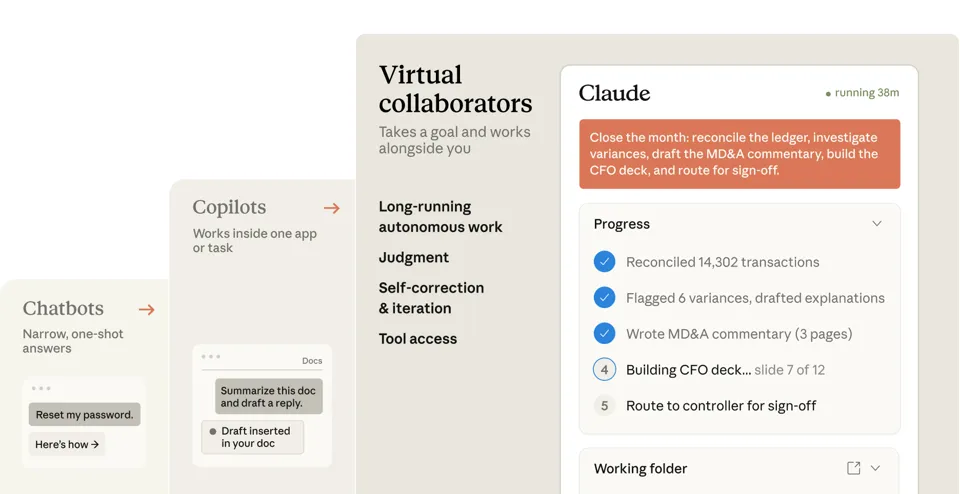
Although "software developers are significant promoters of Claude," this diffusion has extended beyond engineering teams.
The prospectus notes that non-technical teams are increasingly using Claude Code and Claude Cowork to manage their workflows. Anthropic’s description of Cowork continues its positioning of Claude Code: "All digital work ultimately boils down to code."
Cowork extends Claude Code’s agentic architecture to knowledge workers: Users describe a task, and the system can read files, manipulate applications, and execute multi-step workflows on the desktop, all while hiding the underlying code. Anthropic states that they
"will also develop specialized applications for specific professions and industries, continuing to expand upon Claude Code to accelerate Claude’s entry into new domains of knowledge work and broaden its application scope within enterprises."
This also signifies that Claude Code has transformed from a programming tool into the technical starting point for Anthropic’s expansion into broader work scenarios. As of September 30, 2026, the adoption rate of Cowork during the same period following its research preview launch had already surpassed that of Claude Code after its own research preview launch.
Anthropic is also turning the Harness that supports Claude Code into platform capabilities that developers can purchase and use. The filing summarizes this approach in one sentence: "A model alone does not constitute an Agent."
Developers can run Anthropic’s Harness on their own servers via the Agent SDK, or pay Anthropic to host and run it. This brings Anthropic closer to companies building coding agents based on its models. Notably, the S-1 mentions only Google and OpenAI in the competitive landscape, omitting Cursor, Replit, and Cognition.
People Brought In by Claude Code Keep Paying Thanks to New Models
Claude Code brings engineers into the company, while model updates provide enterprises with reasons to continue increasing their investment. Anthropic writes in the S-1 that enterprise customers switch to the latest, most capable versions as soon as new models are released, applying them to their highest-value work. The filing also states: "After each new version release, we see the majority of customers using the latest version of the model." In other words, the entry point opened by Claude Code ultimately leads to Anthropic’s entire family of models.
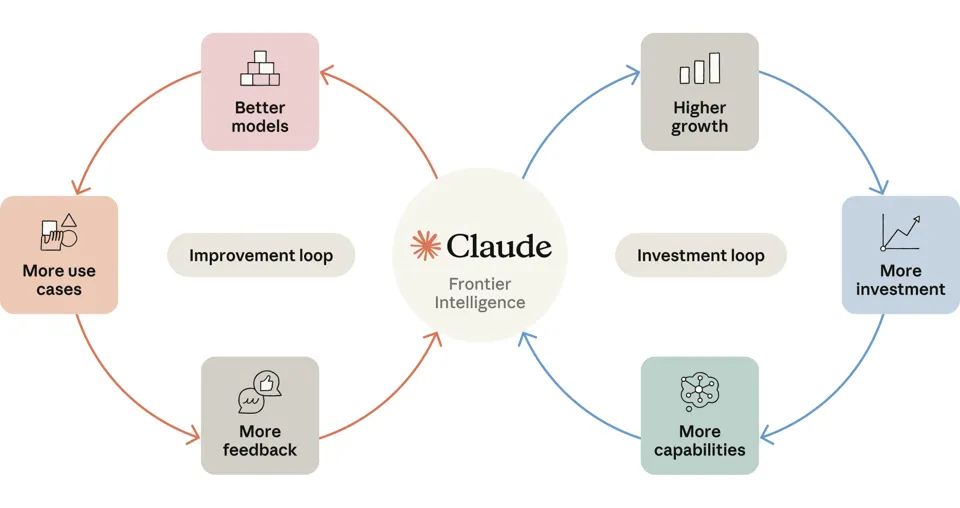
This logic is already directly reflected in revenue. Anthropic reports that as of September 30, 2026, models released in the past six months contributed to over 80% of Anthropic’s Q3 revenue. Between April and September 2026, Anthropic released 8 Claude models available to general users and 3 Mythos models accessible only to specific users.
The prospectus further discloses that in the first nine months of 2026, Anthropic launched a total of 250 new model versions, platform features, and applications (this figure represents the combined total of these three categories; the filing does not break down the numbers separately).
The company states that customer spending is closely tied to the frequency of new model releases and improvements in model capabilities. Every performance boost gives customers more reasons to use Claude; more capable models also attract new customers and encourage existing ones to increase their usage and spending.
This revenue, in turn, funds the next round of R&D. In its filings, Anthropic notes that it relies on growing revenue to cover costs for research and development, compute, and technical talent to build more powerful models. As model capabilities improve, they may further attract new customers and generate more spending, creating a virtuous cycle: each generation of Claude helps fund the next.
There is another number that excites Wall Street: 900%.
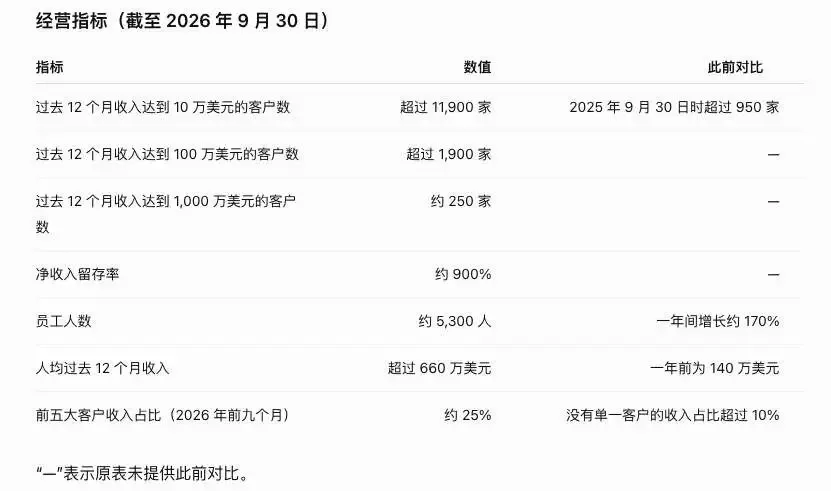
This is Anthropic’s net revenue retention rate as of Q3. Customers who were already paying a year ago are now spending nine times more on average. Among customers with annual spend exceeding $100,000, more than half use both the Claude platform and first-party applications like Claude Code or Cowork. By the end of 2025, this proportion was only about 30%.
The number of enterprise customers is also growing in tandem. As of September 30, there were over 11,900 customers with annual spend exceeding $100,000, compared to fewer than 950 a year earlier; over 1,900 customers have annual spend exceeding $1 million; and approximately 250 customers have annual spend exceeding $10 million. Anthropic’s total enterprise customer base exceeds 300,000.
The pricing model makes this dependency even clearer. Usage-based revenue reached $13.1 billion in the first half of 2026, accounting for roughly 80% of total revenue; in 2024, this figure was $288 million. The more customers use the service, the larger their bills become; the more capable the models are at handling high-value tasks, the greater Anthropic’s opportunity to convert a single Claude Code trial into sustained, growing model invocation volume within an enterprise.
That 5% to 7%: Revenue from Banned Accounts Without Refunds
Another disclosure in the prospectus has been included in revenue figures.
In the nine months ending September 30, 2026, approximately 5% to 7% of revenue came from customers who violated Anthropic’s Acceptable Use Policy or Terms of Service. The company expects this proportion to decline as detection and enforcement efforts intensify. This revenue comes from “customers who lost access after being detected.”
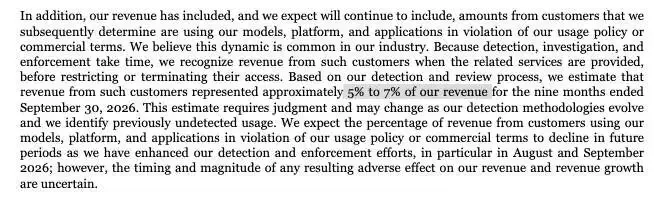
Screenshot source: S-1, page 145
To put it bluntly: for every dollar collected, 5 to 7 cents come from users the company does not want on the platform and intends to remove. Based on the approximately $33.1 billion in revenue for the first three quarters, this amounts to between $1.7 billion and $2.3 billion.
A key detail lies in the order of revenue recognition: Anthropic acknowledges that revenue is recognized when services are delivered, before accounts are restricted or terminated. Recognizing revenue first, then enforcing risk controls—this sequence is closer to the mechanism that truly matters to banned users than any paraphrase. It is not “no revenue because of violation,” but rather “revenue was already recorded, and then the account was banned.”
The prospectus does not break down the sources of this money: how much stems from API abuse, distillation activities, individual developers banned after cross-region subscriptions, or team accounts flagged by risk controls immediately after renewing annual fees. However, Chinese developers using Claude Code have left raw records in GitHub issues for the anthropics/claude-code repository that speak louder than any summary:
- Issue #37057: A user subscribed to Claude Pro on March 16, upgraded to Max 5x on March 17, and upgraded to Max 20x on March 18, paying approximately $209. On the same day, the account was disabled, blocking access to Claude.ai and Claude Code. Appeals received no response, and the user requested a prorated refund.
- Issue #91411: A user paid $249 for Max 20x on September 1 and used Claude Code for normal software development work. The entire account was disabled the next day, with no specific reason, warning, or automatic refund. The user stated: “Charged $249, banned the next day, no specific reason, no immediate refund—it’s indistinguishable from deceptive billing.”
- Issue #41252: A user with a Max 5x gift subscription had their account disabled while using claude.ai and Claude Code normally. Appeals went unanswered for a week, leaving $100 unusable with no path to a refund.

These individuals were precisely those using Claude Code. Their annual fees, top-ups, and consumed tokens were not refunded upon banning but remained in Anthropic’s revenue. Now written into documents shown to Wall Street, this money is categorized as revenue contributed by “policy-violating customers.”
Claude Code is the flagship product Anthropic presents to Wall Street. Much of that 5% to 7% likely comes from Chinese developers who paid for Claude Code annual plans, lost their accounts, and forfeited their money.
This money has also become part of Dario’s pocket.
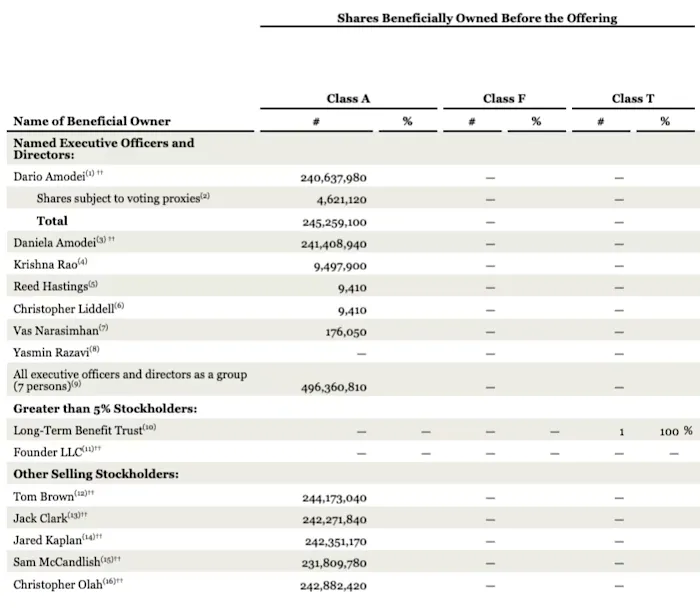
The S-1 filing disclosed Anthropic’s equity structure for the first time: the seven founders hold roughly equal stakes. Once lock-up periods expire, paper wealth will become real wealth. But control will not be relinquished—the company’s issued “Class F” founder shares grant the seven individuals combined voting power equivalent to 50.1% of outstanding shares.
One netizen’s comment was apt: “Anthropic might be the largest IPO in global history, but it could also be the most shameless company globally.”
Reference links: