MatOS Open-Sources Materials Research Agent Operating System
The AI Materials Institute at Zhongguancun Academy has open-sourced MatOS, an agent operating system for materials research that organizes datasets, skills, workflows and expert roles into reusable scientific assets. It ships with 3,135 datasets, 386 skills, 104 workflows, 51 expert roles and 48 integrated materials simulation tools, reaching 97.96% full-task success on the MatTools benchmark and narrowing over 30 million candidates down to 97 solid-electrolyte candidates.
Related Entities
Full Report
Contents8 sections
Screening materials, finding formulations, developing new models... taking on multiple scientific research tasks
Yunzhong, from Aofei Temple QuantumBit | Public Account QbitAI
Large-model agents can already retrieve literature, invoke simulation software, and even collaborate with automated laboratories. But getting them to independently complete a full materials research project still faces challenges:
A single study may require progressively screening tens of millions of candidate structures, or repeatedly searching through hundreds of alloy formulations over several days, continuously adjusting plans based on intermediate results; each time a new database or software is connected, the pipeline often has to be rebuilt; and the experience accumulated in one study is difficult to reuse in others.
To address this, Beijing Zhongguancun Academy and the Zhongguancun Institute of Artificial Intelligence (Zhongguancun Two Institutes) released their annual research progress in September this year — MatOS, a scientific research agent system for materials R&D.
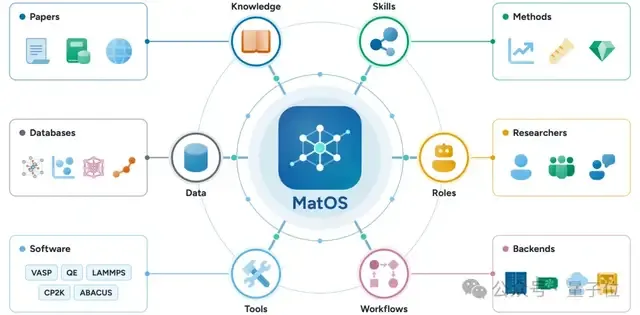
The project was built by the AI Materials Research Institute team at the Zhongguancun Two Institutes. It uniformly organizes data, knowledge, tools, skills, roles, and workflows as scientific assets, supporting both researchers and MatOS itself in building new capabilities on top of existing assets. It executes research tasks through stateful workflows and applies inspected and reviewed asset revisions to subsequent research, enabling scientific research capabilities to continuously evolve through use.
Currently, MatOS's asset library contains 3,135 datasets, 386 skills, 104 workflows, and 51 expert roles, and integrates 48 materials computation software packages; the technical report has been published on arXiv, and the code has been open-sourced on GitHub.
Across 3 agent benchmarks and 8 research case studies, MatOS completed a variety of tasks ranging from end-to-end autonomous research and tool invocation to large-scale screening, formulation design, and new method development, for example:
On the end-to-end autonomous research benchmark ResearchClawBench, compared with Codex CLI using the same base model, the average score was 33.6% higher, and 80.8% higher on materials tasks;
On the materials software usage benchmark MatTools, when using the same base model as Codex CLI and Claude Code, the complete-problem success rate reached 97.96%, the highest of the three;
By constructing a hierarchical screening pipeline, it screened 97 solid-state electrolyte candidates from more than 30 million candidate structures;
It supported the development of the alloy melting point prediction model DuoCompNet, reducing the mean absolute error on a fixed test set to 3.18°C, 13.6% lower than the second-best model.

From answering questions to conducting research, and then to continuously producing high-quality scientific assets
In recent years, work such as ChemCrow and LLaMP has enabled large models to invoke specialized tools, and systems such as MARS have connected agents with automated experiments. Scientific research agents are moving from answering questions toward conducting research.
Materials research imposes three requirements on agent systems:
Databases, simulation software, and machine learning potentials (methods that use machine learning models to approximate interatomic forces and accelerate simulations) are constantly emerging, requiring the system to connect new capabilities without rebuilding;
Research spans literature analysis, computation, and experiments, requiring the system to preserve state and check results in long-duration tasks;
Experience such as simulation duration and sampling strategies mostly comes from practice, and the system must be able to store this experience and effectively reuse it in subsequent tasks.
MatOS responds to these requirements with three major designs: a hierarchical scientific asset graph that organizes and extends R&D capabilities, stateful adaptive workflows that invoke assets to execute tasks and preserve evidence, and evidence-driven asset evolution that transforms reusable experience into inspected and reviewed asset revisions.

Overall architecture of MatOS: hierarchical scientific asset graph, stateful adaptive workflows, and evidence-driven asset evolution.
Three major designs: construction, execution, and evolution
Hierarchical scientific asset graph: combining existing capabilities to build new ones
MatOS organizes data, knowledge, tools, skills, roles, and workflows into six categories of scientific assets.
Each asset has a unique identifier, declared dependencies, and provenance records, and can either directly store content or reference external databases or computation software.
Assets are connected through typed relationships such as dependency, invocation, evidence, and validation. When an agent receives a task, it combines the required capabilities according to these relationships.
Among these, a skill is equivalent to a set of operating procedures for a class of research problems, specifying when to use it, how to select methods, what prerequisites are needed, how to execute, and how to check results; a role is an expert agent defined by a responsibility description and invocable assets; a workflow describes how multiple research stages connect. The same skill can be used by multiple roles, and the same role can participate in different workflows.
Both researchers and MatOS itself can build new capabilities on top of existing assets.
Researchers can register databases, software, or methods as assets and combine them into skills, roles, or workflows according to interfaces and dependencies; MatOS can also create or revise assets based on task evidence, which, after inspection and review, can be reused in subsequent tasks. The use and revision of assets are all recorded, and every improvement is traceable.
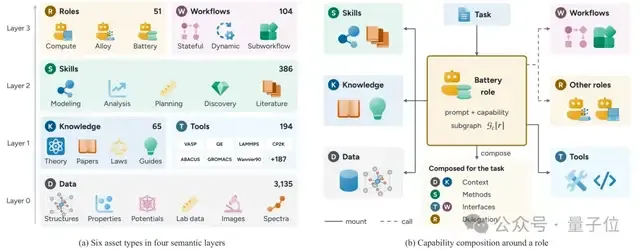
How MatOS organizes scientific assets: (a) six categories of assets belong to four semantic layers, abstracting layer by layer from data, knowledge, and tools to skills, and then to roles and workflows; (b) taking the battery role as an example, the role selects and combines data, knowledge, tools, skills, and workflows from the asset graph.
Stateful adaptive workflows: stable execution and on-demand adjustment
Workflow assets are reusable process descriptions, while a specific study runs through an execution graph. Each node in the execution graph specifies its goal, inputs and outputs, completion conditions, and the assets it references. The system schedules and checks according to the graph, handing over to the agent only the steps that require judgment, such as method selection, plan adjustment, and anomaly interpretation, and steps requiring researcher confirmation can be set as human nodes.
Because large models may produce different outputs for the same input, decisions in long tasks can easily drift away from the goal as context changes. Therefore, MatOS reduces the dependence of execution on model sessions through explicit steps and check conditions, lowering the risk of deviating from research goals during multi-step execution.
Execution graph snapshots, node states, results, and event records are all stored in the system, independent of the model's session.
Computations that take several days are handed off to background execution; when they complete, require input, or become unresponsive, the system proactively notifies the agent; tasks waiting for external results or human input retain their progress and continue execution afterward. Every output is linked to the node and execution attempt that produced it.
Intermediate results may require adjustments to subsequent steps, for example, adding a verification step first and then having subsequent analyses rely on the verification results. In this case, the agent or researcher can propose adjustments to the execution graph, adding or modifying nodes and changing dependency relationships. Adjustments must pass three checks—structural, policy, and compilation—and once passed, a new version of the execution graph is formed; if not passed, the original execution graph continues to run. Every adjustment proposal, check result, and adoption decision is recorded, so the evolution of the execution graph can be fully traced.
Adjustments to the execution graph primarily serve the current task. Among them, process improvements with reuse value enter asset evolution as evidence and, after checks and review, are used to revise the corresponding workflow assets for subsequent similar tasks to invoke.

Stateful adaptive workflow: node types, execution graph and its dynamic adjustment, and persistent state.
Evidence-Driven Asset Evolution: Continuous Improvement Through Use
User corrections, failed tool calls, recurring operations, and workflow results may all indicate that an asset needs improvement.
MatOS first assesses whether the evidence is sufficient, whether the problem is valid, and whether the experience can be reused, then locates the asset responsible for the corresponding function: a wrong method choice may require revising knowledge or skills, incorrect tool behavior requires fixing the tool, and a missing research step requires revising the workflow; when necessary, it also creates new assets or synchronously revises multiple related assets.
For example, if feedback indicates that the equilibration time for molecular dynamics simulation is too short, the system can change the equilibration duration in the corresponding skill from 50 ps to at least 200 ps, and add a check to confirm that atomic diffusion has reached a stable state.
Candidate revisions must undergo structural checks and model-based semantic review: structural checks mainly determine whether new structural, interface, or composition errors are introduced; semantic review determines whether the revision addresses the original evidence, preserves the applicable conditions of the method, and remains consistent with related assets.
Only revisions that pass checks and review are adopted, and the results of subsequent tasks become evidence for the next round of evaluation. These experiences are stored in assets outside the model, and the parameters of the base language model remain unchanged; assets are also not bound to a specific model—in the evaluation, the same MatOS was paired with GPT-5.4 and the DeepSeek series models respectively.
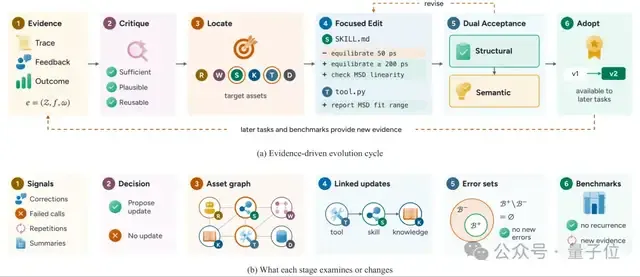
Evidence-driven asset evolution: evidence assessment, target localization, local revision, structural checks and semantic review, and version adoption.
Benchmark Evaluation Results
ResearchClawBench requires systems to conduct research and submit reports based on literature and raw data. The team selected 12 tasks in the fields of chemistry, energy, and materials, and compared against 7 scientific research agents using GPT-5.4, including MIRA, ResearchClaw, EvoScientist, and Codex CLI.
With GPT-5.4, MatOS achieved an average score of 19.46, 11.15% higher than the best baseline MIRA and 33.6% higher than Codex CLI. Performance on materials tasks was even more prominent: 18.7% higher than MIRA and 80.8% higher than Codex CLI. When switched to the lower-cost DeepSeek-V4-Flash, MatOS achieved an average score of 19.20, also higher than all baselines.
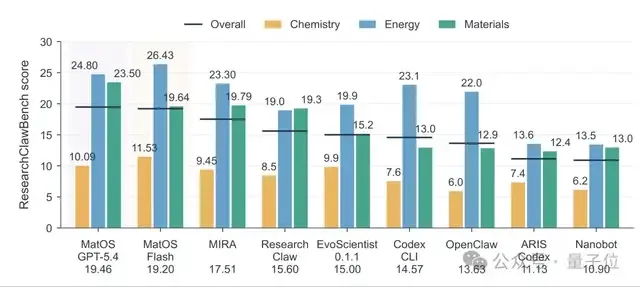
Domain-level average scores and overall average scores on the chemistry, energy, and materials tasks of ResearchClawBench.
In terms of cost, the average cost per task for the DeepSeek-V4-Flash configuration is about $0.85, less than one-third of Codex CLI ($2.70), while achieving a higher score; the GPT-5.4 configuration achieved the highest score at a cost of about $3.78. The two MatOS configurations jointly extend the cost–score Pareto frontier in this evaluation (i.e., finding a set of optimal choices among multiple objectives that each involve trade-offs, but none of which can be comprehensively surpassed by another solution).
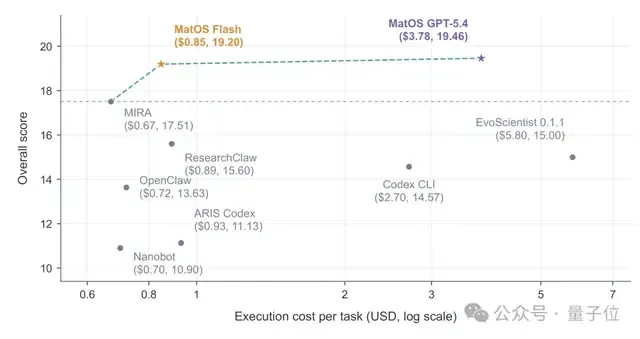
Average cost per task and average score for each system (cost on a logarithmic scale).
On the materials software usage benchmark MatTools and the multi-step tool calling benchmark SciAgentGym, all three systems—MatOS, Codex CLI, and Claude Code—use DeepSeek-V4-Pro as the base model.
On MatTools, MatOS achieved a complete-problem success rate of 97.96%, higher than Codex CLI's 95.92% and Claude Code's 89.80%; its subtask success rate was 97.10%, compared with 95.65% and 91.30% for the other two. On SciAgentGym, MatOS achieved a case success rate of 59.5%, higher than the other two systems' 57.1%.
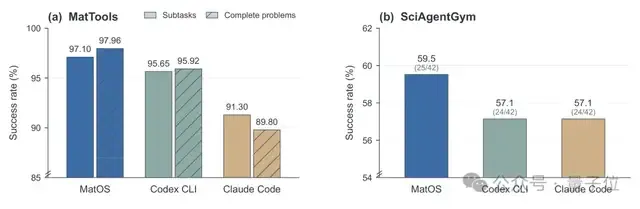
Success rates of the three systems on MatTools and SciAgentGym with DeepSeek-V4-Pro as the common base model.
Research Cases: From Large-Scale Screening to New Method Development
The 8 research cases cover materials directions such as machine learning potentials, solid and liquid electrolytes, and alloys, and extend to fluid mechanics. Task types include large-scale screening, molecular simulation, formulation design, and new method development.
In large-scale screening, MatOS follows the hierarchical screening framework proposed by Du et al.: first, rapid coarse screening using a model based only on chemical composition; then fine screening using a graph neural network that predicts properties from crystal structure; finally, molecular dynamics simulation of ion motion to examine conductivity, electrochemical stability, and mechanical properties step by step, screening 97 solid-state electrolyte candidates from 30,364,908 initial structures, with calculated conductivity up to 59.0 mS/cm.
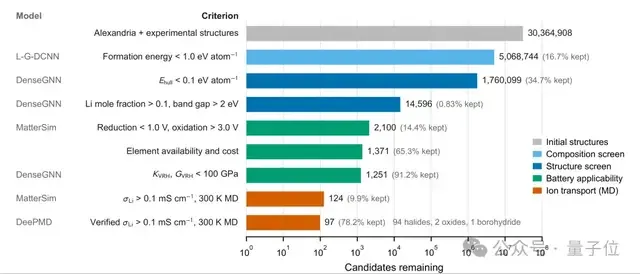
Hierarchical screening of solid-state electrolytes: 30,364,908 initial structures ultimately narrowed down to 97 candidates.
In formulation design, MatOS targets semiconductor packaging and searches for alloys that begin to melt at around 300°C and have a narrow melting temperature range: the large model proposes candidate formulations in four groups in parallel, and a surrogate model (a model for fast approximate computation) predicts the solid-phase and liquid-phase fractions of each formulation at different temperatures, with the scoring results guiding the next round of search.
Among the 286 formulations evaluated, the highest score increased from 0.534 for the starting formulation to 0.927; the highest-scoring Pb–Ag–Pt–Sn alloy is predicted to begin melting at 297.75°C, and after a 4.55°C temperature increase, the liquid fraction reaches 80%.
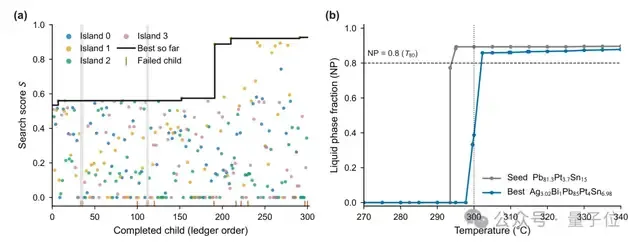
Alloy formulation search targeting melting at 300°C: (a) scores of formulations in four parallel searches, with the black line indicating the current highest score; (b) predicted liquid fraction near 300°C for the starting formulation and the highest-scoring formulation.
In terms of new method development, the research team used MatOS to build an active learning workflow: the system selects alloy formulations that require thermodynamic calculations, and after the calculation results are returned, the model is retrained, with data and model expanding in sync.
DuoCompNet, developed in this process, is used to predict the midpoint of the temperature range from the onset of melting to complete melting for tin-containing alloys. As training data increased, its mean absolute error on a fixed test set dropped from 28.40°C to 3.18°C, the lowest among the six models compared, and 13.6% lower than the second-best Roost; the test set consists of 1,401 tin-containing formulations composed of two or three elements with melting range midpoints between 200°C and 400°C, with reference values from thermodynamic calculations.
Using the training data selection method RarityGuard-MP developed with MatOS, 100,000 structures were selected from about 1.26 million structures for training a machine learning potential. At the same data volume, the combined error in energy, force, and stress of the trained model was 3.10% lower than that of the DIRECT method.
Summary and Outlook
MatOS connects capability building, task execution, and asset evolution:
Researchers can plug in their own data, software, and methods, and the system can propose asset revisions based on task evidence. New assets and revisions adopted after inspection and review become capabilities that subsequent research can directly invoke, so new research does not have to start from scratch.
Next, MatOS will connect instruments and experimental workflows, so that the evidence from computational screening to experimental validation in a single study can be linked within the same system.
Technical report: MatOS: An Agent Operating System for Materials Research Report link: https://arxiv.org/abs/2610.34203 Code: https://github.com/DingyangLyu/MatOS AI Materials Research Institute contact email: [email protected]
*This article is published by QbitAI with authorization; the views are solely those of the original author.