Anthropic Rebuilds Source Control with Scion as Daily Merges Hit 30,000
Anthropic migrated its monorepo from Git to Scion, an in-house server-side source control system built on content-addressed storage and tiered caching to serve agent and CI workloads. Daily merged changes grew from roughly 2,500 in May to over 30,000 in September, with CI performing about 25 million checkouts per day, outpacing shallow clones, sparse checkout and mirror-based Git workarounds. The design trades offline independence for less local data and shared infrastructure.
Related Entities
Full Report
Anthropic recently detailed how it migrated its monorepo from Git to Scion. Scion is a source control management system that moves repository operations to the server side, using content-addressed storage and tiered caching to support agent and CI workloads. The design sacrifices offline independence in exchange for less local data and shared infrastructure.
In an engineering post published on October 13, Anthropic said the number of merged changes per day grew from about 2,500 in May to more than 30,000 in September. Its CI system performs roughly 25 million checkouts per day, while the monorepo's main branch history is close to 100GB, and the compressed working copy exceeds 25GB. The company previously used shallow clones, sparse checkouts, Promisor Remotes, repository snapshots, and hundreds of Git mirrors, but as merge frequency continued to rise, these solutions became increasingly difficult to operate.
ImageNumber of changes merged per day in Anthropic's monorepo from January to September 2026. (Source)
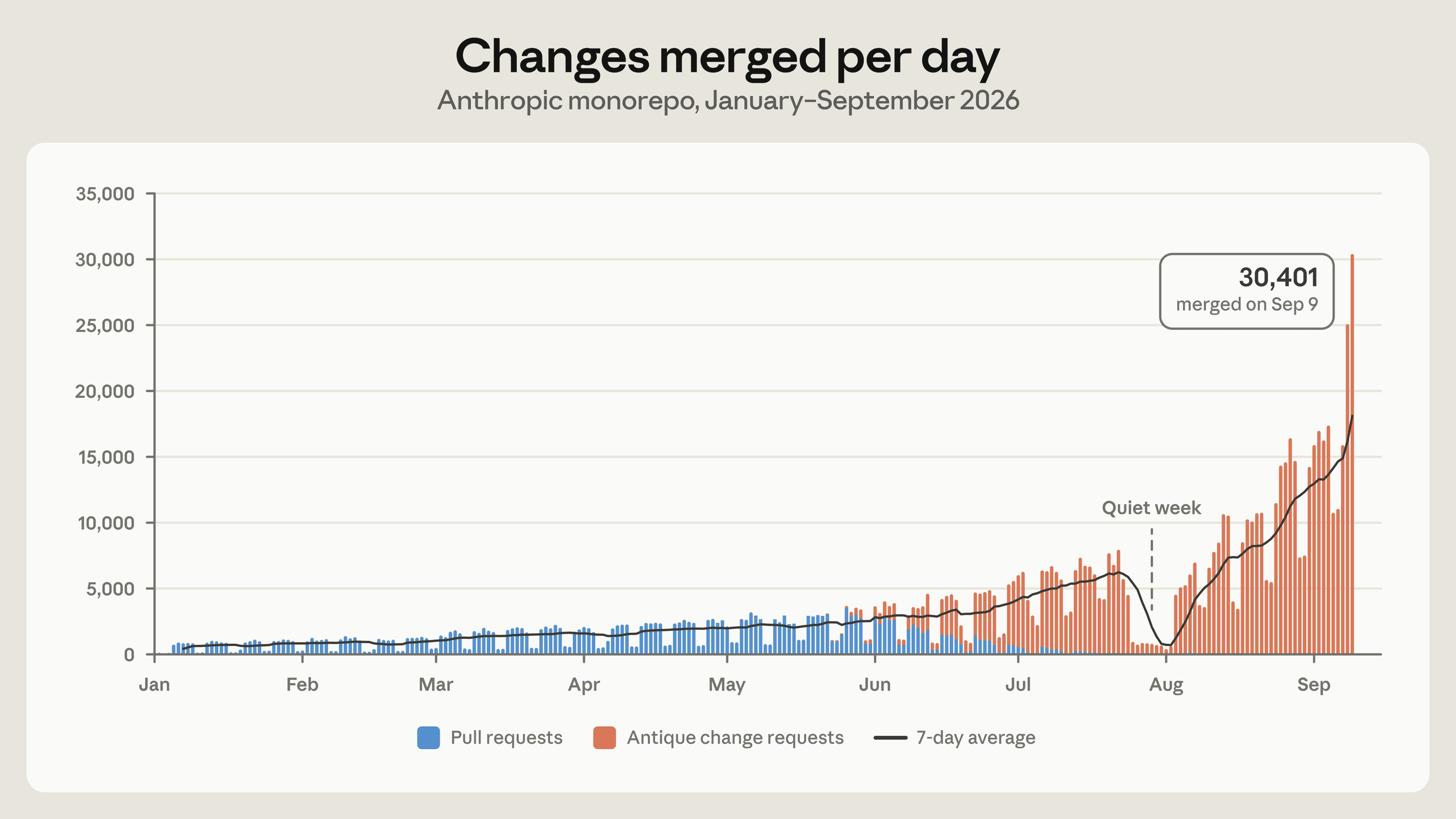
Scion performs commits, merges, rebases, history, and blame queries all on the server side. Clients only maintain a capacity-limited object cache, and virtualized checkouts materialize files on demand. Tools can also query diffs and perform partial write operations through an API without checking out code.
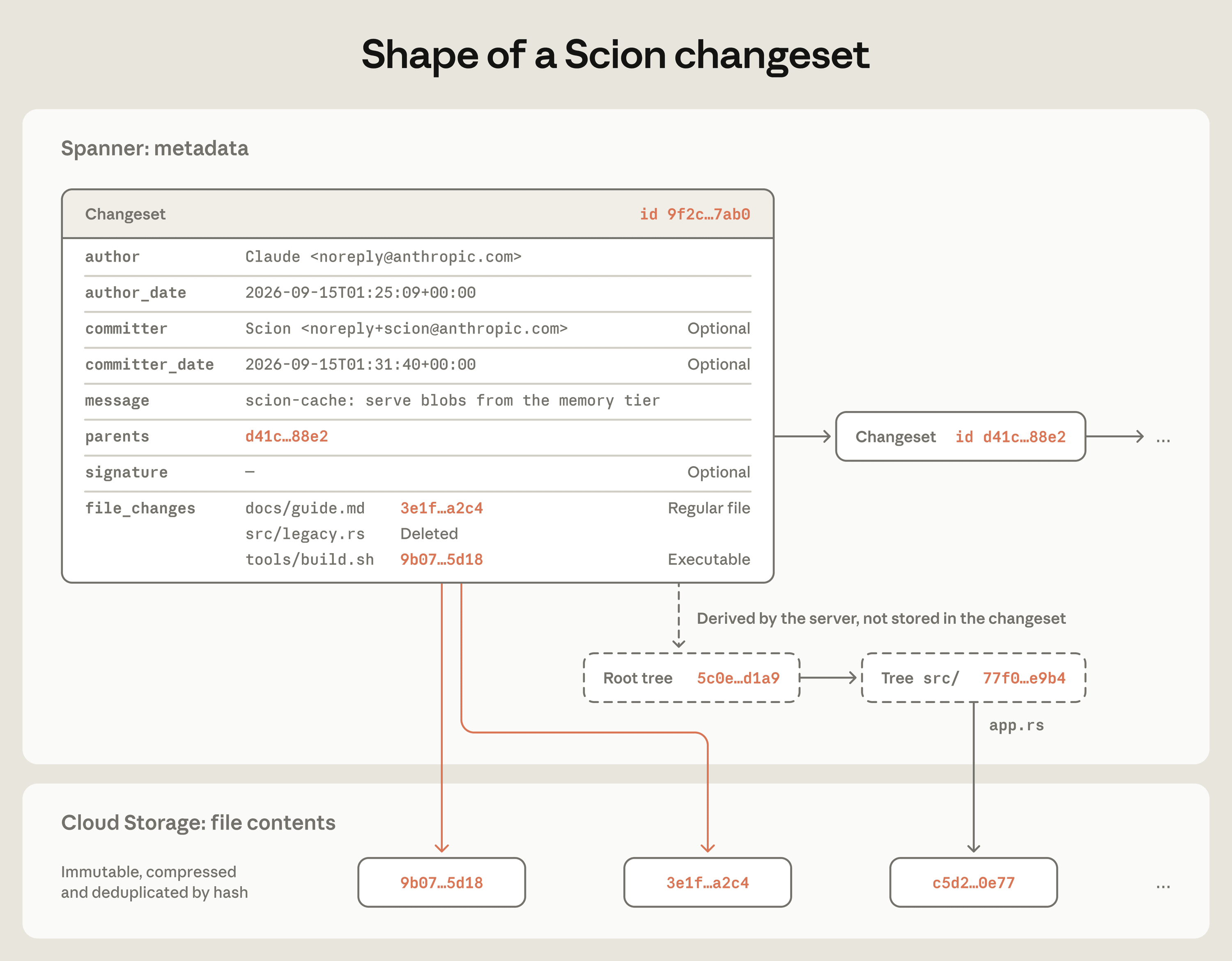
A Scion changeset records the files that changed relative to its first parent changeset and references the compressed file contents in blob storage using content-addressed pointers. Creating a changeset and updating references are separated from each other, so receiving a changeset does not require cross-server coordination. For history and blame queries, Scion builds additional structures called "derived data." This data is computed recursively from parent changesets and can be generated ahead of time or on demand. Because the implementation lives on the server side, derived data can evolve independently without modifying clients.
ImageA Scion changeset records the files that changed and their content references; the tree structure is derived separately by the server. (Source)
When performing a checkout, the client directly requests the missing immutable trees and blobs instead of negotiating the generation of a custom packfile. A node-local daemon shares cached objects across different tasks and fetches data from a regional cache; the regional cache in turn fetches data from authoritative servers backed by Spanner and cloud storage. The regional cache streams objects directly in the storage format used by the daemon, so there is no need to perform delta compression for each request.
Each layer exposes the same checkout protocol RPC, but Anthropic enforces a call order to isolate failures and prevent a flood of requests from overwhelming the authoritative servers when a regional cache fails. Sparse checkouts and virtualized checkouts request only the objects they actually need.
Anthropic reports that cache hit rates at every layer exceed 99%, CPU and memory infrastructure usage is only one two-hundredth of the previous Git mirrors, and checkout speeds for CI and research tasks improved by two orders of magnitude. These results were derived by Anthropic from its internal workloads and are not a general benchmark comparing against Git.
InfoQ previously reported on Uber's GitFarm. GitFarm centralizes standard Git operations on the server side without replacing the source control management system. Scion goes further by changing the underlying data model. Its design also builds on prior work: in an update on October 15, Anthropic explicitly stated that Mononoke and its Bonsai data model pioneered many of the techniques used by Scion.
Anthropic cautions that Scion is not a general-purpose Git replacement. It requires companion code review, code search, and CI systems, and the company's implementations of these are all highly customized. Anthropic suggests bringing some of these design ideas into existing Git platforms, such as comprehensive server-side APIs and more efficient fetch protocols.
For architects, the most important takeaway is: when workloads change, reconsider where computation should be performed. Repository queries do not necessarily require a local checkout, and immutable objects can be shared through caching. These approaches can reduce duplicate work, but Scion depends on server availability, and the required system integration effort is considerable.
Original link: https://www.infoq.com/news/2026/10/anthropic-source-control/