量子位官网 · 10/11/2026, 15:52:16
Terence Tao Proposes Math 2.0: AI Proof Abundance Demands New Verification and Understanding Frameworks
Fields Medalist Terence Tao declares the arrival of 'Math 2.0,' noting that AI has transformed mathematical proofs from scarce resources into abundant outputs. He argues mathematicians must shift from mere problem-solving to building verification systems that enhance human understanding and ensure correctness, addressing the cognitive misalignment caused by mass-produced AI papers.
SOURCE COVERAGEFull Original Report
Contents5 sections
Wen Ting reporting from Aofei Temple QbitAI | Official Account: QbitAI
The era of Mathematics 2.0 has arrived.
Just now, Terence Tao, a leading figure in the mathematical community and Fields Medalist, officially published an article stating:
AI is causing an abundance of mathematical proofs, signaling the end of the "Mathematics 1.0" era, which was built upon the scarcity of proofs.
Since OpenAI announced it had solved the Navier–Stokes Millennium Prize Problem, mathematicians led by Tao have been both criticizing OpenAI and calling for an emergency brake amidst the aggressive push of AI.
However, the tide of history rolls forward relentlessly, and the development of AI is clearly irreversible.
Tao is not simply becoming an AI decelerationist; instead, he poses a more profound question to the mathematical community:
How can we ensure that the growing number of AI-generated proofs brings humans greater understanding, better training, and more reliable contributions to the real world?
And looking ahead, what kind of mathematicians do we actually need?
From "Proof Scarcity" to "Proof Abundance": The Premise of Mathematics 2.0 Has Changed
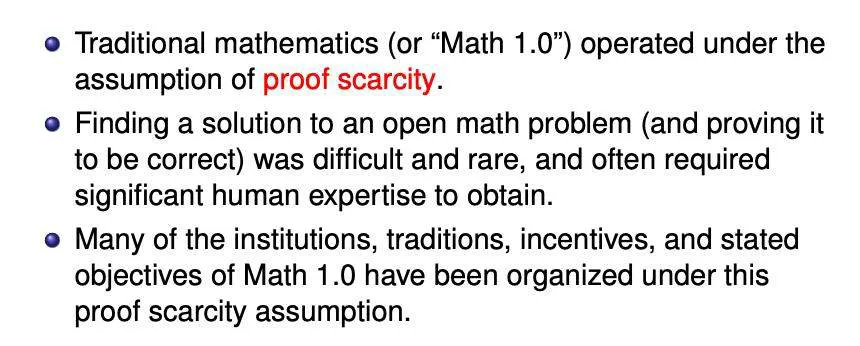
Tao argues that during the era of Mathematics 1.0, traditional mathematics operated within an environment characterized by proof scarcity.
To prove an open problem, individuals often required deep professional expertise and invested significant time and effort;
Consequently, "who solved what first" naturally became the primary metric for measuring contribution in the mathematical community.
But today, AI is profoundly altering this landscape.
Whether it was OpenAI releasing 722 math papers overnight, sweeping through major research areas like the quasi-Riemann Hypothesis, Hodge Conjecture, and BSD Conjecture;
(For details, see: https://mp.weixin.qq.com/s/P40M32TnTppU3jsDTvFGmg)
Or extending Wang Hong's recently proven three-dimensional Kakeya set dimension conjecture (for which she just won the Fields Medal) into four dimensions.
(For details, see: https://mp.weixin.qq.com/s/CDfZGoors8TmTnzSl0rszQ)
All of these are rewriting the pace of mathematical research, challenging the evaluation system of the Mathematics 1.0 era, and forcing mathematicians—beyond joint boycotts—to answer an increasingly urgent question:
Beyond proofs, what truly constitutes a mathematician's moat?
(For details, see: https://mp.weixin.qq.com/s/E-6A_HrJaj7P8j5TXpt_1w)
Regarding this, Tao stated in his article:
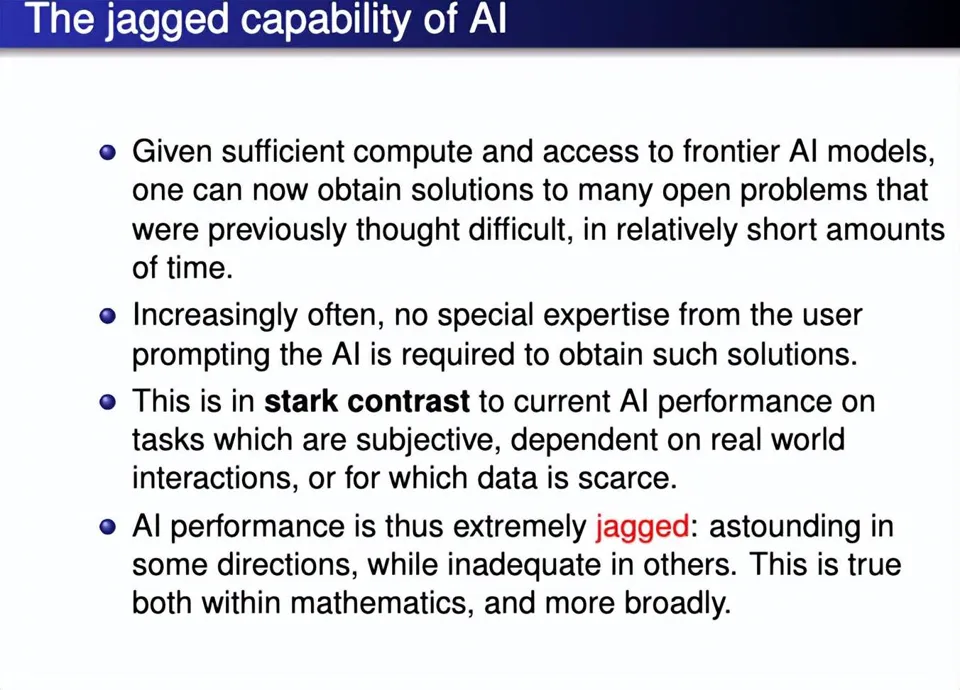
The barrier to obtaining solutions has indeed lowered. With sufficient computing power and access to frontier models, people can now obtain solutions to many previously difficult open problems in relatively short periods. However, determining whether a solution is correct, assessing its magnitude of contribution, and integrating it with existing research still require careful handling. Otherwise, it will lead to a worrying misalignment—solving the problem without correspondingly increasing human understanding.
As for why mathematics is so susceptible to disruption by AI, Tao summarized three overlapping conditions:
1. Proofs can be objectively verified;
2. Mathematical objects and reasoning processes are highly digitizable;
3. A vast amount of high-quality research literature already exists in digital form.
Combined with massive investments from frontier AI labs, these factors have rapidly turned mathematics into a core battleground for leaps in model capabilities.
At the same time, Tao also highlighted the classic plane with bullet holes diagram, warning everyone to beware of "survivorship bias":
Most problems at the current frontier of mathematics remain unsolved. AI capabilities are uneven; it performs astonishingly well in some directions but remains inadequate in others. What AI vendors want us to see are often only carefully selected success stories; Meanwhile, numerous unsuccessful AI attempts may never even enter public view.
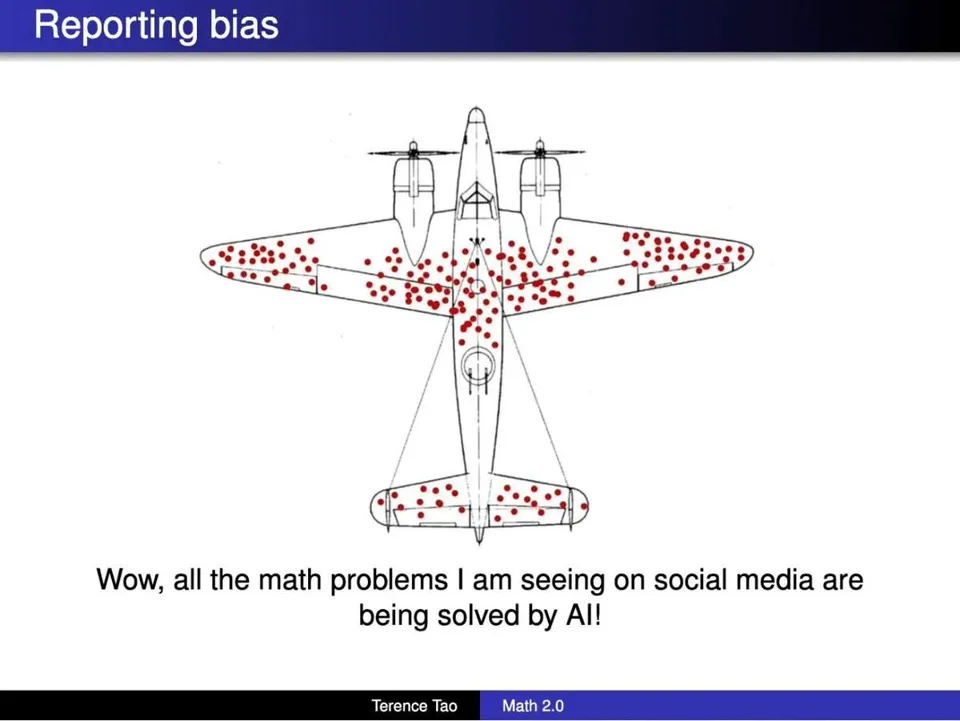
Naturally, this practice of counting only successes fails to address key questions regarding success rates, resource consumption, and the extent of human involvement.
Therefore, Tao calls for the urgent establishment of a more transparent and scientific evaluation mechanism that includes failure results and AI compute costs in reports.
But is it enough for AI to produce correct proofs and report failure results and compute costs?
Tao clearly thinks otherwise.

Blindly Competing on "Problem Solving" May Harm the Long-Term Health of Mathematics
On the question of what the true goal of mathematical research is, Tao offers a vivid metaphor:
Open problems are like lighthouses. They guide people to explore the surrounding mathematical world, but reaching the lighthouse does not mean exploration is complete.

Tao believes that in the process of attempting to solve problems, whether successful, failed, or achieving only partial progress, one may gain insights more valuable than the final answer.
However, if automated tools prematurely deliver answers while the evaluation system rewards only "solved" status, then paths yet untraveled may lose the motivation for continued exploration.
After all, the Millennium Prize Problems are finite, but in actual mathematical research, the paths, understandings, connections, and new problems grown from a single issue are virtually infinite.
He therefore warns:
Continuing to blindly optimize the metric of "problem solving" will harm the long-term health of mathematics!
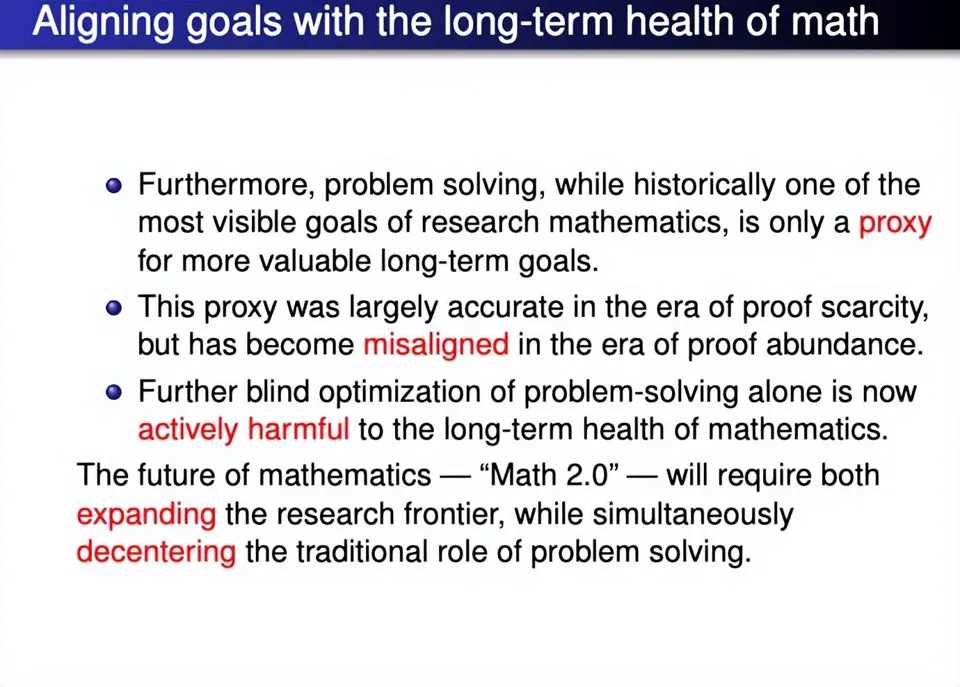
Following this line of thought, it becomes easier to understand why Tao fired such scathing criticism at model companies during his latest speech at SAIR:
It’s sheer madness. AI companies are accelerating endlessly without knowing what happens next. We must slow down. There is absolutely no reason to go this fast, none at all!

(For details, see: https://mp.weixin.qq.com/s/s35QsObpRO2G6mS1CGoBHQ**)**
This concern has long been present in his previous public responses.
As early as the beginning of September this year, Terence Tao pointed out in a blog comment:
AI can serve as a tool for mathematical research, but chasing short-term goals may come at the expense of the long-term sustainability of the mathematical community.
He worries that the latter scenario is accelerating: When answers are readily available, will people still be willing to slow down, understand them, and continue exploring the mathematical world around them?
However, in a dramatic twist, the impact of AI acceleration was vividly reflected in Tao’s own recent lecture.
According to Tao, the original theme of his speech was supposed to be "Machine-Assisted Proofs." However, amid the frequent "bombardment" of the mathematical community by AI in recent times, he had to make significant adjustments, ultimately settling on the theme "Mathematics 2.0."
Truly... surreal.

So, as AI becomes increasingly proficient at solving problems and proving theorems, where exactly lies the core moat for human mathematicians?
The answer may lie in Tao’s proposed "Cancer Therapy Experiment."
Beyond Proof: Understanding, Training, and the Real World
To illustrate why human understanding remains crucial, Tao presented a striking thought experiment during his lecture:
Suppose you ask an advanced AI to find a cancer therapy capable of passing Phase III clinical trials. After burning through computational resources, it outputs a mixture of unknown chemicals: the model predicts it kills cancer cells, Lean verification passes, and Phase III trials are successful; But no one knows how it found this solution, nor can anyone determine whether the AI truly discovered a therapy or merely exploited loopholes in the trial process. Before the needle enters your vein, wouldn’t you hope that at least one cancer specialist understands its mechanism of action, one mathematician comprehends the mathematical reasoning behind the model, or at least one scientist understands the model used to find the therapy?
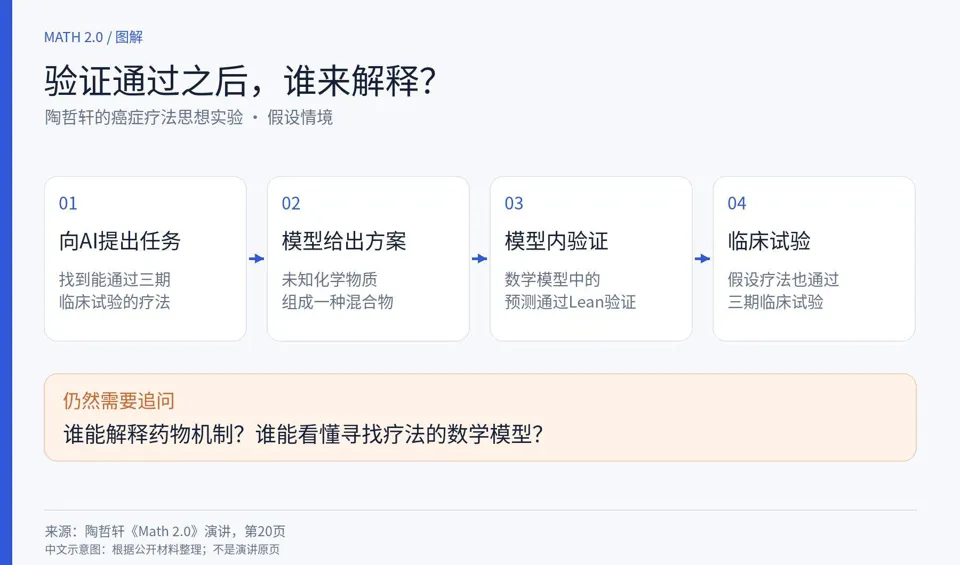
This is a thought experiment about goals, verification, and understanding.
It grounds abstract mathematical discussions in a concrete scenario: Even if conclusions within the model pass verification, someone must still judge whether they align with real-world objectives.
And this may well be the key reason why human scientists cannot be replaced—models can generate answers, verify reasoning, and accelerate exploration, but they cannot act as gatekeepers for humans.
The value of mathematical proofs must also progress along this chain.
In his previously published work "Mathematics in the Age of AI," Tao broke down problem-solving into five stages:
- Generating proofs;
- Verifying correctness;
- Explaining clearly;
- Being understood and accepted by the community;
- Ultimately integrating into the field's standard theory.

Among these, the final step is particularly slow:
Researchers need to find more natural formulations and better proofs, connecting results with other knowledge, before they can enter textbooks and the toolkit of the next generation of mathematicians.
This is precisely what AI finds difficult to accelerate.
If AI primarily accelerates the earlier stages, we may face "proof indigestion" in the later stages.
Therefore, he advocates:
Reducing the emphasis on rushing to generate proofs, and increasing the focus on explanation, peer review, and knowledge curation.
The debate surrounding "what comes after proof" intensified in early October:
On October 7, OpenAI released 722 mathematical papers in one go, thoroughly angering the "AI deceleration" faction led by Terence Tao.
Subsequently, Tao quickly spearheaded the establishment of the Association for Human Mathematics (AHM) and issued a heavyweight joint statement:
Releasing over 700 files at once is not scientific research; it is purely a display of computational hegemony. We strongly urge all mathematicians to cease collaboration with OpenAI and return to a scientific vision centered on human understanding!
(For details, see: https://mp.weixin.qq.com/s/E-6A_HrJaj7P8j5TXpt_1w**)**
In Tao’s view, formal verification alone is insufficient; authors should also be able to clearly articulate their findings.
Results lacking this explanatory capability remain incomplete in his eyes.
This series of events also struck at the heart of the most pressing question for young researchers:
If AI can rapidly generate papers, do we still need to pursue Master’s and PhD degrees?
In the Age of AI, Is a PhD Still Necessary in Mathematics?
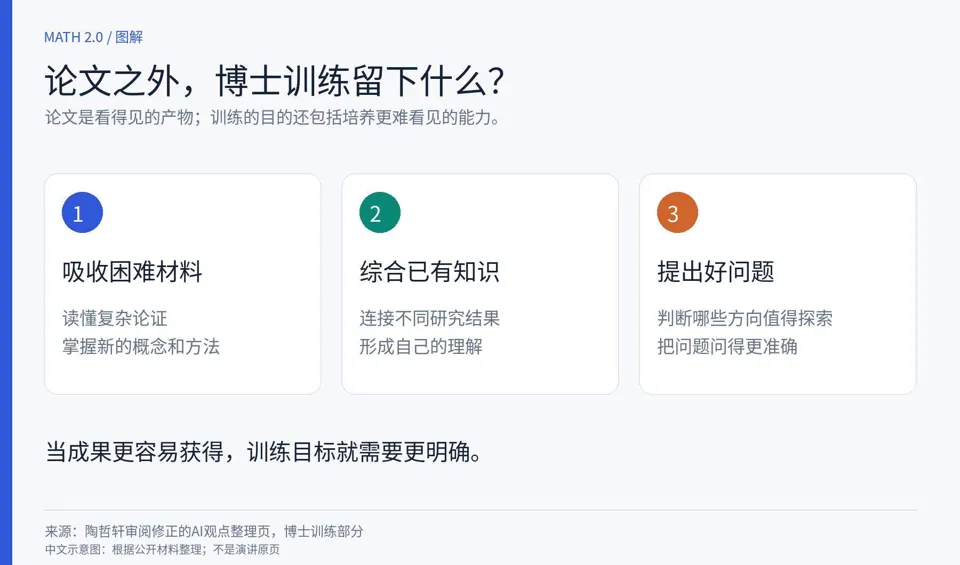
Tao believes that in the age of AI, the necessity of pursuing a PhD does not hinge on whether one can produce papers, but rather on cultivating a systematic ability to absorb difficult material, synthesize knowledge, and pose good questions.
Using diet and exercise as analogies, he stated frankly:
In the age of AI, if you hope that a PhD yields not just a paper, but trains you to tackle hard problems, synthesize knowledge, and ask good questions, then a PhD certainly retains its value; But if your sole aim is to produce output, then indeed, its necessity is declining in the age of AI. It is like when food and transportation become abundant, people must learn to exercise on their own; When answers are readily available, people must consciously maintain their cognitive abilities and resist the convenience of bypassing thought; and these are often the very capabilities fostered by doctoral training.
Is there a way to find a method where AI and researchers grow together?
Tao revealed in his lecture that he is already advancing specific initiatives;
For example, the Open Mathematical Model Initiative launched by the SAIR Foundation, which he co-founded, targets daily research needs in its first phase, such as understanding difficult arguments, checking citations, exploring examples, writing code, and formalizing proofs.
He also teased that these open-source mathematical models will be released soon, generating significant anticipation.

△ A more sustainable "Mathematics 2.0" AI application paradigm presented by Terence Tao
One More Thing
At the conclusion of his talk, Terence Tao identified imagination as the primary bottleneck in realizing Mathematics 2.0.
In his view, while the supply of proofs is undergoing a transformation, how to leverage this change to advance understanding, training, and exploration simultaneously remains a choice that the mathematical community must make collectively.
Once an AI proves a problem, the mathematician's next question may well shift to:
What else can we learn from this answer?
And what can we do next?

References: [1] https://teorth.github.io/tao-web/ai-views.html [2] https://x.com/ns123abc/status/2109045309112250560 [3] https://teorth.github.io/tao-web/slides/math-2-0-caltech-2026.pdf?utm_source=chatgpt.com [4] https://arxiv.org/html/2608.16753v1?utm_source=chatgpt.com