InfoQ 中文 · 10/8/2026, 1:48:05 AM
OpenAI Codex Lead Pledges Daily Improvements Amid Config Fatigue
OpenAI Codex lead Tibo Sottiaux launched a '28-day daily delivery' challenge, using user benefit or quota resets as the sole acceptance criteria. He admitted that complex model selection and parameter configurations in current AI toolchains severely hinder usability, noting that faster agents are restoring developer flow rather than nostalgia for manual coding.
SOURCE COVERAGEOriginal coverage
Contents7 sections
Tibo Sottiaux has committed to delivering user-perceptible improvements or credit resets for Codex/Work every day for the next 28 days, effectively handing the judgment of product value over to real-world workflows. He emphasizes that autonomous decision-making authority is critical for rapidly responding to issues and feedback, while candidly admitting that the current complexity of model selection and configuration in AI toolchains has severely degraded usability.
The commitment uses daily user benefit as the sole acceptance criterion; credit resets serve both as a compensation mechanism for failures and a way to celebrate positive milestones. The overload of model and parameter configurations is becoming a core experience bottleneck hindering AI adoption.
This article is suitable for AI platform product managers, developer tools engineers, and LLM application architects.

Tibo Sottiaux, Head of ChatGPT and Codex at OpenAI, recently set a checkable daily commitment for his team on X: For the next 28 days, they must either ship an improvement clearly useful to most Codex and Work users or perform a full credit reset.
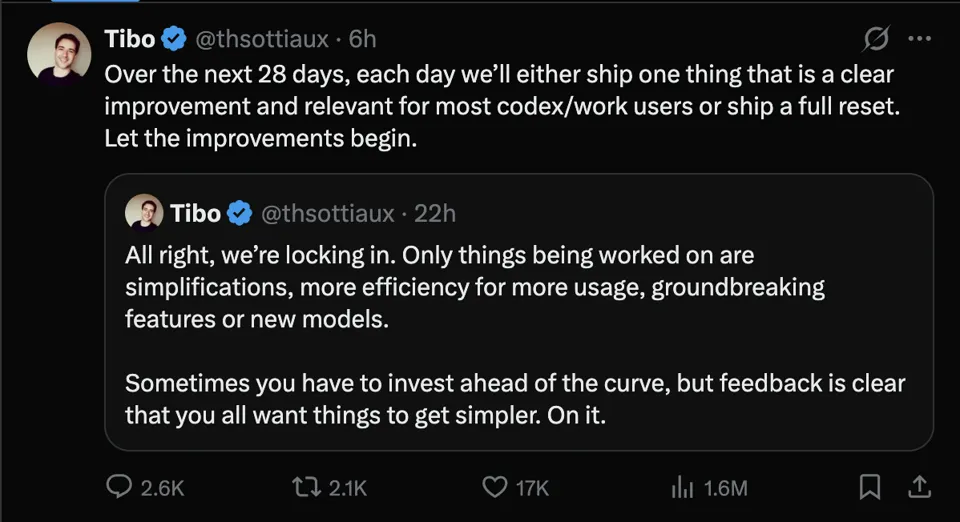
This commitment places the judgment power directly in the hands of users. Whether the product has improved cannot be measured solely by the number of features released, but by whether users truly benefit in their daily work. Regarding credit resets, Tibo explained in a recent interview exactly why he can make such decisions directly.
"As long as it's necessary and I deem it appropriate, I can press the credit reset button," he stated. This autonomy allows him to stay closer to the community, noting, "I don't need this to go through layers of approval."
When host Lenny asked how many more credit resets could be expected, Tibo’s answer carried a touch of self-deprecation: "It depends on how many times we break things." He added that resets would happen when issues arise, but also to celebrate noteworthy achievements. He frankly admitted that on his third day at OpenAI, he had already crashed the production environment.
However, more significant than "how much free quota remains" is this product leader’s assessment of the AI usage experience: Even he himself has grown tired of increasingly complex choices.
Which model should I choose? How high should the reasoning intensity be set? Should I use multi-agent mode or Ultra mode? What are the actual differences between these options? At the end of the interview, Tibo spoke plainly about being exhausted by them: "You practically need a PhD in Model Selection." He hopes to shed these burdens soon, allowing the applications themselves to gradually fade into the background.
This pursuit of a simple experience stems from changes in his own workflow. Today, the vast majority of code required for analyzing business trends, researching the next feature, and checking the performance of previously released products is written by Codex. Hand-writing code has become a relaxation activity, limited to occasionally solving a few LeetCode problems on weekends.
He hasn’t blindly pursued running more agents simultaneously. As agent speed increased, he regained his work flow state: Ideas no longer get interrupted by long waits, building can be driven via voice, and attention can focus more intensely on creation itself. "This flow is different from before, but I no longer miss the old state."
In Tibo’s view, future product design needs to account for three shifts: Most operations on the internet will be performed by agents; models will quickly become cheaper and faster; and interactions across different modalities will become smoother. This is also why he questions certain external products: If one seriously envisions these capabilities being ten times stronger a year from now, developers would build differently.
From this perspective, the 28-day improvement commitment echoes the direction he repeatedly emphasized in the interview: Turning more powerful capabilities into easier-to-use products.
During DevDay, in an interview with Lenny, Tibo further discussed the personal agent platform Dots, the integration of Codex with ChatGPT, and why manually building loops and repeatedly tuning agent workflows may just be a transitional phase. He also answered questions closer to practitioners: After AI takes over more execution work, which skills will become more important? Do humans necessarily have to do more because of this? And how should risks be controlled when agents begin to act proactively?
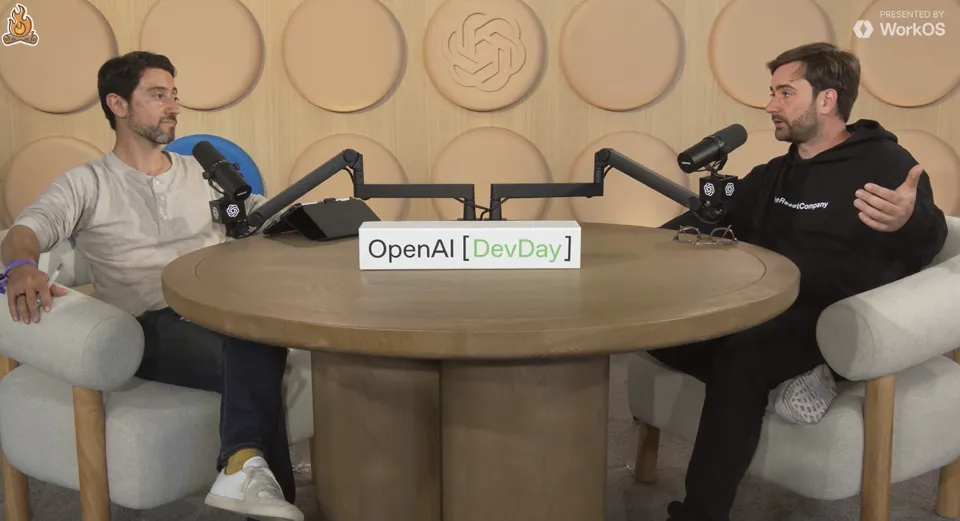
Below is the full interview, compiled by InfoQ:
Lenny: Thanks for joining us. You’ve shipped a lot recently. How have you been sleeping? Are you holding up okay?
Tibo Sottiaux: I’m doing well, lucky to have an excellent team. While I sleep, they’re awake for most of the night. We have a great room in the office called "The Library." We completely transformed it into a large war room. The atmosphere there is fantastic, and everyone stays busy until very late.
Lenny: You were an engineer for many years. Do you still write code? Do you submit PRs (pull requests), or are you mostly writing docs and attending meetings?
Tibo Sottiaux: What do you mean by "writing code"?
Lenny: Like submitting PRs, occasionally merging some code.
Tibo Sottiaux: Technically speaking, a massive amount of code is written for me to complete various analyses. For example, understanding trends, understanding the business, researching the next feature, and analyzing how previously released products are performing. A huge portion of the code needed for this work is written by Codex. I obviously no longer hand-write this code.
Occasionally, on weekends, I’ll hand-write a few LeetCode problems to enjoy some relaxation and stress relief. But that’s the only scenario where I still write code by hand.
Lenny: In your daily work, how many agents do you typically run simultaneously?
Tibo Sottiaux: Previously, I ran more agents simultaneously. Later, we were lucky enough to achieve a breakthrough in ultra-high-speed capabilities. Now, I feel like I can maintain my work flow state again. A faster agent helps me significantly.
The number of agents running simultaneously actually fluctuates. When I’m exploring capability boundaries, I assemble increasingly larger agent teams. But when the model achieves its next breakthrough, I suddenly realize that a single more capable agent can handle all the work, keeping all information in memory and continuously learning. So, I shrink the team size again.
This process is constant expansion, contraction, and then expansion again.
How AI Will Continue to Change Work
Lenny: Can you explain that further? It reminds me of discussions about loops earlier, and then execution graphs. Is what you’re describing somewhat an evolution of those approaches?
Tibo Sottiaux: Building loops, repeatedly tuning loops, and figuring out how they should operate might have excited some people. But I don’t think the future will operate that way.
I believe the future aligns more closely with how we position Dots and the product we’re launching now: you have a highly intelligent agent that works 24/7, understands your goals, knows your preferences, and learns from feedback.
The product we’re launching isn’t perfect. By opening it to all Pro users, we’ll learn a great deal. But in the long run, what you need is a system that continuously learns based on what you want to achieve. You shouldn’t have to think, “To get results, I must force it into this strict loop.”
Lenny: Right now, there’s Codex, ChatGPT Work, consumer-facing ChatGPT, and Dots. It sounds like you believe we’re moving toward a future where Dots becomes the primary interface for human-AI interaction, orchestrating these other tools and services. Is that right?
Tibo Sottiaux: Yes. But stepping back, regardless of whether it ends up being Dots, the fundamental goal is to free people from the constraints of technology itself.
You possess an intelligence that is persistent and always active. It knows what needs to be done and can interact with you through any client, on any screen. You can also call it. For example, when you walk into a meeting room, it joins the meeting and takes notes for you. Later, you can continue the conversation via email; when you need it, you can send it a message.
You don’t need to stay glued to your laptop or constantly watch your phone. When you need it, it’s there; when you don’t, it doesn’t get in your way. I can’t wait to see this become reality. Right now, we carry laptops everywhere like bricks. We are tethered by technology, rather than having technology work for us.
Lenny: I wanted to ask you this today as well: over the past two years, our ways of working seem to have changed significantly. Especially for engineers, but also for many other roles, daily workflows have clearly shifted.
Do you think we are gradually approaching the fundamental form of future work—say, within the next five years (though five years feels too distant, so let’s say the next two)? Or will our ways of working still undergo more drastic changes?
Tibo Sottiaux: I believe it will continue to change quite drastically.
Even today, technologies like voice, multimodal input, and output seem to finally be coming together, but they still feel somewhat clunky to use. I think this feeling will persist until one day it suddenly stops being clunky. At that point, you’ll realize, “I can just talk to it directly, like we do now. It remembers everything accurately. If I want to brainstorm or ideate, we can sketch things out, and I have an interface to collaborate on.”
Imagine having a shared whiteboard where humans and humans, agents and agents, can collaborate together.
I believe this will transcend conversation and many of today’s client forms. After all, these things aren’t truly operational yet. So, we will go through another major wave of transformation.
Future Direction of Dots
Lenny: It sounds like Dots is a key component of the future. This AI assistant can handle various tasks for you, so you no longer need to distinguish between when to use Codex and when to use ChatGPT, right?
Tibo Sottiaux: Yes. We will integrate Codex and ChatGPT. Currently, we have chat mode and a toggle switch for Work mode. We’ve heard very clear user feedback: people like the capabilities of Work mode, but sometimes they prefer chat mode because it’s faster and more comfortable to use.
So, we are integrating these experiences to reduce complexity. Eventually, we will bring all of Dots’ capabilities directly into chat mode, raising the baseline capabilities available to our 1.2 billion users. Of course, we’ll see what the user count looks like by then.
We hope the entire experience becomes truly seamless. What excites me about Dots is that it has no model selector and requires no configuration—you just talk to it. The only thing you configure is which channels you want to communicate through.
Lenny: This sounds a lot like the world depicted in the movie Her. Do you think of that film? It’s exactly that kind of vision…
Tibo Sottiaux: I saw it once. I find the concept interesting. However, I think more often about sci-fi works from thirty or forty years ago and how visionary they were at the time.
Lenny: Are there any sci-fi works that particularly influenced you?
Tibo Sottiaux: Books like Neuromancer, and the original Star Trek. I often think about these works. One thing that impressed me deeply about Star Trek was how practical the technology was. You could speak directly to the computer, and it would do things for you; you could speak to the ship, and it would act.
These things are becoming reality. We are entering that era.
Lenny: We are recording this interview in front of a live audience. There’s a long line outside the door, with everyone waiting to meet you and hear your insights. How do you view your current position and the responsibility that comes with it? What you are building impacts people’s lives. How does that feel?
Tibo Sottiaux: I believe it’s crucial to be part of the community and build products together with everyone.
In a sense, we are exploring this technology together and discovering what we can do with it collectively. Every time I talk to someone, I discover, “Oh, you’re using it for this—that’s something I never thought of.”
It influences your life in some way, and it influences another person’s life too. Putting these experiences together makes one feel humble and inspired. I believe this process is essential to creating something truly useful for people. I don’t know how we could achieve this without the community.
Lenny: I often hear developers of AI products say that before launch, they don’t really know what they’ve built. Only after releasing it, seeing how people use it and what new use cases emerge, do they gradually understand it. It sounds like you mean the same thing: building together with others, rather than saying, “This is our vision; we’ve figured everything out.”
Tibo Sottiaux: Exactly.
Tibo Sottiaux: Additionally, I have a Dot. We haven’t launched team-based Dots yet, but today we released the primary Dot that users can configure. You can connect it to your own apps and gradually discover what a single Dot is capable of. Later on, we will open up the ability to create multiple Dots. Personally, I have a dedicated Dot for Twitter.
Lenny: Could you elaborate? Currently, everyone has only one Dot and cannot add more, correct? In the future, people will be able to have multiple Dots. How do you see this direction evolving?
Tibo Sottiaux: Yes. We want to start with a primary Dot first. It is likely the assistant you will contact via messaging, and it will develop the deepest understanding of your preferences.
We want to see how people use it first, observe how the system needs to adapt, and learn by exploring and using it together with the community.
Soon, you will be able to add a second, third, or fourth Dot, creating as many as needed to form your own virtual team and assigning them specific roles.
I don’t think this is absolutely necessary in all cases. But sometimes, I have a task that requires significant effort, such as continuously monitoring Twitter for me. The workload might be substantial enough to occupy an entire Dot. You can have several such Dots.
OpenAI’s Open Ecosystem and Plugin Revenue Sharing
Lenny: Looking back at everything recently released, Dots are probably the most eye-catching. Is there anything you believe hasn’t received the attention it deserves but will become very important in the future? Something people haven’t fully realized yet but is crucial to the overall vision?
Tibo Sottiaux: I think the underappreciated aspect is the ecosystem: opening up the entire system and our firm commitment to comprehensive openness. We have already signed 16 partners, and I am very proud of that.
This actually started quite naturally last year. At the time, I was talking with developers from Pi and OpenCode, and we felt it was obvious that users should be able to log in using Codex and utilize their own quotas.
So, we essentially shook hands online, saying, “Just use this authentication mechanism; we trust you won’t do anything improper.”
Later, this approach became increasingly popular. Now, we have turned it into a formally supported mechanism, advancing it with many partners. I look forward to rapidly expanding partnerships in this area. On the other hand, we are also opening up our infrastructure and the way we build ChatGPT, including plugin extensions and plugin discovery, giving anyone the opportunity to bring their products to approximately 1.2 billion users and benefit from this distribution capability.
We have also designed a revenue-sharing mechanism, though we didn’t mention it in the keynote. For popular plugins with high usage, we will pay compensation, and they will receive a portion of the revenue share.
I believe this commitment to an open ecosystem will lead to very exciting developments.
Lenny: For example, if someone uses the Notion or Figma plugin within ChatGPT Work, Notion and Figma earn revenue because users are utilizing them within the app, right?
Tibo Sottiaux: Yes. We have many subscription users who use ChatGPT, and they receive certain usage quotas. When users spend these quotas on plugins, or use quotas in other products via “Log in with ChatGPT,” we share the revenue with the corresponding partners, compensating them accordingly.
Lenny: One reason plugins and ecosystems are exciting is that they serve as distribution platforms, helping products get discovered: “People found my app, and then it took off quickly.” What advice do you have for developers hoping their plugins stand out and get discovered by more people?
Tibo Sottiaux: Build a good plugin. Our mechanism works like this—and the system will continue to evolve: we look at user retention data, assess whether the plugin is successful and its quality, and based on that, begin recommending it to users during conversations. This gives your plugin the chance to be recommended to a significant number of users. However, if the plugin isn’t good enough, the system will stop recommending it.
Lenny: It’s interesting that you focus on whether users who try a plugin stick around.
Tibo Sottiaux: We need to see if it truly adds practical value and enables ChatGPT to accomplish more tasks.
Lenny: Understood. So, the key isn’t doing AEO (Answer Engine Optimization)—choosing the right keywords so more articles mention you to increase the chances of being recommended by AI—but rather whether people consistently use your product and choose to stay.
Tibo Sottiaux: Exactly.
Lenny: So, you consider this something currently undervalued that will become very important later. I know this is effectively your second attempt, having previously tried an app marketplace.
Tibo Sottiaux: This time, the direction is right.
Lenny: Good, this time it will succeed. Let’s go back to Dots, as they seem to be a vital part of the future vision.
Research Accumulation Behind Dots
Lenny: When did you start working on Dots? Previously, OpenClaw generated significant attention, Peter joined you, and a foundation was established. Additionally, there were products like Grokbot, Muse, and Instinct. How long have you been working on this? Why launch the product now?
Tibo Sottiaux: Do you remember Codex Cloud?
Lenny: Yes, the earliest version, roughly a year ago, right?
Tibo Sottiaux: If you look back at Codex Cloud and the short animation we used at the time, I think that might have been the inspiration for Grokbot. They are very similar—I’d even say surprisingly so. But seriously, on the research level, we have been conducting research on persistent execution and long-horizon tasks for over two years. We have also spent nearly the same amount of time researching memory systems capable of maintaining coherent consistency.
Many of these capabilities have already been directly integrated into ChatGPT. I think users really appreciate how much information ChatGPT knows about them. When I chat with many people, they often share this sentiment.
Additionally, ensuring product safety and system security is paramount. This is precisely why we chose to power Dots with Astra: it is our safest model and the one most aligned with our goals. To make Dots truly safe and reliable, we have invested significant effort.
Lenny: I like to ask guests on the podcast this question: As AI takes on more work, in which areas do you consider yourself indispensable? In the long term, what aspects of the human brain remain useful or most valuable?
Tibo Sottiaux: I believe this largely depends on how we build technology. At OpenAI, we design everything with humans at the center, building technology as an extension of the person—an extension of your will and taste—making it a true tool for empowerment.
As long as we continue in this direction, letting technology help you achieve what you want to do, expanding your creativity and taste, and making you feel great while using it, then it essentially becomes a creative tool.
In the future, we may no longer have people whose sole job is writing code, but there will be more creators than ever before. I think some profound humanity will remain in this process: people want to learn, and they want to see what others are creating.
These are the things that interest me most. I am here talking to you, not to Dot. I believe this will not change for a very, very long time.
Lenny: After engineers' work lives changed, a phenomenon emerged: they need to switch contexts more frequently. There is also a growing sense of loneliness because they spend all day talking to agents rather than interacting with other people. To what extent do you consider these impacts of AI on people's lives? Is there a way to solve these problems or make the experience less annoying?
Tibo Sottiaux: Yes, we are constantly thinking about this. Reducing configuration fatigue is one direction. Another is changing the state where interacting with agents feels like a "solo adventure": you only talk to your own single agent, and then you have many agents, requiring you to delegate numerous tasks separately to them.
Improvements across many dimensions will combine to make the entire experience more enjoyable. My team and I have spent a lot of time thinking about these issues.
For me, the ideal workflow is for it to exist directly in the physical space where you are. We are talking like this now; it can observe and understand the ideas we propose.
We can write something on paper, and it receives that content, starting to build in the background. Then, you say, "Actually, I have another idea," and it starts building another thing.
You can project the results onto a screen and speak directly to it. It can also participate in conversations between people. This way, you don't need to stare at the screen constantly figuring out how to write prompts, eliminating that fatigue. The whole process becomes very natural.
This is the direction we are heading. We haven't fully achieved it today, but we will in the future.
Does AI doing more mean humans must do more?
Lenny: Continuing on this topic, there is already a negative side effect: because we can do more, we face pressure to do even more. People say, "Come on, run 30 agents simultaneously. Why aren't you delivering more? Everyone else is delivering more." Do you think this problem can be solved? Or is it just human nature: if you can do more, you should do more?
Tibo Sottiaux: We also hear Sam talk about the promise of this technology: reducing noise so you can focus on what you truly care about. Right now, there are many things—perhaps important, perhaps not—all competing for your attention. We hope to lower these distractions so you can focus on what genuinely needs your attention.
I've noticed a clear pattern: every time I go on vacation and completely disconnect from work for a week, I start thinking in different, more creative ways. I am very eager to see if we can bring this state into daily life. Perhaps you need fewer meetings, or you don't need to do so many things. In fact, if you rest better, you might actually become more productive.
I believe the entire industry needs to figure this out together. But this is the value AI promises, not making you input one more prompt per second.
Lenny: I'm currently building a bot, similar to an "energy audit assistant." It checks my calendar and asks me, "Is this activity replenishing your energy or draining it? Can this task be delegated to someone else?" I feel AI should tell me, "Lenny, maybe you can delete these appointments and make yourself happier."
Recently, have you done anything particularly interesting with AI that made you think, "This is amazing, it really opened my eyes"? Or have you heard others share such cases?
Tibo Sottiaux: There was indeed one interesting incident. Although the live demo failed in front of everyone earlier—which certainly wasn't good—it actually highlights something. My Dot knew I was attending DevDay. At that moment, our ChatGPT production environment had a failure, and it alerted me five minutes before the last demo started.
It was quite nerve-wracking. It said, "Production environment has failed. Do you want me to try fixing it?" I thought, "Little Dot, I don't think you're capable of that yet, but thank you for offering to try." Afterwards, I contacted the engineering team, and we began troubleshooting what happened. The issue is now fixed.
What impressed me was its ability to understand the relationships between these events: there is a major event called DevDay; there is a production system; and there is a live demo that likely uses this production system. So, these two things are connected. The demo starts in five minutes, so I should alert him because he probably wants to know about this situation.
I think that is quite remarkable.
Lenny: It is indeed remarkable. It knew what was going to happen next and told you in advance. And I loved that it proactively offered to fix the problem, while you said, "Not yet, you're not at that level."
Tibo Sottiaux: I didn't say, "Go ahead and try, impress me."
Lenny: Now, let's move on to...
The fundamental difference in how we build Dots is that the agent runtime framework—the harness—does not run on the machine it operates. People may not yet realize this, but it means it can connect to any number of devices. It has its own computer, and you can also connect it to your laptop. In the future, you might connect it to ten different devices, and it can control all of them, somewhat like an octopus.
Lenny: So, you’re talking to your Dot. It exists in a virtual machine somewhere?
Tibo Sottiaux: It might be running in a VM, or it might not. It’s a standalone system that can connect to multiple devices.
Which Skills Are Becoming More Important in the AI Era?
Lenny: I know you’re hiring heavily, and you’re involved in interviews. Among the capabilities you assess, which skills are becoming increasingly important and decisive for success? And which skills are losing importance, making you think, “We don’t need that as much anymore”?
Tibo Sottiaux: One skill whose importance is declining is fast typing. It’s no longer as useful. Increasingly important skills include excellent taste, thinking from the user’s perspective, and building a connection with the users you serve. Many former founders or serial entrepreneurs are performing exceptionally well now. We’ve seen this in OpenAI’s hiring too; there are many entrepreneurs within the company.
I believe OpenAI currently has over 120 founders who have participated in YC. It feels like a giant startup here.
That passion and desire to create something truly meaningful, along with knowing what constitutes quality, is more important than ever before.
Lenny: I’ve always believed product managers will thrive in this era because this is essentially the PM job: deciding what to build, helping others build it, judging whether it’s correct and good enough, and then iterating continuously.
Tibo Sottiaux: I agree. Additionally, the boundaries between roles are blurring. You might have previously only done design or only engineering, often feeling constrained by those rigid roles. Now, this is your time to shine.
Lenny: Do you miss the engineering part of the work? I used to be an engineer for ten years, though you might not know that. There’s a flow state when doing engineering. Simply building things, watching them succeed or fail, has an inherent beauty.
Do you miss that? Or do you feel, “That was my past life”?
Tibo Sottiaux: For a while, I did miss it. But now, as speed has become extremely fast, I’ve regained that feeling. So, I strongly want as many people as possible to experience this.
It will take some time to make it truly ubiquitous, reaching over a billion users. But our pace is already astonishing. Even internally, we’re surprised: “Wow, we can already do this.” This is also related to our use of Astra; we’ve found we can push its capabilities quite far.
With this kind of speed, especially after enabling voice control, you re-enter a highly creative state of thought, returning to flow. This flow is different from the past, but I no longer miss the old state.
How Products Are Developed and Launched Internally at OpenAI
Lenny: Regarding how work happens inside OpenAI, what surprises outsiders? From the outside, it seems you’re constantly writing code and launching products. The process looks chaotic but brilliant. What actually happens inside OpenAI that would surprise people?
Tibo Sottiaux: I’m not sure if this is surprising, but as I mentioned, we have many former founders, and people propose exciting ideas bottom-up.
For example, the Decisions API was built in a very short time. We realized Luna is a great model capable of constrained sampling, and we could release it via an interface distinct from the Responses API. This approach is faster and offers a good user experience in certain scenarios.
If you look closely at the process behind it, you’ll see: initially, a Slack channel was created, and four people started experimenting over a weekend. Then, it was opened up for internal use, people got excited, and started building around it.
Someone discovered, “We can support visual input, which is even better than what’s available externally.” Excitement grew, and more people joined. The whole process seemed to lack a fixed organizational structure, yet everyone pushed it forward until it launched as a product.
At the same time, we strive to maintain high quality standards. If something isn’t good enough, we halt it before launch or give it more time to polish. Originally, there were more features planned for DevDay, but we decided, “There’s already a lot today; let’s save some for later and spread out the release cadence.”
So, there will be more launches coming. There is a strong bottom-up energy here, where people proactively take on roles and channel this momentum toward tangible results.
Lenny: A very obvious and unique characteristic of OpenAI is that you seem to have significant autonomy. You can reset quota limits at any time, or post opinions directly on Twitter. This culture is special, granting you great autonomy, which I assume stems from strong trust. Can you talk about this cultural philosophy? I think this is an advantage that allows OpenAI to move faster.
Tibo Sottiaux: You get significant autonomy, but you must also be accountable for your decisions. We trust people to make good choices. If something goes wrong, we fix it quickly or learn from the mistake. So far, this works well. It’s an environment that fully unleashes individual potential.
Indeed, whenever necessary—and if I deem it appropriate—I can press the quota reset button. It’s a privilege that allows me to engage with the community in ways that would otherwise be difficult. I don’t need to go through layers of approval for this.
Lenny: You mentioned that sometimes people make mistakes. With so much autonomy and trust, have you ever messed anything up?
Tibo Sottiaux: Yes. I think there were times when I could have better motivated the team to build less complex solutions, consistently striving for simplicity. Early on with Codex, there were a few service outages caused by me.
On my third day at OpenAI, I took down production. However, despite that incident, I stayed with the company and learned from it.
Lenny: People also wanted me to ask you: How many quota resets can we expect in the next month or week?
Tibo Sottiaux: It depends on how many times we break things.
Lenny: So, that’s your principle: if something breaks, reset the quota?
Tibo Sottiaux: Yes. We reset when things break, and we also reset when there’s something worth celebrating.
Lenny: Let's zoom out a bit. Regarding future directions and upcoming changes, what do you think are the things that people haven't fully considered or clearly seen yet?
Tibo Sottiaux: I think there are still many factors that haven't been adequately accounted for. First, most operations on the internet will be performed by agents. Second, models will become significantly cheaper and faster at a remarkable pace. Third, we will finally be able to integrate all modalities in a truly seamless manner.
These three points often lead me to look at what is being developed externally and think, "You don't really understand this yet."
You are getting close, but if you push yourself to think one step further—seriously envisioning how these capabilities might be ten times stronger than today in a year—you would build products in a completely different way.
Lenny: In a world where most operations are handled by agents, what further implications arise? Perhaps even most traffic will come from agents.
Tibo Sottiaux: Yes.
Lenny: What subsequent changes do you anticipate?
Tibo Sottiaux: There will be many. First, if you want your product to succeed with agent users, you must build it to scale accordingly. For example, we have a very close partnership with Notion. Once they built their MCP interface, suddenly all those agents capable of actually executing tasks could access and use it.
As a result, they saw a massive influx of traffic. This obviously puts significant pressure on the system, and you need to figure out the cost-benefit relationship behind it.
This creates a dilemma: when developing a product, should you provide such an interface? You can postpone it for now, but this trend is inevitable. Most products and services will be used by agents, so preparing for this future is crucial.
On the other hand, I believe we haven't invested enough in new experiences designed for humans. These experiences should leverage all modalities to make them genuinely enjoyable to use.
Lenny: One last question. Is there anything in current applications that annoys you specifically, making you think, "We absolutely need to change this"?
Tibo Sottiaux: I feel that model capabilities are approaching that level, but we're not quite there yet: making the application itself almost entirely fade into the background. I am eager to achieve ultimate simplicity. Even I get fatigued by options like model selectors, reasoning intensity, and deciding whether to use multi-agent mode or Ultra mode. Figuring out what these options actually do requires effort.
It feels like you need a PhD in "Model Selection." I just want to move past all of this as quickly as possible.
References: