量子位官网 · 10/12/2026, 15:48:53
GPT-6 Astra Helps Amateur Prove 57-Year Circle Packing Conjecture for N≤20
GPT-6 Astra assisted amateur mathematician 'nor' in rigorously proving the optimal circle packing configurations for N=15 to 20, a problem unsolved since 1969. This breakthrough demonstrates large language models' capability to tackle long-standing combinatorial geometry challenges through iterative reasoning and formal verification.
SOURCE COVERAGEFull Original Report
Contents2 sections
AI is now sweeping through mathematical proofs.
Just moments ago, a math enthusiast used GPT-6 Astra to make significant progress on a 57-year-old mathematical problem.

The problem sounds simple enough:
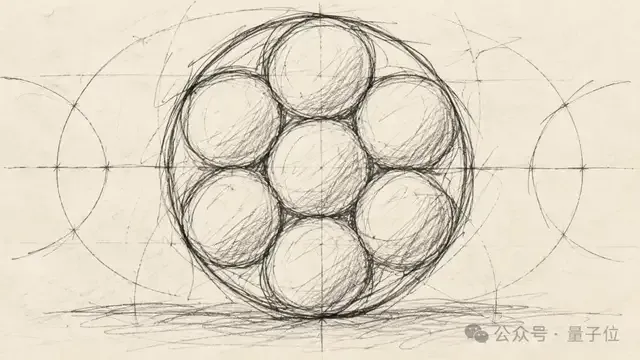
Given N disks of radius 1, how do you pack them into a larger circle such that the radius of the large circle is minimized?
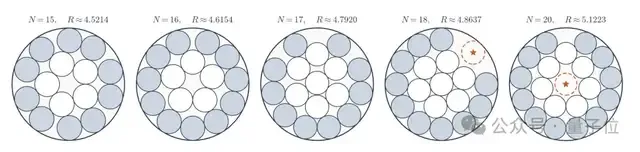
In fact, mathematicians did propose elegant packing arrangements as early as 1969. However... for 57 years, no one had been able to rigorously prove that those arrangements were optimal.
So this time, math enthusiast nor brought out GPT-6 Astra... and successfully provided rigorous proofs for five specific cases—N=15, 16, 17, 18, and 20—effectively covering all remaining cases where N≤20.
Previously, only the cases for N≤14 and N=19 had been verified.
Oh, by the way, reaching N=20 isn't AI's limit; it’s just that nor didn’t feel like proving further...

A Proof Stuck for Half a Century
Let’s formalize the problem mathematically.
Assume there are N disks, each with a radius of 1, and a large circle with radius R.
Requirements:
- All small disks must lie entirely within the large circle. They may be tangent to the boundary but cannot exceed it.
- No two small disks may overlap internally, though they are allowed to touch each other.
- The small disks can be moved and arranged arbitrarily within the large circle; there are no restrictions on the arrangement method.
The question is: For a given positive integer N, what is the minimum possible value for the large circle's radius R?
It looks like a standard Olympiad-style problem, but finding the optimal arrangement is only the first layer of difficulty. The real challenge lies in rigorously proving, mathematically, that the arrangement has reached its limit and that no better configuration exists.
In 1968, American mathematician Ronald Graham proved the cases for N≤7.
In 1969, researcher Udo Pirl extended the proof to 10 disks and further investigated arrangements for 11–19 disks.
However, it wasn't until around 2003 that the cases for N≤14 and N=19 were rigorously proven.
nor is a technical writer who has long studied mathematics, machine learning, and optimization algorithms, frequently participating in public discussions on AI-assisted mathematical research.
He first encountered this problem over a decade ago, and indeed, there had been little progress on it in the intervening years...
So, naturally, he threw it at GPT-6 Astra (just kidding).
nor proceeded step-by-step: first having GPT-6 Astra handle the case for N=15; once the model solved it, he asked it to generalize the same method to 16, 17, 18, and 20... GPT-6 Astra successfully produced proofs for all these cases.
But...
As usual, the proof process was obscure and difficult to follow.

Simply put, GPT-6 Astra’s core strategy was:
Instead of directly searching for the optimal solution, use geometric constraints to reduce infinite possible arrangements to a finite set of cases, then eliminate them one by one using computers, ultimately rigorously proving that the classical arrangements are already optimal.

The proof process consists of 5 steps:
- Push outer disks to the boundary. Prove that under specific conditions, disks near the outer circle can be moved outward without causing overlaps. This divides the disks into a group on the boundary and a group in the interior.
- Eliminate many arrangements using angular relationships. Since disks cannot overlap, they must maintain certain angular separations. If a particular arrangement requires an angle sum exceeding 360°, it can be immediately ruled out.
- Enumerate remaining possibilities via computer. Instead of searching for the exact coordinates of each disk, check the distance intervals from the center and the circumferential ordering of the disks.
- Prove exact optimality using geometric rigidity. The previous search proves that all feasible arrangements are very close to the known classical arrangements. Next, use contact constraints between disks to prove that these arrangements cannot undergo any valid infinitesimal deformation, thereby upgrading "very close" to "strictly identical." The case for 15 disks utilized a different odd-ring argument.
- Restore the original arrangement. Finally, prove that in the original arrangement, at least one disk must be touching the outer circle's boundary. This implies that it is impossible to fit all disks into a smaller outer circle, thus completing the proof of optimality.
It is worth emphasizing that nor didn't just give one prompt and have Astra bang out all the proofs instantly.
In his blog post, nor wrote that his contributions as a human included:
Determining the feasibility of the problem, guiding the model, battling with a buggy web UI, tolerating poor copywriting, fixing subtle issues, repeatedly refining explanations, manually verifying validity, and using Astra and Opus 5.5 to re-check everything.
One More Thing
Interestingly, when nor published the results, he discovered quite a few peers using AI to study the same problem.

Some netizens commented that AI breakthroughs have made mathematics more accessible, saying, "I didn't know there could be such a vibrant atmosphere of exploration in the field of mathematics."

From the perspective of math enthusiasts, this represents a new spirit of the "Mathematics 2.0" era.
Original Link:
[1]https://nor-blog.pages.dev/posts/2026-10-11-circle-in-circle-packing-15-20/
[2]https://x.com/norxornor/status/2109078411251454017
— End —