MolRSI Lets AI Rewrite Its Own Discovery Strategy, Lifting Wet-Lab Hit Rate 82%
The team introduces MolRSI, a recursive self-improving agent for molecular discovery that folds model choice, screening-rule composition and candidate prioritization into its search space, then iteratively refines its workflow using experience from prior tasks. In an antibacterial screen over roughly 12.1 million compounds, it reached a 15.9% wet-lab hit rate versus 8.7% for a human-expert-designed non-agentic workflow, a relative gain of about 82%; on de novo pMHC-binding protein design it produced 8 hits meeting specificity criteria versus 0 for a Claude Science baseline. The work extends the recursive self-improvement loop into a domain gated by wet-lab validation.
Full Report

MolRSI achieved 8 binding hits that met the experimental specificity criteria, compared with 0 for Claude Science.

Finding new antibacterial molecules requires simultaneously weighing antibacterial activity, cytotoxicity, and structural novelty among massive numbers of candidates. MolRSI autonomously optimizes this screening pipeline, achieving a wet-lab hit rate of 15.9%, compared with 8.7% for a previously human-expert-designed non-agentic workflow—a relative improvement of about 82%. Both used the same training data and a screening library of approximately 12.1 million compounds, with hits counted according to the same MSSA antibacterial criterion.
In molecular discovery, choices must be made about which model to use, how to combine screening criteria, and which candidates are worth sending to the lab. MolRSI incorporates these choices into its search and uses experience accumulated from past tasks to improve its strategy for the next round of selection and workflow optimization.
The research team also had MolRSI design binding proteins from scratch that can selectively recognize pMHC. pMHC consists of MHC molecules on the cell surface and the short peptides they present. The difficulty is that the target and non-target may share the same MHC and differ only at a few peptide residues. Patients' tumor antigens and HLA (human MHC) types may differ; binding proteins customized for the corresponding pMHC could potentially serve as recognition components for engineered immune cells, helping them identify the corresponding tumor cells for personalized cancer immunotherapy.
On the two pMHC targets in this study, MolRSI achieved 8 binding hits that met the experimental specificity criteria, compared with 0 for Claude Science. Both used the same design conditions and computational budget.
These two types of tasks raise the same question: What kind of pipeline did MolRSI actually optimize, and which choices did past search experience specifically change?

- Paper: MoLRSI: A Recursive Self-Improving AI agent for Molecular Discovery
- Paper link: https://arxiv.org/abs/2610.39714
- Project website: https://yikunpku.github.io/MolRSI/
Before Finding Molecules, First Learn How to Find Them
Faced with tens of millions of candidate molecules, researchers must first decide on a screening route: which model to use for predicting activity, how to control toxicity risk, and which candidates are worth sending to the lab. Different combinations of models, training methods, and screening rules lead research toward different molecules. Finding a good pipeline is itself a search problem.
MolRSI hands this problem to AI. The system organizes methods from papers and code, transforms them into executable skills verified through running, and then combines, tests, and modifies workflows. After each attempt, what is obtained is not just a score, but also under which conditions the pipeline is effective, which modification improved performance, and how to fix errors after they occur.
These records connect MolRSI's two loops. The inner loop optimizes the workflow for the current task; the outer loop carries accumulated experience into subsequent tasks to improve the search strategy. When a new task begins, the system can use this to choose a starting point, plan exploration directions, and leverage previously validated modifications and fixes.
Specifically, MolRSI uses experience-guided Monte Carlo tree search: each candidate workflow is a node, and modifications to it form new branches. Evaluations of the current task, historical performance on related tasks, and exploration of new proposals jointly influence where to go next. Plan memory, improvement memory, and execution memory respectively store pipeline performance, modification effects, and execution experience.
Search generates experience, experience changes the subsequent search policy, and new search brings new experience. MolRSI's recursive self-improvement thus occurs within the search process of scientific research workflows.
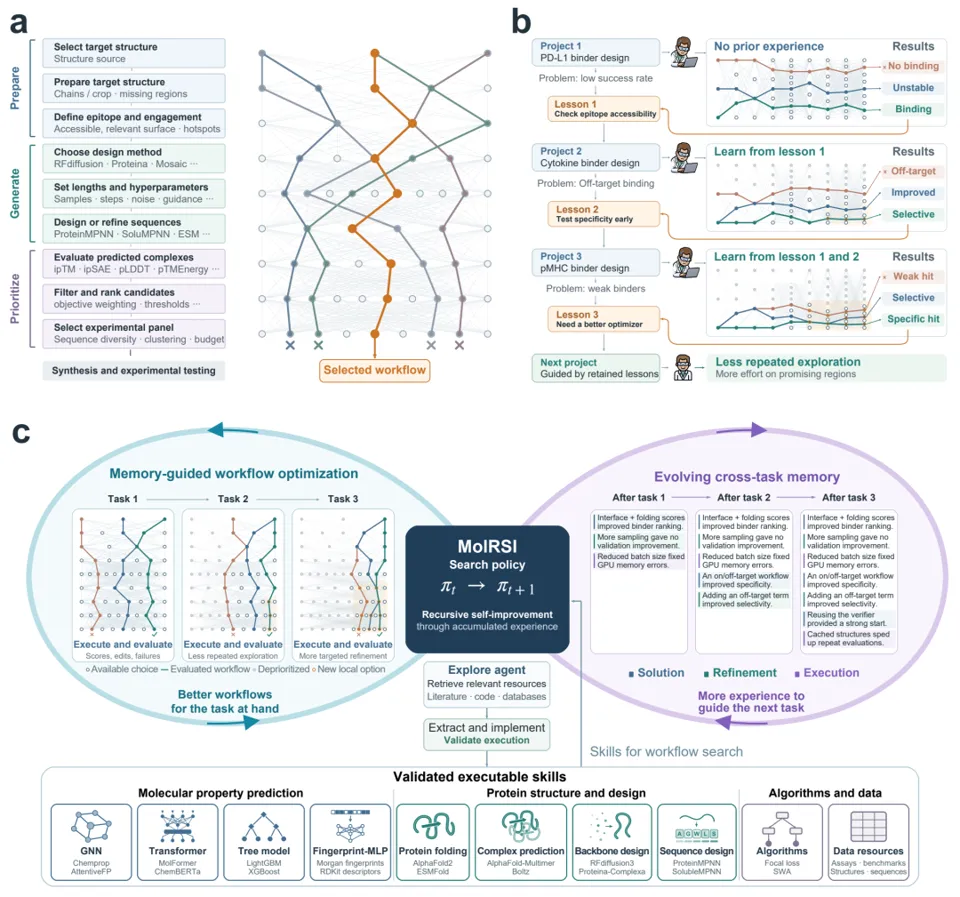
Figure 1 | MolRSI's dual loops. The inner loop searches and optimizes the current workflow, while the outer loop accumulates and reuses experience, influencing workflow selection, modification, and execution in subsequent tasks. Source: Paper Figure 1.
Starting with Experience
How Will the First Attempt Be Different?
After experience is stored, will the next search really be better? The team first had MolRSI accumulate experience on 25 molecular property prediction and cytotoxicity tasks, then placed it on 6 antibacterial prediction tasks that were not included in the source experience pool.
The control setup is straightforward: both groups used the same initial skill library, underlying model, and search budget, and both could utilize records generated in the current task; only one group could inherit experience from past tasks. As a result, after adding cross-task experience, the average test AUPRC improved on all 6 tasks. This metric measures the model's ability to rank active molecules at the top of the candidate list.
The value of experience becomes apparent right at the start of the search. In the E. coli and Neisseria gonorrhoeae tasks, the workflow first evaluated by MolRSI already surpassed the final pipelines selected by Biomni, STELLA, Codex, Claude Code, and Claude Science after 20 rounds of search each. Past search records gave new tasks a better starting point.
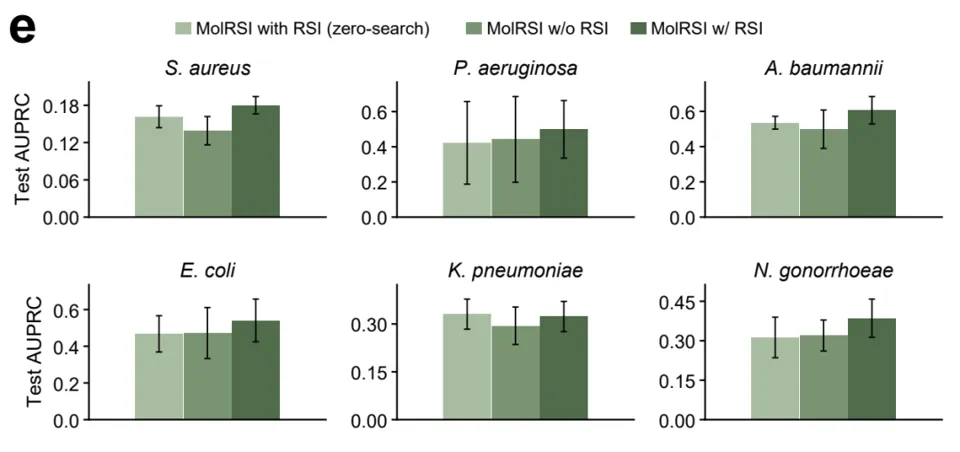
Figure 2 | Comparison with and without cross-task experience. Both groups retain memory updates within the current task; w/ RSI additionally inherits source task experience. zero-search directly transfers configurations and still requires model training and validation on the target task. Source: Paper Figure 2e.
What happens with further experience accumulation? The team gradually expanded the source task pool from 2 to 25 and retrospectively analyzed the workflows available for transfer to subsequent tasks. Their average test AUPRC on the 6 antibacterial tasks rose from about 0.32 to about 0.37, surpassing the 0.361 achieved by systematic search for 20 rounds without prior experience.
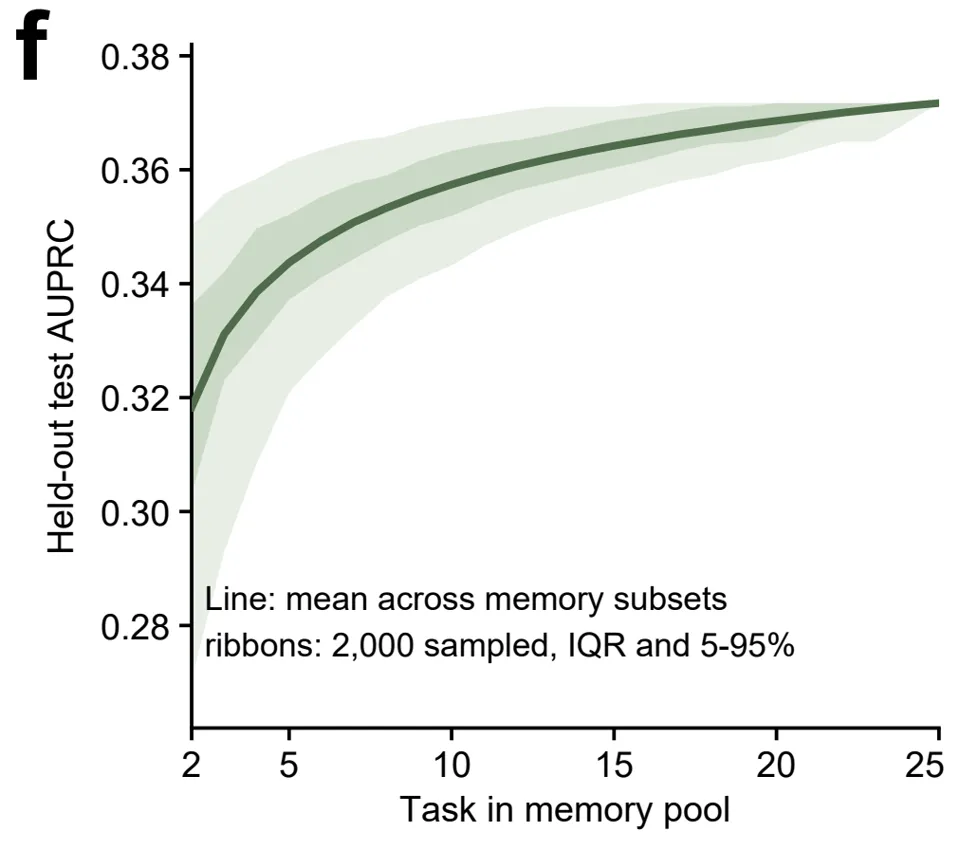
Figure 3 | The more source tasks there are, the better the transferable workflows perform. Solid lines show the retrospective average of transfer performance achievable by experience pools of each size; dark and light shading indicate the 25th–75th and 5th–95th percentile ranges of experience pool combinations. Source: Paper Figure 2f.
This retrospective analysis shows that more experience allows better workflows to enter the transferable method library.
From tens of millions of compounds,
screen out candidates worth experimenting on
Improved scores on benchmarks ultimately must answer a practical question: can such workflows enable limited experimental opportunities to find more active molecules?
In the antibacterial discovery task, what screening pipeline did MolRSI optimize? It first performs structural novelty filtering, removing specified common antibiotic scaffolds and candidates too similar to known antibiotics, then predicts toxicity against three types of human cells. For activity ranking, it adopts two MiniMol schemes and a LANTERN–RADR ensemble, combining predictions with weights of 55%, 30%, and 15%.
After ranking, the system clusters structurally similar molecules into groups, then selects candidates from different groups to preserve chemical diversity. The final pipeline connects the model ensemble, screening order, and sampling method, selecting 107 compounds from approximately 12.1 million for experiments, yielding 17 hits.
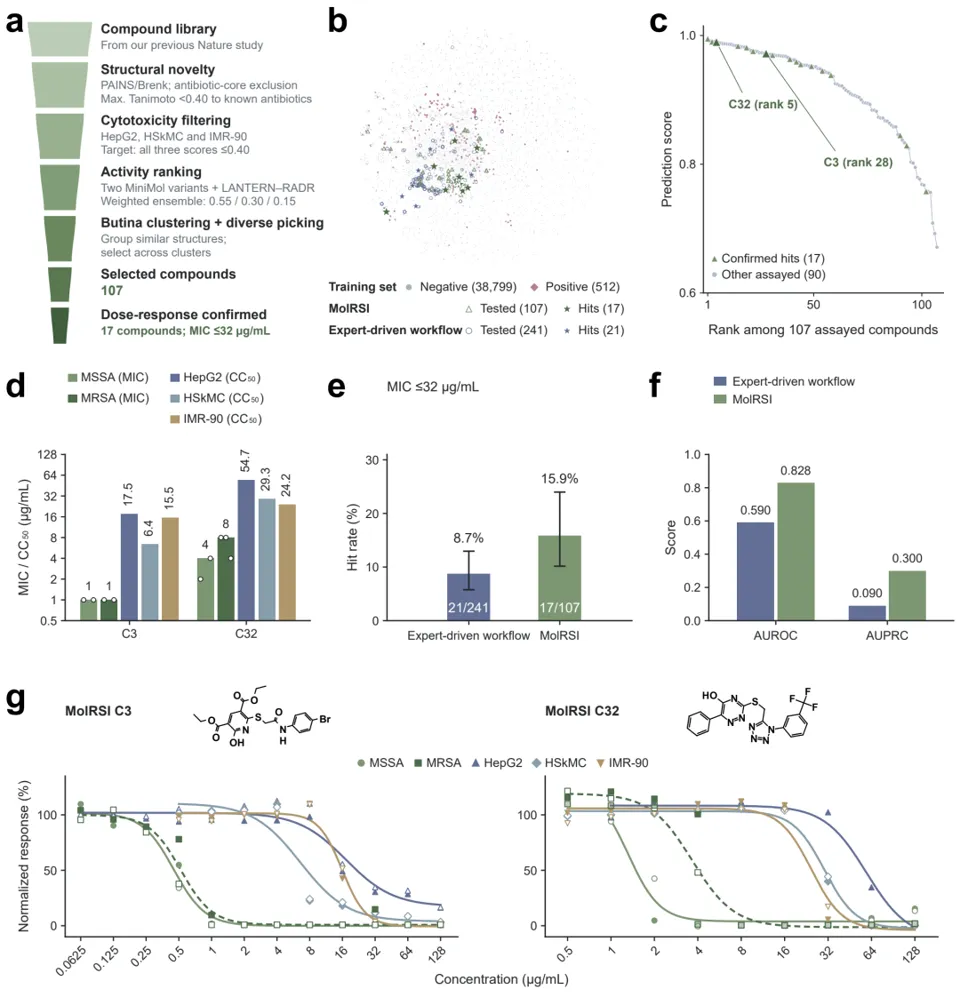
Figure 4 | Comparison of MolRSI with a non-agentic workflow designed by human experts. Hit rates are 17/107 and 21/241, both defining hits as MSSA MIC ≤ 32 μg/mL; MRSA activity of C3 and C32 was measured separately. Source: Paper Figure 3.
Compared with the previously human-expert-designed non-agentic workflow, both use the same training data and screening library, and count hits by the same threshold: minimum inhibitory concentration (MIC) against methicillin-susceptible Staphylococcus aureus (MSSA) not exceeding 32 μg/mL. The expert pipeline tested 241 compounds and hit 21; MolRSI tested 107 and hit 17. The experimental hit rate thus rose from 8.7% to 15.9%, a relative improvement of approximately 82%.
The same set of 271 independent test compounds provided another comparison: MolRSI's antibacterial activity predictor outperformed the predictor in the expert workflow on both AUROC and AUPRC. Among them, AUPRC increased from 0.090 to 0.300. This comparison uses the same test set; the aforementioned hit rates come from the experimental candidates each pipeline selected.
The team also performed further testing on representative molecules. The MICs of C3 and C32 against methicillin-resistant Staphylococcus aureus (MRSA) were 1 and 8 μg/mL, respectively; in three types of human cells, the half-cytotoxic concentrations of both were higher than the corresponding MRSA inhibitory concentrations. Dose-response curves grounded the screening predictions in the molecules' actual activity performance.
Designing binding proteins
also requires distinguishing the target
The starting point of the antibacterial task was a ready-made compound library. Another independent validation route required AI to design pMHC-binding proteins from scratch and to make them discriminate between similar targets.
pMHC can be understood as a short-peptide display platform on the cell surface: MHC holds a peptide and presents it. Two targets may share the same MHC framework and differ only in a few exposed residues of the peptide. A candidate that appears to bind well may also primarily recognize the shared framework. Therefore, the pipeline must not only judge whether a credible binding can form, but also check whether the candidate still receives equally high evaluation after swapping in a different peptide.
MolRSI first accumulated experience from 14 small-protein binder ranking tasks, then used two sets of gp100 data to develop the pMHC ranking pipeline, leaving MART-1 as an independent test. With prior experience, the enrichment factors of the top 1% and top 2% candidates reached 3.65 and 5.55, respectively; without this experience, both were 0.
This search left behind a concrete evaluation pipeline: ESMFold2-Fast structure prediction plus eight equally weighted scoring items. The eight metrics cover interface contacts, complex and interface confidence, monomer folding confidence, and helical structural features; they are first unified to a "larger is better" direction, then summed to obtain the ranking basis. What MolRSI searches and selects is the combination of predictive models and scoring items.
Selectivity is then implemented in the final screening through paired comparisons between target and non-target. In the pre-specified pairs of the study, the same binder is evaluated against two pMHCs: the MHC framework remains the same, and only the presented peptide is swapped. Candidates must satisfy that the target score is higher than the non-target score and pass thresholds such as interface confidence and monomer folding quality, after which they are ranked by target score. In this way, target binding quality and the ability to discriminate against similar non-targets become conditions that must be considered simultaneously.
With the ranking pipeline in place, MolRSI fixes it and separately searches generation methods and configurations for MART-1 and SARS-CoV-1. Each scheme sequentially undergoes backbone generation, peptide hotspot contact filtering, SolubleMPNN sequence design, and scoring, with schemes evaluated by the average score of the top 5% candidates. After 30 rounds of search, the three highest-scoring workflows each scale up generation, then merge, deduplicate, and screen candidates. Developing the evaluation method first, then using the fixed evaluation method to optimize generation, constitutes the main thread of this design pipeline.
In the prospective design phase, MolRSI and Claude Science used the same target and non-target settings, design constraints, and computational budget, each running its own workflow. After two rounds of phage display screening, MolRSI obtained 5 specific binding hits among 251 evaluable MART-1 designs and 3 among 266 SARS-CoV-1 designs; Claude Science's corresponding results were 0/288 and 0/267. Across both target types combined, specific binding hits were 8 versus 0.
The experimental criterion here is target enrichment log₂FC > 4, and higher than the highest enrichment value among all measurable non-targets for that design. It tests binding preference relative to the measured non-targets, a different quantity from the preceding computational scores; quantitative affinity and broader cross-reactivity still require subsequent measurement.
Does candidate ranking actually help? After removing MolRSI's ranking step, among 479 evaluable designs across both targets combined, none satisfied the same specific hit criterion. This control supports the contribution of candidate ranking to the experimental hits in this study: after generation, how to judge which designs are worth sending to experiments is a key step in the pipeline.
The predicted complex structures of representative hits also show that the binder sits above the exposed peptide and may form contacts with multiple peptide residues. This is consistent with the design goal of identifying peptide differences and provides an intuitive clue for readers to understand selectivity; the role of specific contacts still requires structural and functional experimental validation.
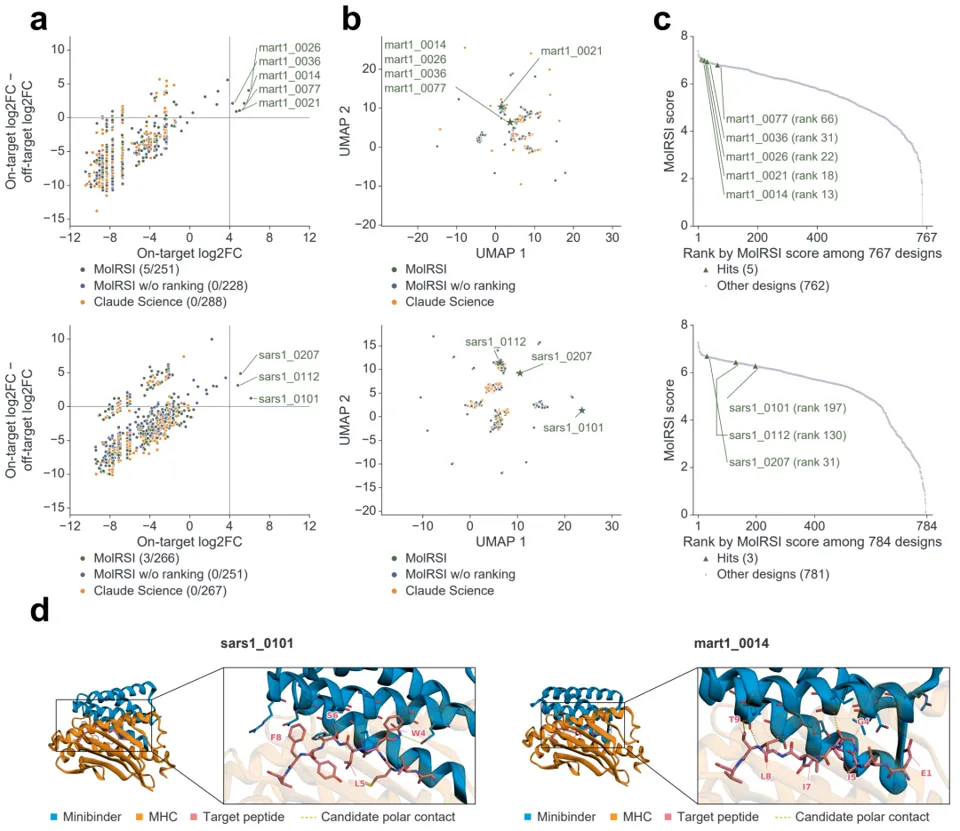
Figure 5 | Experimental validation of two classes of pMHC targets, MART-1 and SARS-CoV-1. Counts are "specific binding hits / evaluable designs"; the scatter plot shows target enrichment and its difference relative to non-targets, with predicted complex structures below. Source: Figure 5 of the paper.
After a single study concludes, MolRSI leaves behind candidates that enter experimental validation, as well as workflows and search experience that can be reused for the next task. Current strategy improvements mainly come from computational search, and future work can further incorporate wet-lab feedback. Enabling one study to provide a better search starting point for the next is precisely the motivation behind this work.
© THE END
For reprints, please contact this official account for authorization.
Submissions or story inquiries: [email protected]