RoboChallenge Zero Debuts Real-Robot Benchmark for 11 Multimodal Models
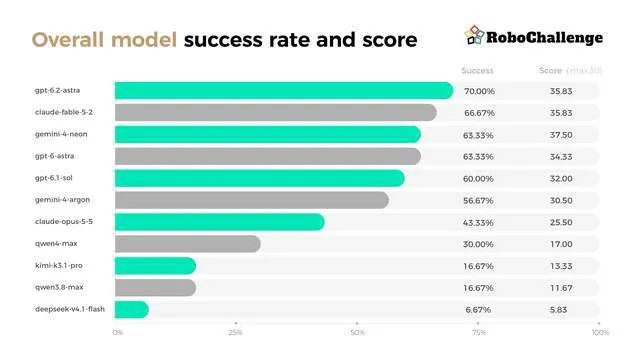
RoboChallenge released RoboChallenge Zero, a real-robot zero-shot benchmark that plugged 11 multimodal large models into a unified control interface across two robot platforms, running 330 trials on six tasks. Overall success rate was 44.85%, with the best model at 70%; coarse pick-and-place was reliable, while deformable-object and long-horizon tasks nearly all failed, and successful runs averaged over 13 minutes, showing general models remain far from reliable, efficient physical manipulation.
Related Entities
Full Report
Contents5 sections
RoboChallenge officially releases a new evaluation benchmark, RoboChallenge Zero, aiming to test models' embodied zero-shot capabilities through real robot tasks, and simultaneously publishes the evaluation results of the first batch of 11 multimodal large models across 6 tasks and 330 real-robot tests.
As general-purpose multimodal large models continue to improve in embodied-related evaluations, a discussion has begun to emerge in the industry: Will general large models replace specialized embodied models and directly take on robot understanding, decision-making, and manipulation? To discuss this possibility, we must first answer a concrete question: when a large model is connected to a real robot and faces actual objects, spaces, and contact relationships, to what extent can it complete tasks? To this end, we introduce the real-robot zero-shot evaluation benchmark RoboChallenge Zero, which tests the embodied capabilities of large models by testing robots.
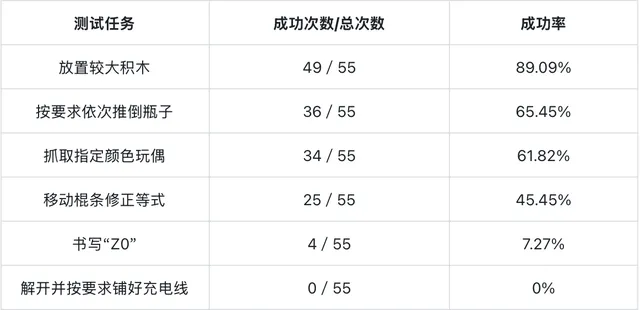
In the first evaluation round, we connected 11 multimodal large models to a unified robot control interface and conducted 6 manipulation tasks on two types of real robot platforms, completing a total of 330 independent tests. The results show an overall success rate of 44.85%, with the best-performing model reaching a success rate of 70.00%. However, there are significant differences across tasks: the success rate for placing larger blocks was 89.09%, while writing "Z0" was only 7.27%, and in the 55 tests of "untying and laying out the charging cable as required," not a single complete success was achieved. Execution efficiency is equally noteworthy. Even when block placement and doll grasping were successfully completed, they took an average of about 13–14 minutes; the 4 successful writing tasks took an average of 23.8 minutes. These results indicate that general large models can already support some real robot operations, but there is still a clear gap from understanding tasks and planning actions to reliably and efficiently completing physical operations.
Testing Large Models by Testing Robots
In RoboChallenge Zero, we treat robot tasks as exam questions, putting large models into a real perception–reasoning–action loop. At each step of operation, the model receives camera images and robot state, and may obtain additional information such as depth and torque, specifying the target pose of the robotic arm end-effector and gripper commands through tool calls. After the controller executes the motion, new observations are returned to the model, which decides the next action. We use whether the robot fully achieves the task goal as the primary evaluation criterion, while separately recording partial progress to distinguish "getting one step right" from "completing the entire task." The 11 models in this round used the same prompt template and tool interface, and each model underwent 5 independent tests per task. Between tests, the robot and scene were reset, and system performance was observed through multiple real executions.
Basic Grasping and Placing Performs Well, Complex Operations Clearly Limited
The first 6 tasks cover target recognition, sequential execution, mathematical reasoning, continuous trajectories, and deformable object manipulation.
Placing larger blocks was the most stable task, with 7 of the 11 models succeeding in all 5 tests. This indicates that, under the conditions of this test, recognizing targets and completing relatively coarse-grained grasping and placing is already within the capability range of most tested systems. The equation correction task demonstrated how reasoning ability helps in selecting manipulation targets. Faced with "6+4=4," the model needed to move one stick to make the equation valid. In the tests, different models found different solutions: moving the vertical stick in the plus sign to obtain "8-4=4"; or moving the horizontal stick in the middle of the digit 6 to obtain "0+4=4."
However, when tasks required precise, continuous motion and judgment of changes in object form, success rates dropped significantly. Writing "Z0" required the system to translate character requirements into continuous and spatially accurate motion trajectories. Of 55 tests, only 4 succeeded, from GPT-6.2 Astra, Claude Fable 5.2, and Gemini 4 Neon respectively. Knowing what to write is not enough to guarantee that the robotic arm can write it accurately.
The task of untying the data cable was even more difficult, as the system needed to judge the cable's crossing structure, choose the correct grasping position, and assess the changes after pulling. A seemingly reasonable pull might fail to loosen the knot and instead tighten it further; after each operation, the system also needed to re-judge the cable's state. Among the 55 tests, one execution driven by Gemini 4 Neon successfully untied the knot but did not straighten it as required, thus earning 7 progress points and not being counted as a complete success.
This indicates that current systems can make progress in some complex tasks, but continuously organizing this progress and stably completing all goals remains difficult. In the first leaderboard, GPT-6.2 Astra completed 21 of 30 tests, ranking first with a 70.00% success rate; Claude Fable 5.2 completed 20, ranking second with 66.67%. Even the leading models did not maintain an advantage on all tasks. The distribution of performance across different tasks presents the boundaries of current capabilities more concretely than a single ranking.
Beyond Completing Tasks, Speed and Reasoning Overhead Also Matter
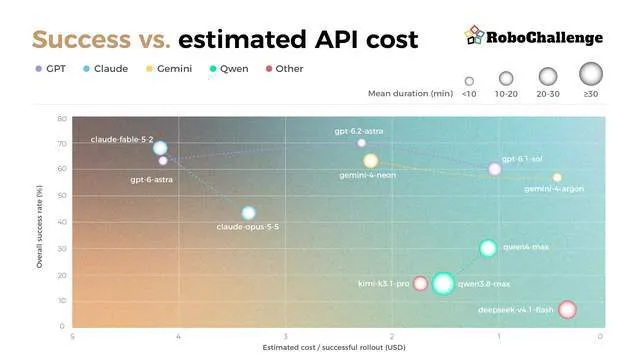
Robots in real scenarios need to balance success rate, cycle time, and resource investment during continuous operation. A task ultimately succeeding answers only part of the question. The first round of tests showed that successfully completing larger block placement and doll grasping took an average of about 13–14 minutes, with average token consumption of about 480,000 and 518,000 respectively. For the writing task, the 4 successful executions took an average of 23.8 minutes, consumed an average of about 1,735,600 tokens, and involved 43.8 model calls, approaching the upper limit of 50 calls for dual-arm tasks. In these tasks, the system gradually approached the goal through multiple rounds of observation, reasoning, and action correction. More reasoning loops can help the system attempt error correction, but they also mean longer execution processes and greater resource consumption.
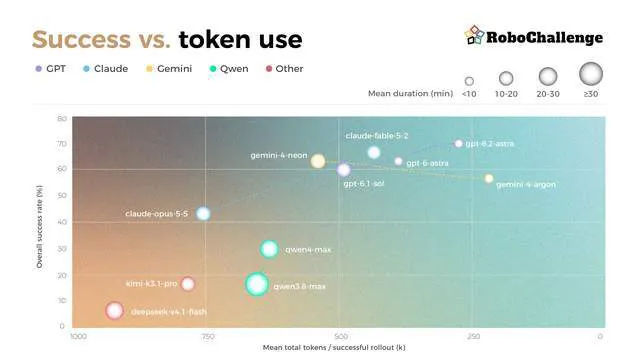
For applications requiring high cycle rates and repetitive operations, completing actions promptly and stably is itself part of the capability requirement. Therefore, we also report success rate, execution time, and number of model calls, and present reasoning overhead combined with token consumption and API cost estimates. The execution time here reflects the complete task process under this configuration; pricing methods and the composition of successful tasks also differ across models, so the related results need to be understood in the context of specific tasks. Together, these metrics answer: whether the system can complete the task, and how much time and resources are required to complete it.
From Understanding to Action, Where Exactly Does the Gap Appear?
In real-device testing, we observed that large language models still have shortcomings in fine-grained perception, spatial judgment, and action correction: the model may misjudge whether a bottle is high or low, choose the wrong grasp position for a charging cable, collide during motion, or fail to adjust its actions in time as the object's state changes. These phenomena show that improvements in general model capabilities bring more possibilities to robots; whether these capabilities can be translated into reliable and efficient manipulation still needs to be verified item by item on real devices.
Continuously Updated, So Evaluation Keeps Pace with Capability Progress
We will introduce new tasks every month and adjust the objects, layouts, and instructions of existing tasks, continuously testing the system's zero-shot capabilities under the conditions of no task demonstrations, no task-specific training, and no human guidance. RoboChallenge Zero has opened submissions for native VLA models, and we welcome more models and systems to participate, so that together we can examine the real progress of embodied capabilities under unified task objectives and success criteria.
This article is provided by RoboChallenge. QbitAI is authorized to repost it, and the views belong to the original author.