Rohan Paul (@rohanpaul_ai) · 10/21/2026, 04:06:23
Meta Paper Reveals Timing, Not Content, Is Key Bottleneck for Proactive Assistants
A new Meta study identifies that proactive AI assistants fail primarily due to poor timing judgment rather than content generation. Using the ProPerMem benchmark with long-term memory and distractors, researchers found that while frontier models perform well with oracle evidence, their accuracy plummets when autonomously deciding when to intervene. The work highlights that precise timing and sparse firing are critical for practical proactive agents.
SOURCE COVERAGEFull Original Report
Rohan Paul (@rohanpaul_ai) · 2026-10-20 20
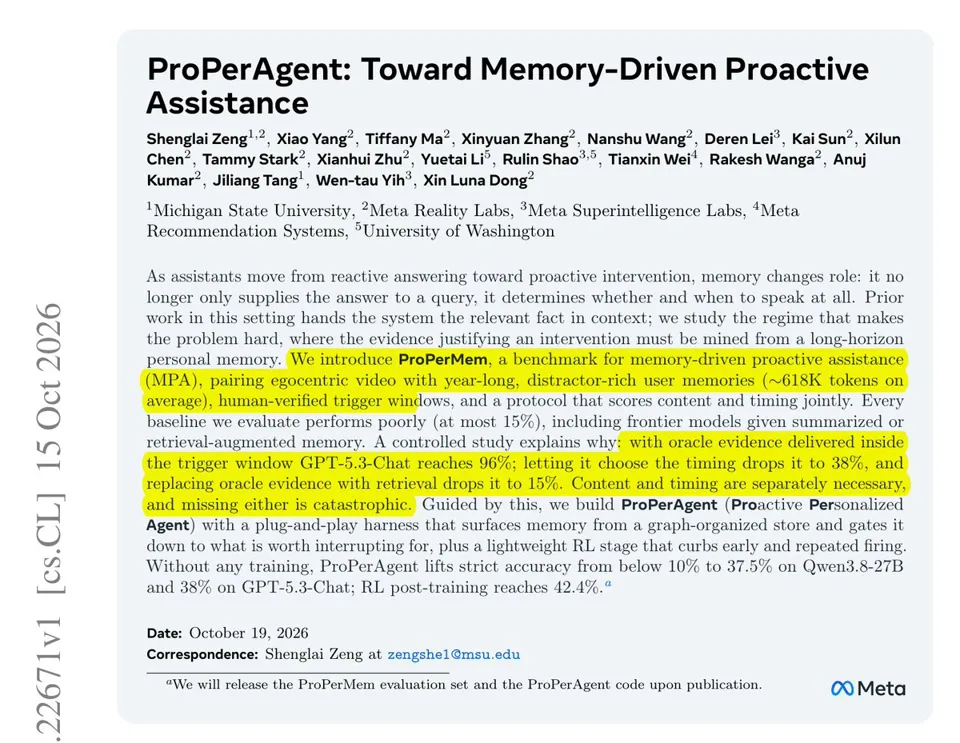
New Meta paper shows that deciding on its own when to interrupt, not just what to say, is where proactive assistants fail.
Proactive assistants, like AI glasses, get no query. They must decide when to speak and what to say by finding the justifying fact in a year of personal memory, not handed to them.
They built ProPerMem: egocentric video paired with a distractor-rich, year-long memory averaging 618K tokens, with human-verified trigger windows. A clip counts only if the assistant speaks just when due inside the window with grounded content.
Every baseline scored at most 15%, even frontier models with retrieval-augmented memory. With oracle evidence in the window GPT-5.3-Chat reached 96%, but choosing its own timing dropped it to 38%, and using retrieval dropped it to 15%.
For proactive assistants, get both the content and the timing right and fire sparingly, which lifted accuracy from below 10% to 42.4%.