Hacker News AI · 2026/10/21 07:55:03
Gamow Labs 发布 LabRobotBench 评估湿实验室机器人智能体
Gamow Labs 推出 LabRobotBench v0.1,这是一个专门用于评估前沿 AI 模型在湿实验室环境中操作机器人能力的基准测试。该基准通过模拟物理机器人的命令接口,重点测试智能体在处理复杂生物工作流程、空间推理以及从设备故障中自主恢复的能力,旨在提升实验吞吐量并减少人工干预。
报道全文原始报道全文
本文目录15 个章节
Gamow Labs builds frontier AI systems to interpret the human genome. We’re building an agent-operated lab to accelerate that work.
Our in-silico simulation mirrors the command interfaces of our physical robots, allowing us to develop and evaluate agents that can run experiments and recover from equipment failures.
When a robot encounters an error, an experiment can stall until a person steps in. Agents that can diagnose the problem and safely resume work could keep experiments running overnight, reduce downtime, and let scientists run more experiments at once. This is what we’re building at Gamow Labs: accelerating human progress by using agents to increase experimental throughput.
To address this challenge, we present LabRobotBench. Its evaluations test how frontier AI models reason about physical space and complex biological workflows to troubleshoot and carry out wet-lab experiments.
Results · Cell assay recovery · Assays and cold stocks · Dose-response recovery · Partner with us
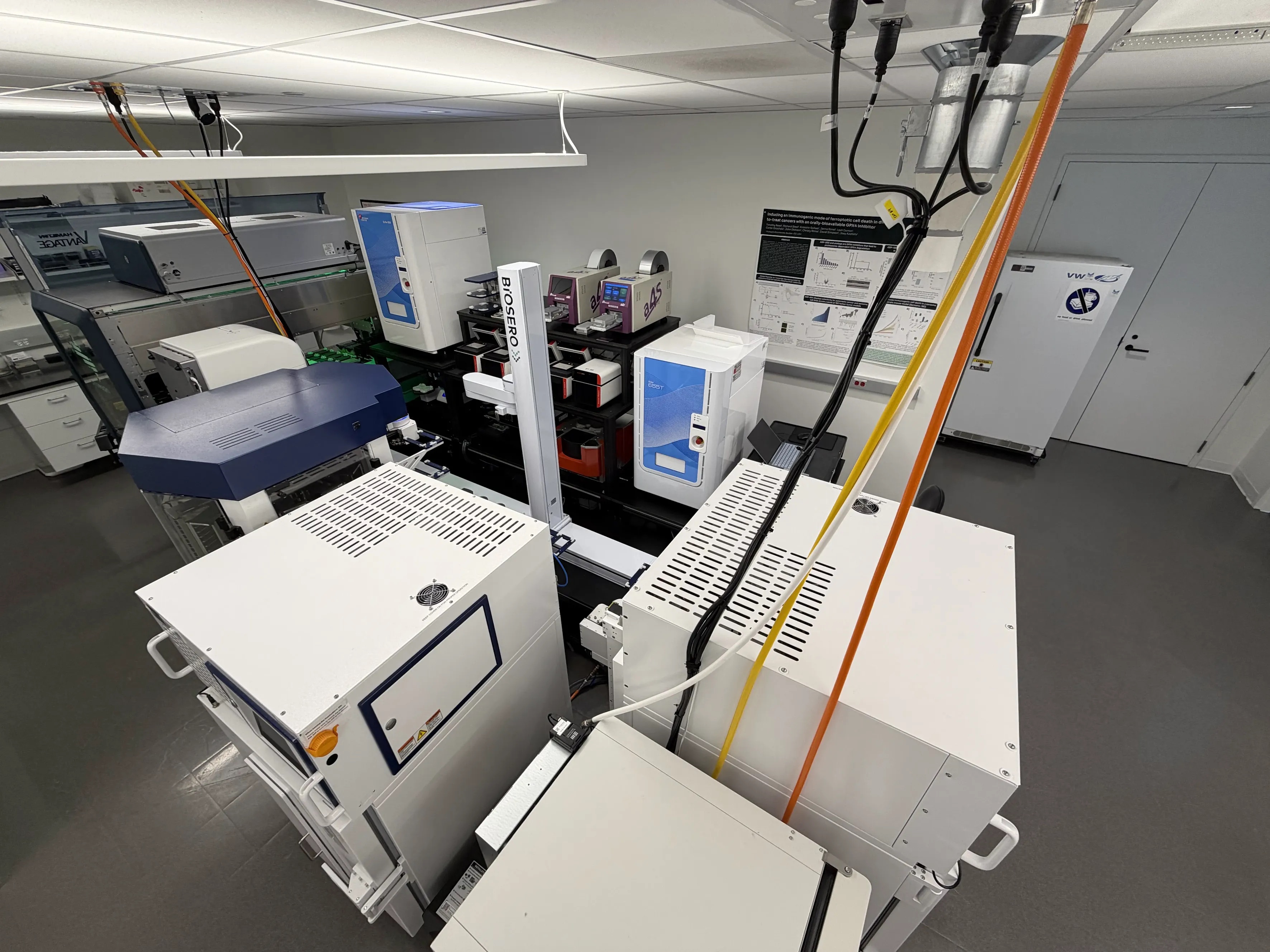
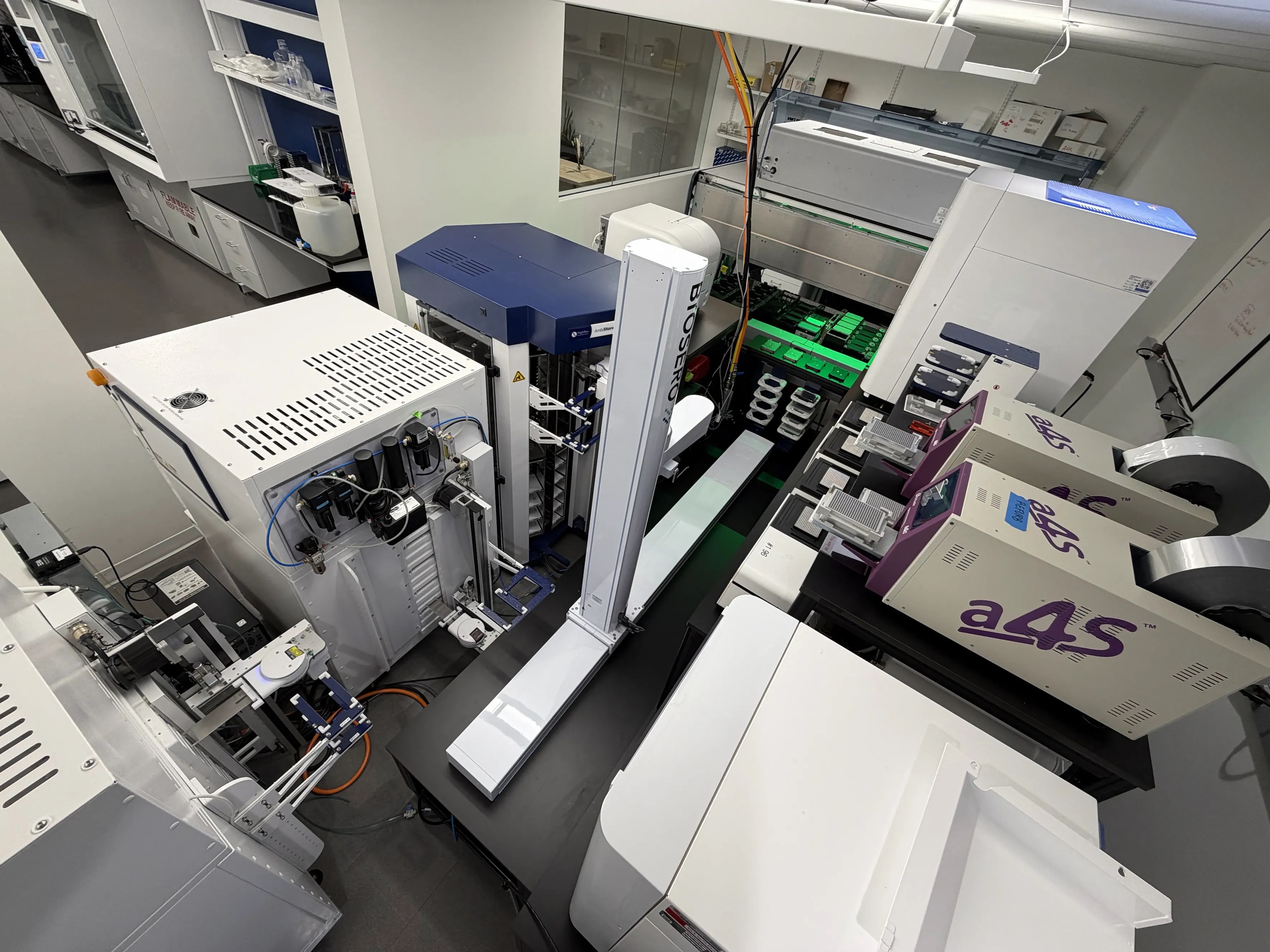 The robotic wet lab at Gamow Labs. 01 / RECOVERING INTERRUPTED EXPERIMENTS
Results
How much of the required physical workflow does each agent recover?
Mean score across our held-out subset
0%25%50%75%100%
- GPT 6.1 SolCodex46.7%
- Opus 5.5Claude Code23.0%
- Gemini 4 ArgonGemini CLI20.9%
CASE 01 · Recovering an interrupted cell assay
Finishing an interrupted experiment
A robot stopped halfway through an experiment involving four trays of cells. Three could still be tested. The agent needed to finish preparing them, measure the results, and put them away. The fourth was already spoiled and needed to be set aside.
What the agent needed to do
Each tray was at a different step when the robot stopped. The agent had to work out which steps were already done, then finish washing the cells, add a chemical used to measure cell activity, and run the measuring instrument. It also needed to save the results and return each tray with its lid. Repeating a chemical treatment could ruin a sample.
Why it matters in a wet lab
A tray can be safely back on its shelf while the experiment is still unfinished. The important question is whether the cells received the right treatment and were measured in time.
Opus puts an unfinished assay back on the shelf.
Watch Opus put the yellow-labeled tray back on the shelf. Its cells have been washed, but the agent never adds the chemical needed for the test or measures the result. The tray is put away; the experiment is left unfinished.
CASE 02 · Rescuing assays and cold stocks
The cost of choosing what to save first
The agent had several jobs competing for its attention: finish two experiments, set aside one spoiled sample, return two trays of supplies to cold storage, and leave a comparison sample untouched. Some of these jobs had only a few minutes left.
What the agent needed to do
One experiment needed its next chemical addition finished within 200 seconds. The cold supplies could spend no more than 240 seconds outside storage. Because the same robot moved all the trays, the agent had to choose what to handle first.
Why it matters in a wet lab
In a lab, helping one sample can mean leaving another waiting. An agent needs to keep track of both deadlines and choose an order that protects the materials.
The agents chose different priorities.
GPT gets both trays of cold supplies back in time but fails to finish one experiment. Opus finishes both experiments, but leaves both trays of supplies out too long.
Cold supplies return to storage too late.
Watch Gemini carry the red-labeled tray to the cold-storage machine. By the time the tray is stored inside, it has spent about 422 seconds outside—well past the 240-second limit. The robot moves it successfully, but too late to satisfy the task.
CASE 03 · Finishing a time-sensitive dose-response assay
A completed read can still be too late
This experiment tests how cells respond to different amounts of a chemical. The agent needed to finish testing two trays of cells and set aside a third that was already spoiled. One tray was close to its measurement deadline.
What the agent needed to do
The agent was expected to finish an experiment within a fixed timeframe. After the cells were treated with the test chemical, it had 30 minutes to complete a measurement of their response. It needed to check which steps were already done, finish preparing the samples, and leave enough time for the measuring instrument to run.
Why it matters in a wet lab
Timing requirements like this are common in live biology experiments, where a sample’s response can change after treatment. Taking measurements at the required time helps scientists compare results across samples. The agent therefore needs to plan around the experiment’s timing, as well as operate the equipment.
GPT collects a result that missed the deadline.
Watch GPT take the tray out of the measuring instrument. The machine has finished, but its measurement ended 42.5 seconds after the deadline. The robot carries on normally, and the agent later reports the test as completed.
Partner with us
Build the future of experimental biology.
At Gamow Labs, we work at the frontier of AI and wet-lab biology to better understand rare diseases. We’re building agents that can operate robotic laboratories and help scientists uncover how genetic changes cause disease.
If you’re developing frontier models, building laboratory automation, or looking to expand your experimental capabilities, we’d love to work with you.