The Decoder · 2026/10/15 03:18:44
Google DeepMind 工程师披露:AI 自主研究未现加速,复杂任务仍依赖人类监督
Google DeepMind 工程师 Haydn Belfield 指出,尽管 AI 已生成超过 75% 的生产代码,但并未观察到由 AI 驱动的 AI 研究出现可测量的加速。数据显示,随着任务复杂度增加,智能体在无人干预下的成功率急剧下降,且 88% 的代码变更仍需人工审查,表明创造性研究与长期规划仍高度依赖人类。
报道全文原始报道全文
Google engineer Haydn Belfield says self-improving AI remains far off, even as significant automation is already taking hold.
Google Deepmind has seen no measurable acceleration of AI research driven by AI itself, according to Belfield. That doesn't mean significant automation isn't happening already: AI now writes more than 75 percent of production code. But about 88 percent of code changes still need human oversight or review, and every change is reviewed by a human before submission, according to Belfield. The share of code changes fully delegated to AI rose from 7.5 to 11.9 percent.
The more complex and time-consuming a task gets, the less likely AI is to handle it on its own. Across 1,389 internal Argon agent runs, the success rate without human input dropped sharply as complexity increased. Humans remain essential for creative research, novel experiment design, diagnosing subtle training instabilities, and long-term planning, Belfield said. A survey of twelve senior Deepmind researchers confirmed the pattern, with automation running highest for well-defined, verifiable tasks and lowest for open-ended scientific ideation.
On Deepmind's in-house benchmark RE-Bench, which includes 74 realistic ML engineering tasks, Argon solves about half of them. That's a big jump from Gemini 3.7 Flash at 27 percent, but it's still far from the near-perfect performance full automation would require.
Google's own capability index shows no speedup in AI research
To track progress systematically, the team built a General Capability Index (GCI) covering 123 models and 92 benchmarks. Gemini model capabilities are growing at a steady pace of about 0.1 GCI points per month, with no significant change in speed. The team attributes Gemini 4 Argon sitting slightly above the trend line to more compute and organizational investment rather than AI-driven acceleration.
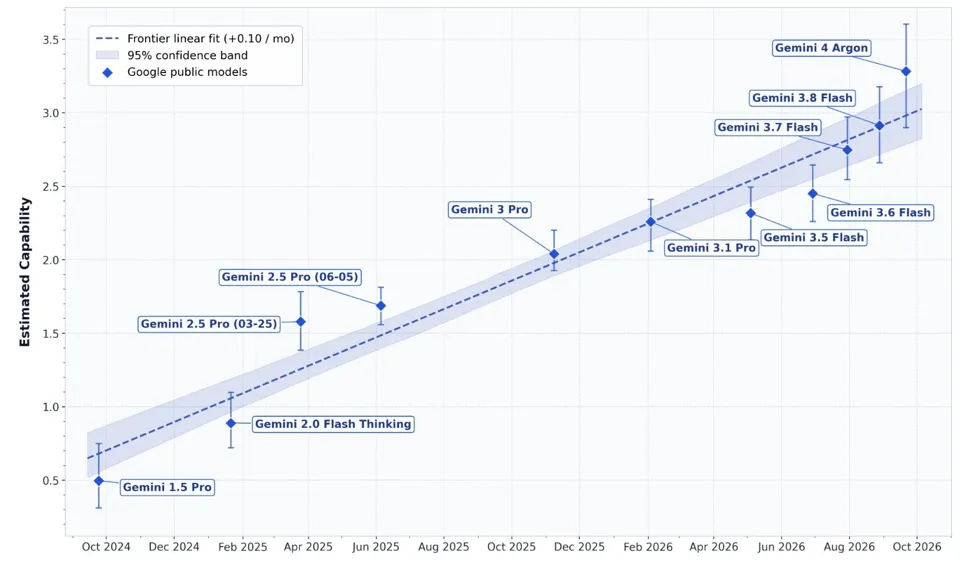
The General Capability Index (GCI v1) shows steady growth in Gemini capabilities with no statistically significant acceleration. | Image: Haydn Belfield / Google Deepmind
The team currently rates the risk from AI-driven research automation as low but is building the measurement infrastructure to track signs of acceleration going forward.
Belfield's findings align withrecent research, but not everyone in the field agrees. More than 20 AI researchers, including Geoffrey Hinton, Yoshua Bengio, and OpenAI's Jakub Pachocki, recently warned of a possible "intelligence explosion" in a research paper. They argued that AI systems could automate all AI research and development within a few years, compressing what would normally be years of progress into just months.