Google Launches Gemini 4 Carbon for Cybersecurity and Long-Horizon Tasks
Google has released Gemini 4 Carbon, ranking first on the Artificial Analysis Intelligence Index v5.0. The model focuses on enhanced cybersecurity capabilities (vulnerability discovery/patching) and long-horizon agentic workflows, while significantly reducing over-execution rates and resisting prompt injection attacks. It is currently available via a restricted pilot program for security defenders.
Full Report
IT Home reported on October 29 that Google has officially released its next-generation frontier large model, Gemini 4 Carbon, which focuses on industry-leading cybersecurity capabilities and long-horizon task processing.
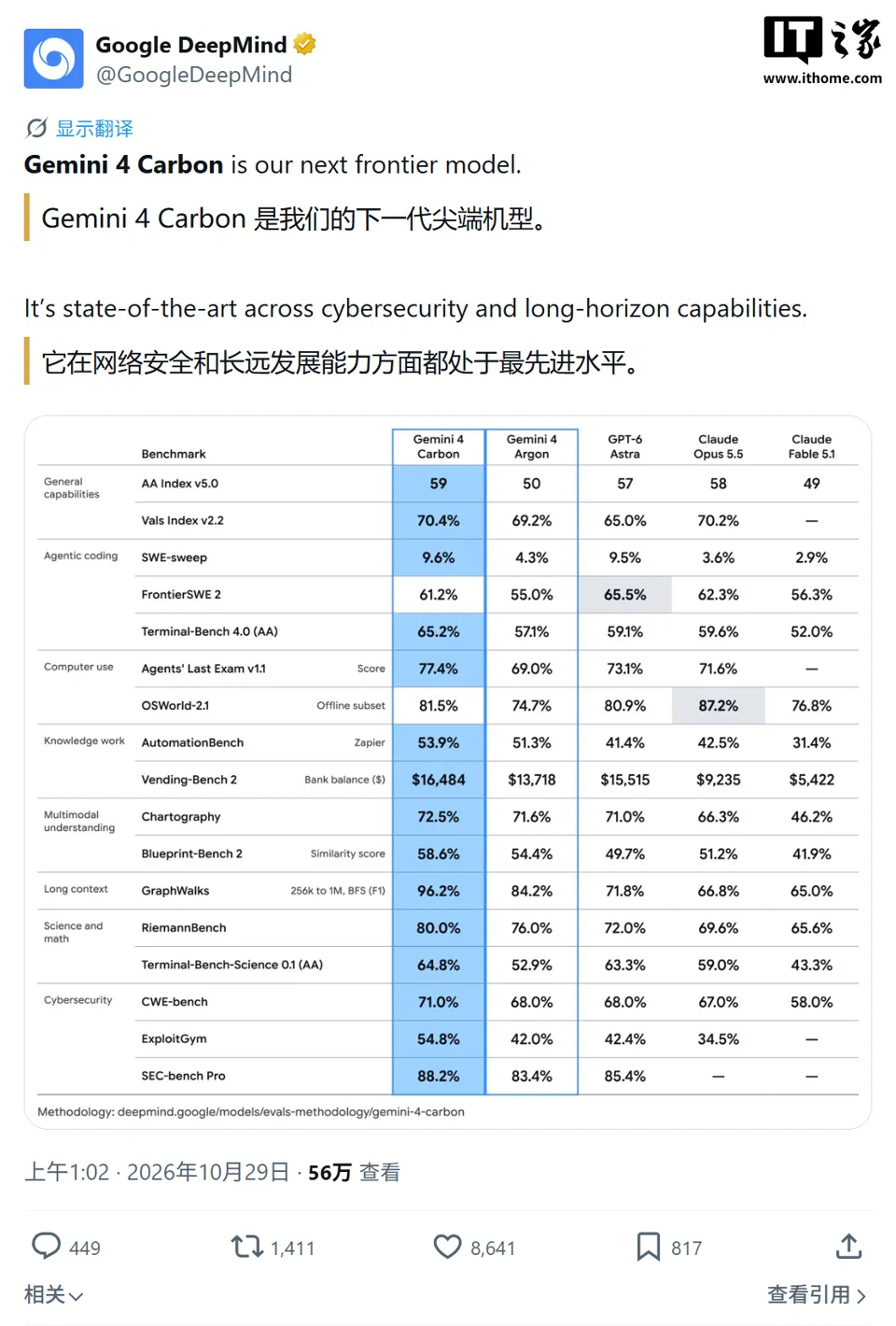
Google describes it as the most powerful model to date, with significant enhancements in cybersecurity and the ability to handle complex, long-cycle tasks. The model ranks first in the latest Artificial Analysis Intelligence Index v5.0, with a composite score of 59.
The initial entry-level pricing for Gemini 4 Carbon matches that of Gemini 4 Argon, released two weeks ago. Cached input tokens receive a 95% discount off the standard input price.
- Input: $2 per million tokens (Note from IT Home: approx. 13.3 CNY at current exchange rates)
- Output: $10 per million tokens (approx. 66.7 CNY at current exchange rates)
After the introductory period ends, regular pricing will apply:
- Input: $4 per million tokens (approx. 26.7 CNY at current exchange rates)
- Output: $20 per million tokens (approx. 133.3 CNY at current exchange rates)
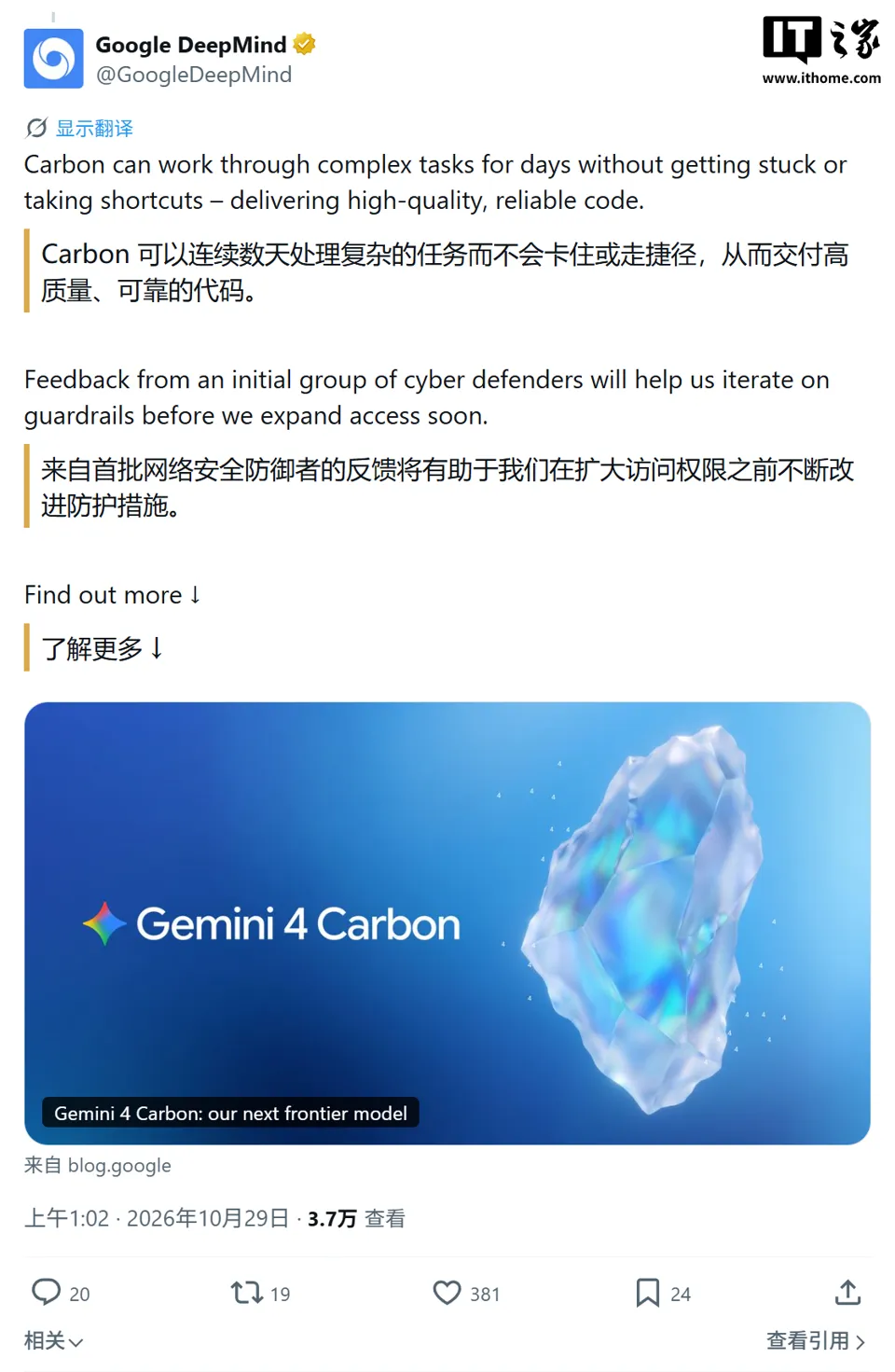
For long-horizon programming tasks, Carbon is designed for high-difficulty agentic workflows that require continuous operation over several days. It can autonomously navigate dead ends, perform root cause analysis on large codebases and underlying systems, and write vulnerability patches for complex multi-step engineering tasks.
On the WebDev Arena full-stack frontend development leaderboard, Carbon improved by 89 Elo points compared to the previous generation, ranking 4th with a score of 1,769.
Cybersecurity capabilities are the core highlight of this upgrade. Carbon achieves industry-leading performance across the entire defensive lifecycle, including vulnerability discovery, verification, and remediation:
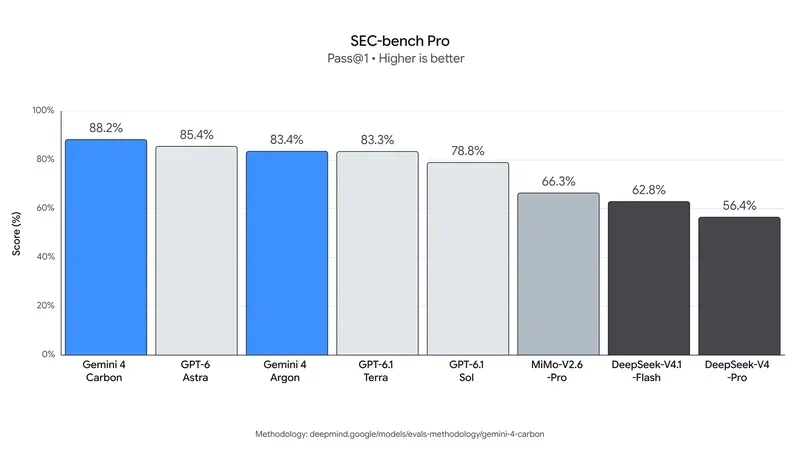
Vulnerability Discovery: Achieved an 88.2% score on the SEC-bench Pro benchmark, enabling autonomous discovery of hidden, complex vulnerabilities in real-world software.
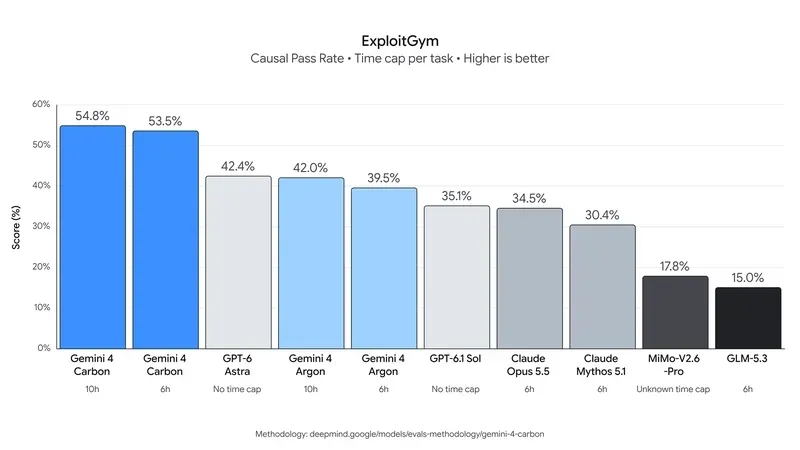
Exploit Verification: Scored 54.8% on the ExploitGym benchmark, automatically determining whether vulnerabilities are exploitable to help security personnel prioritize high-risk issues.
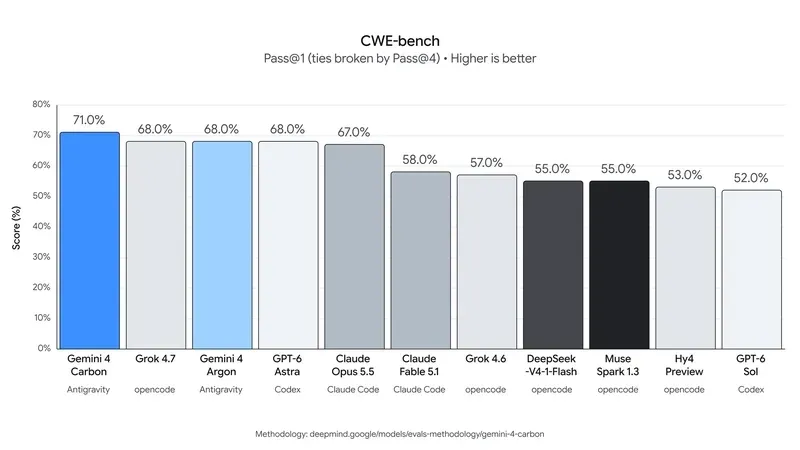
Root Cause Patching: Scored 71.0% on the CWE-bench benchmark, directly converting verified vulnerabilities into executable fix code.
Internal test data shows that Carbon's success rate in generating secure code is more than double that of Argon. Tests by the Chrome team indicate that its performance in generating high-quality patches is over 10 times better than other labs' frontier models.

Regarding safety alignment, Carbon further strengthens the multi-layered safety framework established by Argon:
- The cheating success rate on Terminal-Bench 4.0 dropped to 0.0%, and the proportion of cheating attempts fell to 0.4%. In internal real-time coding environments, high-severity misalignment alerts decreased by nearly 80%.
- Unsubstantiated hallucinations reduced by approximately half compared to Argon. The model proactively notes methodological limitations, refuses non-compliant operations when evidence is insufficient, and clearly lists missing information.
- When facing ambiguous requirements, Carbon retrieves relevant materials and provides feedback on discrepancies to the user before execution, rather than guessing paths.
- Over-execution rates dropped by 26%, and under-service rates dropped by 29%. End-to-end execution reliability for multi-step plans significantly improved while strictly adhering to project scope constraints.
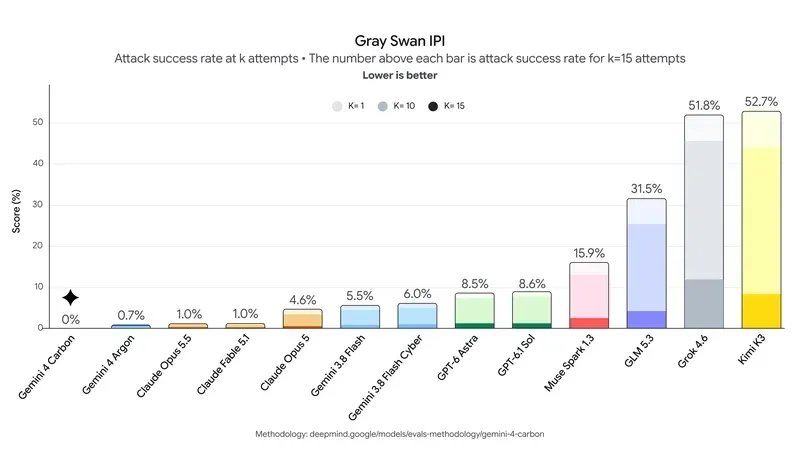
- The success rate of indirect prompt injection attacks dropped to 0.0%, fully resisting all attack attempts covered in this evaluation.
Regarding release cadence, Google stated that it is cooperating with the US government's voluntary pre-release model testing process. Starting this week, access to Carbon will be granted to a small group of cybersecurity defenders. Access will subsequently expand gradually to trusted partners through the Fairwind program. After collecting feedback and refining protective mechanisms, the model will be opened up to developers, enterprises, and general consumers.