OpenAI Releases GPT-6.1 Terra with Halved Pricing and Enhanced Computer Control
OpenAI has officially launched GPT-6.1 Terra, featuring halved API pricing compared to its predecessor while delivering significant performance gains in benchmarks like Agents' Last Exam. The model natively supports screen understanding and cross-software coordination, drastically reducing the cost of automated workflows and marking a key breakthrough in high-efficiency, high-execution large models.
Full Report
Want to monopolize the headlines? Ask the new model first.
GPT-6.1 Terra leads with the pitch: "Half the price, stronger capabilities."
Compared to GPT-5.6 Terra, its standard API pricing has been cut in half:
Input: $1 per million tokens; Cached input: $0.05 per million tokens; Output: $5 per million tokens.

And while prices drop, capabilities actually improve?!
In the workplace software practical test Agents’ Last Exam, Terra not only significantly outperforms GPT-5.6 Terra but matches the performance of GPT-6 Astra at one-tenth of the token cost.
Furthermore, compared to Claude Opus 5.5, Terra’s token price is only one-quarter as high, its token efficiency exceeds 3x, and the cost per task is roughly one-ninth that of its competitor.
Is AI cost reduction and efficiency improvement really this competitive now?
In terms of use cases, GPT-6.1 Terra’s core selling point is extremely clear—faster, stronger, while drastically reducing the cost of computer control.
It natively supports screen understanding, cross-software collaborative operations, and natural language writing, firmly targeting the complete workday of office workers.
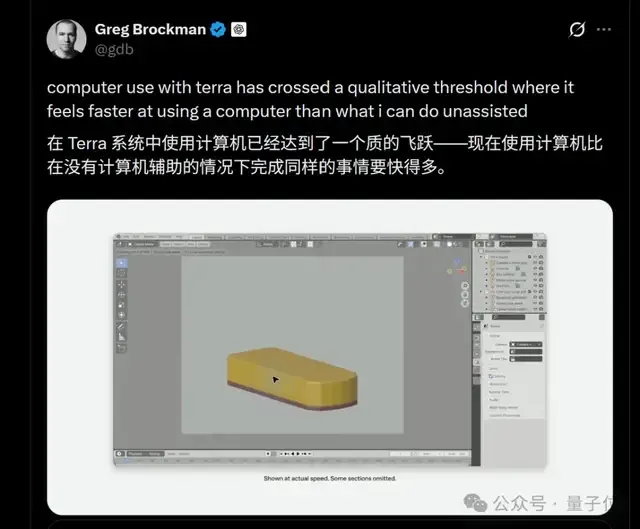
OpenAI co-founder Greg Brockman even stated that Terra’s computer operation capabilities have crossed a "qualitative threshold," making it faster to use than his own manual operations.
Currently, Plus, Pro, Enterprise, and Edu users can directly experience it via ChatGPT Work and Codex. Developers can also access it anytime through the standard API (gpt-6.1-terra).
Even more explosive is that on the same day, OpenAI announced three scientific results produced by internal AI systems, spanning mathematics, computer science, and physics.
On one hand, they are driving down the cost of AI-operated computers; on the other, they are elevating the imagination of AI participating in frontier research.
Has it gone crazy before Thursday??
GPT-6.1 Terra officially launches, with prices halved.
To assess specific capabilities, let’s first look at the official scorecard provided by OpenAI.
First, the overall conclusion:
GPT-6.1 Terra is not OpenAI’s most capable model, but it has reached the capability range of flagship models at a lower cost.
In Agents’ Last Exam, GPT-6.1 Terra (medium setting) scores 15 percentage points higher than GPT-5.6 Terra, yet the cost per task is only about one-third of the latter.
This test specifically evaluates whether AI can use professional software to complete complex tasks, such as turning architectural blueprints into 3D models or reviewing animations shot-by-shot to generate repair logs with timecodes.
More surprisingly, officials claim Terra’s performance is comparable to GPT-6 Astra, but the price per token is only one-tenth of the latter, and task completion speed is over 3x faster than both GPT-6 Astra and GPT-6.1 Sol.

Next, let’s look at visual capabilities.
In the MMMU-Pro benchmark, GPT-6.1 Terra surpasses GPT-5.6 Terra across all reasoning intensities and approaches GPT-6 Astra and GPT-6.1 Sol at a lower cost.

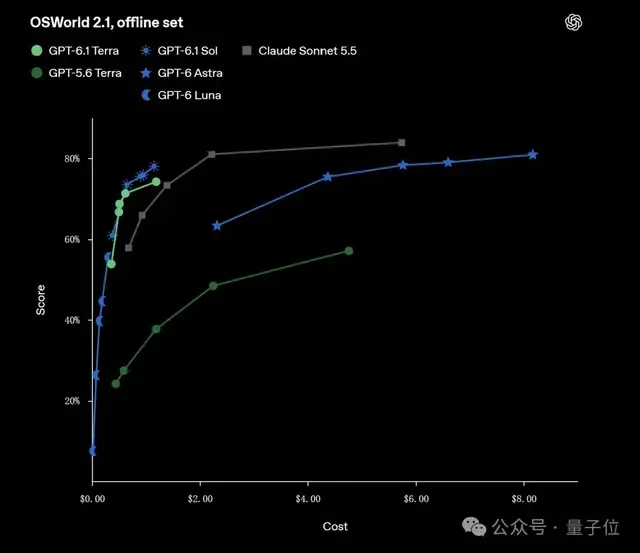
In the computer operation benchmark OSWorld 2.1, its medium-setting score also exceeds the previous highest level achieved by GPT-5.6 Terra.
This means the new Terra doesn’t just "see" better; it also executes tasks effectively based on screen content.
Coding capabilities have also seen a significant boost.
In Terminal-Bench 4.0, GPT-6.1 Terra (max setting) solved 50.3% of tasks, whereas GPT-5.6 Terra’s previously published score was only 21.5%.
That’s more than double the improvement.
However, OpenAI also drew a line:
For the most complex programming, research, and deep reasoning tasks, GPT-6.1 Sol and GPT-6 Astra remain the more suitable choices.

Another notable upgrade is reduced hallucination.
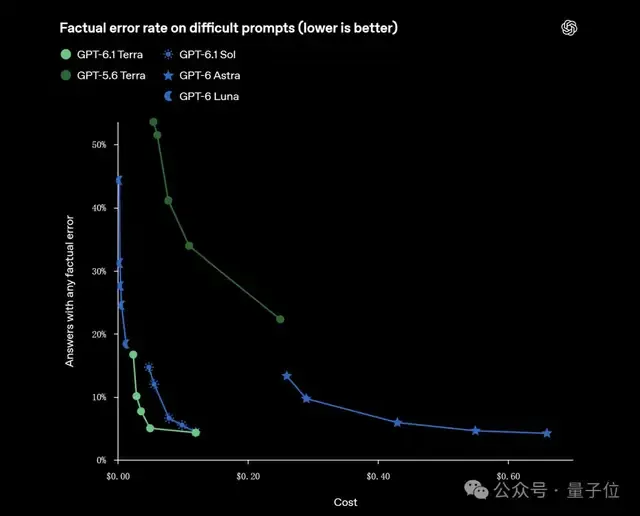
In OpenAI’s internal high-difficulty factuality stress tests, the error rate at low reasoning intensity dropped from 53.6% for GPT-5.6 Terra to 16.7%.
At the max setting, it further decreased to 4.3%, approaching the levels of GPT-6 Astra and GPT-6.1 Sol.
At least based on this round of official results, Terra’s positioning is clear:
Deliver near-flagship capabilities while driving down the cost of numerous computer-based tasks.
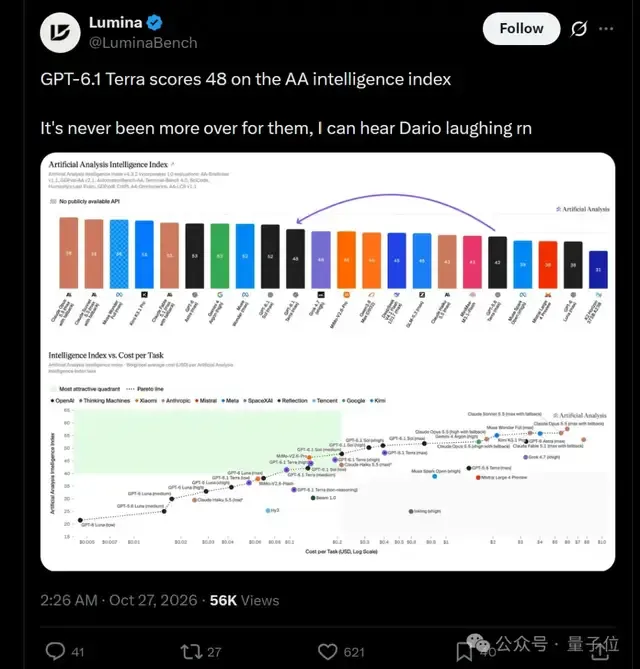
In Artificial Analysis’s comprehensive intelligence index, GPT-6.1 Terra (max setting) scored 48 points, ranking behind Claude Opus 5.5, Kimi K3.1 Pro, Google Gemini 4 Argon, Meta Muse Wonder, and GPT-6.1 Sol, but ahead of Grok 4.7 and Xiaomi MiMo-V2.6-Pro.
Overall, it sits in the mid-tier among global top models.
User Tests: Finer Details, 38% Lower Cost
So, how does the model perform in real-world scenarios?
As usual, let's take a look at the real-world test results shared by netizens.
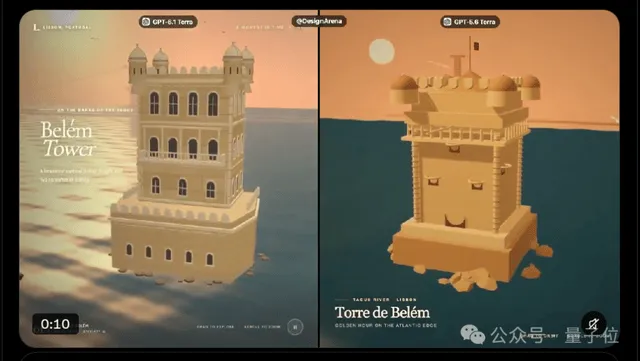
DesignArena gave GPT-6.1 Terra and GPT-5.6 Terra the same challenge:
Replicate the Belém Tower in Lisbon during the golden hour.
The task required not only drawing this 16th-century limestone fortress but also accurately rendering the stone-carved ropes, open balconies, battlements, and domed turrets. The scene also needed to include seagulls, sailing ships, and the April 25 Bridge shrouded in mist.

The results were quite interesting.
GPT-6.1 Terra took nearly four times as long as its predecessor and used 48% more tokens.
However, because its unit price was less than half that of the previous generation, the total cost ended up being 38% lower (the new Terra cost $0.047, while the old Terra cost $0.077).

Fortunately, the extra time spent did translate into better visual quality.
It is immediately obvious which output is more refined and complete.
Another developer, Victor Nunez, brought out the "long form" test.
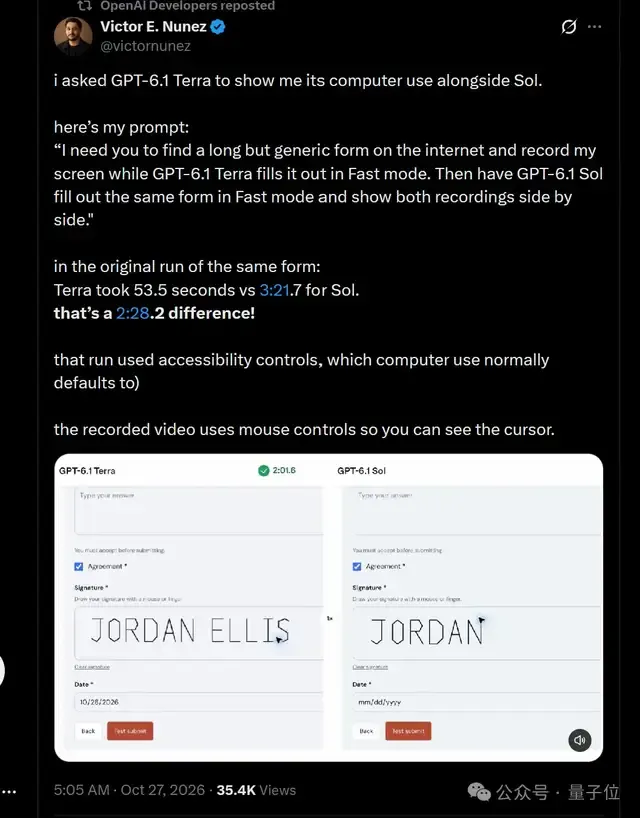
He had both GPT-6.1 Terra and GPT-6.1 Sol locate and fill out a lengthy generic form in Fast mode, then compared their computer operation processes side-by-side.
According to Nunez, in the first test, Terra completed the form 53.5 seconds faster than Sol.
OpenAI's developer account subsequently reshared this demonstration.
This aligns perfectly with Terra's official positioning:
It may not be responsible for solving the hardest problems from start to finish, but it excels at identifying information within interfaces, performing continuous clicks, filling in content, and rapidly executing long sequences of steps.
Another netizen, Leo, placed Terra alongside Claude.
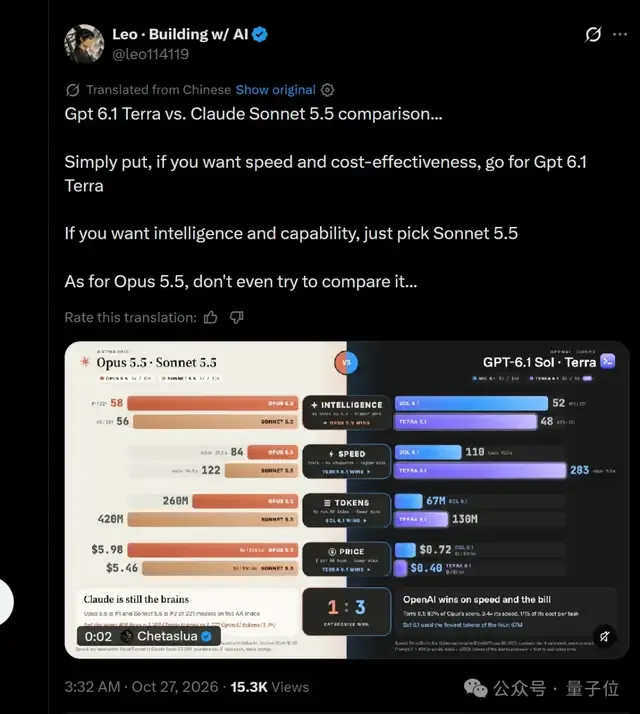
In terms of overall intelligence scores, Terra scored 48 points, lower than Sonnet 5.5's 56 points and Opus 5.5's 58 points.
But when it came to speed and cost, the results reversed completely:
Terra achieved a generation speed of 283 tokens/s, which is 3.4 times faster than Opus 5.5, with a per-task cost of only $0.4—approximately one-fifteenth of Opus 5.5's cost.
So Leo's summary was straightforward:
Choose Sonnet 5.5 for intelligence and capability; choose Terra for speed and cost-effectiveness. As for Opus 5.5, Terra is not yet in the same league.
Moreover, another netizen's real-world tests corroborated Leo's conclusion.
Comparing Sonnet 5.5 and 6.1 Terra using the same prompt, it goes without saying which one performed better.

Compared to Opus 5.5, the price is indeed much cheaper, but considering the generated results, one can only say:
You get what you pay for (doge emoji).

On the same day, OpenAI also dropped three new AI scientific discoveries.
Beyond Terra, OpenAI released an even bigger "academic bomb" on the same day.
The company announced that its AI system had derived three new results in mathematics, computer science, and physics, involving harmonic analysis, complexity theory, and quantum field theory, respectively.
And these weren't just natural language derivations.
For the mathematics and computer science results, both natural language drafts and Lean formalized proofs have been made public.
For the physics result, the Lean formalization of the existence proof for pure Yang-Mills theory has been completed, but the materials will first undergo review by an external expert panel.

I won't go into specific details here, but I've briefly summarized OpenAI's progress:
1. Solved a conjecture that had puzzled the mathematical community for over 30 years
OpenAI stated that its AI system proved the local smoothing conjecture in all dimensions, thereby further resolving the Kakeya conjecture and the Stein restriction conjecture.
Simply put, this research discusses how waves focus during propagation.
Proposed by mathematician Christopher Sogge in 1991, the problem had previously only been solved for certain dimensions.
Now, the AI has not only provided a natural language proof but also encoded it into the Lean formal proof system.
If confirmed by the mathematical community, this would mean AI has truly entered a domain of problems that humans have failed to fully conquer for decades.
2. A foundational theory in computer science, used for decades, might be wrong
The second achievement targets the Exponential Time Hypothesis (ETH).
This hypothesis roughly posits that complex problems like 3-SAT are difficult to solve with algorithms significantly faster than brute force.
Over the past few decades, many conclusions in computer science have been built upon the assumption that ETH holds true.
However, OpenAI claims that its AI system proved ETH to be false, and has already completed the Lean formalization.
Note that this does not mean the P vs NP problem has been solved, nor does it imply that practical new algorithms will appear immediately. It simply suggests that some complex problems may not be as computationally difficult as previously imagined.
3. Providing mathematical proofs for four-dimensional quantum field theories in physics
The third achievement directly enters the realm of quantum field theory.
OpenAI states that its system provided existence proofs for certain four-dimensional quantum field theories, including Quantum Chromodynamics (QCD).
Simply put, it attempts to prove from a rigorous mathematical perspective:
That these physical theories, used to describe quarks, gluons, and strong interactions, are indeed valid.
This includes the proof of the existence of pure Yang-Mills theory—
Which is part of the famous Millennium Prize Problem regarding "Yang-Mills Existence and Mass Gap."
But note, this is only a partial solution.
The quality gap issue remains unresolved, so it cannot be said that AI has conquered this million-dollar global challenge.
Currently, the relevant results are being reviewed by external experts, including Nobel laureate David Gross.

Releasing new models while simultaneously solving problems that have plagued humanity for decades.
OpenAI:
If I can't beat Anthropic to an IPO, I certainly have other ways to grab the spotlight.
References: [1] [2] https://developers.openai.com/api/docs/models/gpt-6.1-terra [3] https://developers.openai.com/api/docs/pricing [4] https://x.com/OpenAI/status/2114780711664398349 [5] https://x.com/DesignArena/status/2114800086391878104