MIT and Meta Propose Self-Correcting Memory for AI Agents
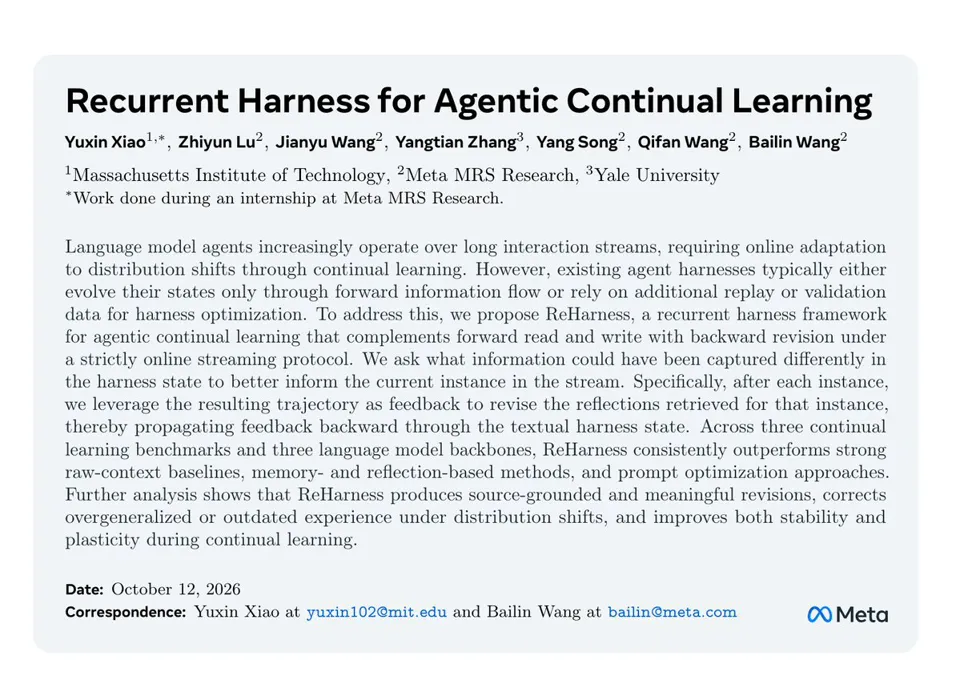
A joint MIT and Meta paper introduces ReHarness, which revises an agent's previously retrieved notes using the outcome of each task instead of only appending new ones, preventing stale or over-broad lessons from misleading the agent. Across three benchmarks and three frontier models it averaged 0.240 normalized gain versus 0.168 for the best raw-trajectory baseline, while using roughly one-third the tokens of replaying full raw history on CL-Bench with Claude.
Related Entities
Full Report
Rohan Paul (@rohanpaul_ai) · 2026-11-13 00
New MIT and Meta paper finds that agent memory works better when old notes get corrected using what happened the next time they were used.
Agents that learn on the job save notes from past tasks and reuse them. Once written, those notes rarely change, so an overly broad or outdated lesson keeps misleading the agent.
After each task, ReHarness sends the retrieved notes and the result to a revision agent. It narrows or corrects each note, using only facts from that note's original task.
Across 3 benchmarks and 3 frontier models, it averaged 0.240 in normalized gain, the share of possible improvement over a memoryless agent. The best raw-trajectory baseline scored 0.168, and replaying full raw history used 3.4× as many tokens on CL-Bench with Claude.
If your agent learns from experience, let each outcome edit the notes that shaped it, not only add new notes.