MIT 与 Meta 提出智能体记忆纠错新方法
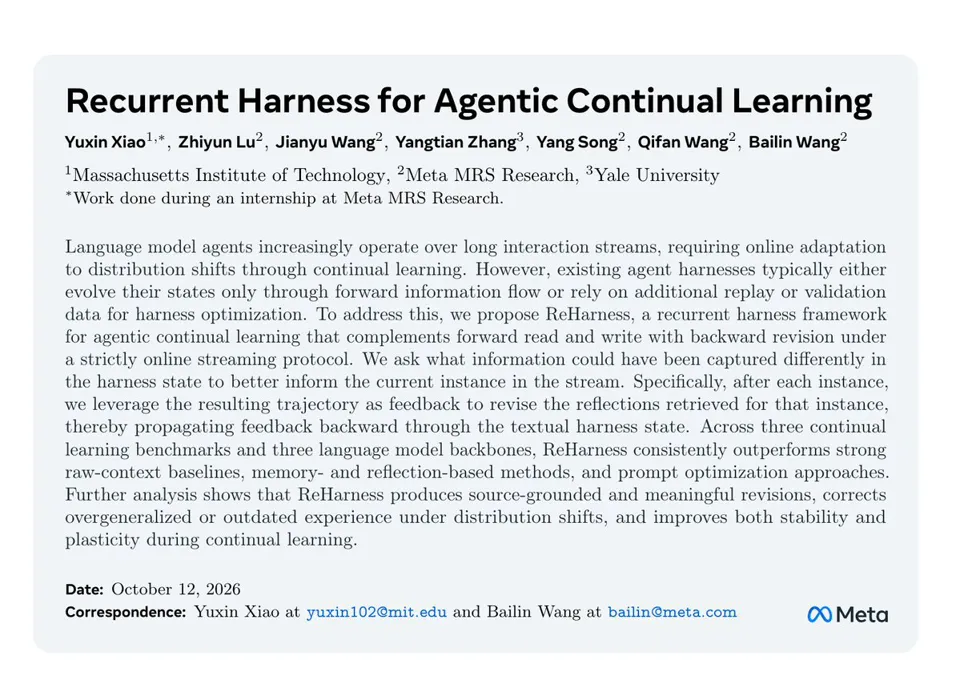
MIT 与 Meta 联合论文提出 ReHarness 机制,让智能体在每次任务结束后,用任务结果反向修订此前被检索复用的旧笔记,而非只追加新笔记,从而避免过时或过宽的教训持续误导智能体。在 3 个基准与 3 个前沿模型上,该方法平均取得 0.240 的归一化增益,优于最佳原始轨迹基线的 0.168;在 CL-Bench 上配合 Claude 时,其 token 消耗仅为回放完整原始历史的约三分之一。
报道正文
Rohan Paul (@rohanpaul_ai) · 2026-11-13 00
New MIT and Meta paper finds that agent memory works better when old notes get corrected using what happened the next time they were used.
Agents that learn on the job save notes from past tasks and reuse them. Once written, those notes rarely change, so an overly broad or outdated lesson keeps misleading the agent.
After each task, ReHarness sends the retrieved notes and the result to a revision agent. It narrows or corrects each note, using only facts from that note's original task.
Across 3 benchmarks and 3 frontier models, it averaged 0.240 in normalized gain, the share of possible improvement over a memoryless agent. The best raw-trajectory baseline scored 0.168, and replaying full raw history used 3.4× as many tokens on CL-Bench with Claude.
If your agent learns from experience, let each outcome edit the notes that shaped it, not only add new notes.