Anthropic Mathematician Claims Riemann Hypothesis Proof With Claude
Anthropic mathematician Levent Alpöge released a four-page note claiming a proof of the Riemann Hypothesis developed with Claude, publishing the full Lean formalization as 14 compressed archives that would exceed 250,000 pages if expanded. The note credits Claude with the key idea of successive Theta Lifts and a critical parameter, and claims the method extends to the Generalized Riemann Hypothesis. The proof has not yet been peer-verified.
Full Report
Contents4 sections
Hengyu, reporting from the Non-Linear Lab QuantumBit | WeChat Official Account QbitAI
Just now, 34-year-old Anthropic mathematician Levent Alpöge released a PDF document, claiming that he, in collaboration with Claude, has found a proof of the Riemann Hypothesis (the most famous century-old problem in mathematics, with a $1 million prize) .
Alpöge did not publish a complete paper; instead, he chose to release the entire set of Lean formal proof code, split into 14 compressed files for the public to download.
If converted into a document containing all the details, it would exceed 250,000 pages.
Alpöge also stated in the document that in the final stage of the research, Claude had already far outpaced him, and even he himself said that he "presented the complete argument to the world without yet having mastered the vast amount of surrounding mathematics."
The original text puts it vividly:
No, Claude flew, and danced, and sparkled near that finish line.
As the endgame approached, Claude no longer crept forward step by step—it spread its wings, took flight, and finished the journey in a dance.
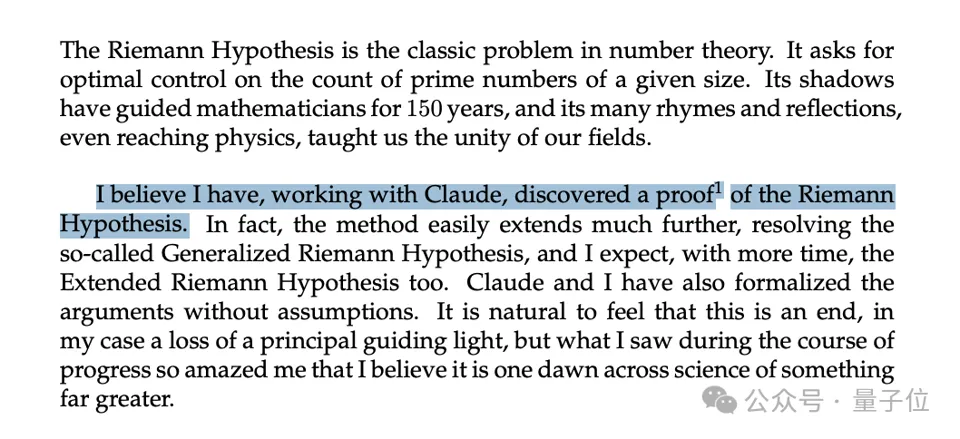
According to Levent Alpöge, this approach can also solve the Generalized Riemann Hypothesis (GRH) and is expected to extend to the Extended Riemann Hypothesis.
Since it was proposed in 1859, the Riemann Hypothesis has remained unresolved for 167 years. Countless mathematicians have devoted themselves to it, yet no one has produced a complete solution.
An AI research effort that could rewrite the history of mathematics is now awaiting verification.
Claude Provided the Key Insight
The PDF Levent Alpöge released, titled "Remark," is only 4 pages long.
As for the mathematical method used to solve the Riemann Hypothesis, this proof draws on the Stepanov method, which was used to solve an analogous proposition of the Riemann Hypothesis in function fields.
In function fields, mathematicians can advance the proof by constructing auxiliary functions with high-multiplicity zeros. But when transferring this method to ordinary integers, a difficulty arises—integers lack a natural structure that fully corresponds to function differentiation.
Levent Alpöge stated in the document that he guided both parties to find a suitable mathematical setting, after which Claude began to demonstrate technical capabilities that astonished him.
During this process, Claude proposed a new and crucial suggestion.
Through successive Theta Lifts, gradually accumulate the required multiplicity within the framework of automorphic forms.
According to the document, each lift increases the multiplicity by one unit, ultimately forming a sufficiently long chain of lifts.
Claude also proposed a key parameter: for a von Mangoldt sum of length X, the length of the Theta lift chain should reach √X.
In addition, the entire argument involves multiple modern number theory tools, including the relative trace formula, Iwasawa theory, and Bessel periods.
This is also what surprised the author—
Levent Alpöge stated that since his student days, he had planned to spend decades researching the Riemann Hypothesis, and had therefore been accumulating mathematical tools that might be useful.
Alpöge said he had originally thought he had prepared enough mathematical tools for the Riemann Hypothesis, but only after truly beginning the derivation did he realize that the mathematical knowledge mobilized by the entire proof far exceeded what he had imagined as a student.
Over the past few months, he has engaged in extensive collaboration with Claude. His own grasp of the field of higher-rank automorphic forms is also limited, and the technical capabilities Claude demonstrated in this area astonished him.
As the end of the problem approached, Claude had already broken out of conventional reasoning paradigms.
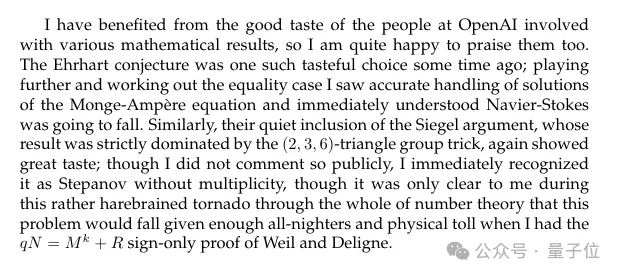
In addition, in the 4-page document, the author also publicly stated that he benefited greatly from the excellent ideas of the people involved in various mathematical research efforts on the OpenAI team.
First, 14 Lean Code Files
Like those previous "mathematician-AI collaboration" cases that caused a stir in the mathematics community, the author did not publish a complete mathematical paper.
He said that he had not yet fully mastered the vast amount of mathematics surrounding this proof, and it would not be appropriate to directly submit to the world a huge, difficult-to-read mathematical paper that he himself did not yet fully understand.
Therefore, he chose to first release the formal proof code.
The entire codebase is written in the Lean language and split into 14 compressed volume files for the public to download and verify.
Lean is an interactive theorem prover that can transform mathematical theorems and derivations into a form that machines can check.
Roughly speaking, mathematicians write the proof process as code, and the Lean kernel checks whether each logical step complies with the rules.
So if a proof can fully pass verification in Lean, and the proposition ultimately proved truly corresponds to the original mathematical conjecture, then it can provide a very strong guarantee of the proof's correctness.
The author claims that he and Claude have completed the formalization of the entire argument, and that it does not rely on additional assumptions.
As for why a complete paper was not released at the same time, the document explains that the entire argument is simply too long and has not yet been organized into a form convenient for mathematicians to read.
The author hopes to continue understanding the proof, look for parts that can be simplified, and ultimately write it out in full.
Note, however, that Lean can verify logical derivations within a formal system, but it cannot automatically guarantee that the theorem definition entered by the researcher accurately corresponds to the Riemann Hypothesis.
Therefore, external researchers still need to check whether the code compiles completely, which axioms are used, and whether the final theorem is truly equivalent to the Riemann Hypothesis.
Meet the Author, Levent Alpöge
Levent Alpöge is a Turkish-American mathematician born in 1992, whose main research areas are Number Theory and Arithmetic Statistics.
He attended Harvard University for his undergraduate studies, achieving a perfect 4.0/4.0 GPA and graduating with highest honors; he then pursued his PhD at Princeton University under the supervision of Manjul Bhargava, a 2014 Fields Medal winner and a leading figure in number theory.
After completing his PhD, he conducted postdoctoral research at Columbia University and Harvard University successively, and was selected as a Junior Fellow of the Harvard Society of Fellows.
After leaving his academic position in Harvard's Mathematics Department, he joined Anthropic as a Member of Technical Staff, where he currently focuses on exploring the application of large models to frontier mathematical proofs.

Claude Had Already Made Significant Progress on the Riemann Hypothesis
This is not the first time Anthropic has had Claude take on the Riemann hypothesis.
In August of this year, Anthropic publicly disclosed a related study, stating that Jarred Sumner, a non-mathematics employee at the company, had Claude attempt to directly tackle the Riemann hypothesis.
Although it ultimately did not succeed in proving the conjecture, it raised the known lower bound on the proportion of non-trivial zeros that can be proven to lie on the critical line of the Riemann zeta function from 41.6% to 67.2%.
Subsequently, Anthropic mathematicians Levent Alpöge and Ralph Furman analyzed and verified the research results and published a related paper.
Sharp-eyed readers will surely have noticed that the mathematician who verified the new August results is none other than Levent Alpöge, the author of the PDF document released today...
PDF link
https://alpo.ge/remark.pdf?utm_source=chatgpt.com
The related Lean files are divided into 14 compressed archives, with links as follows:
https://alpo.ge/lean.tar.gz.part01 through https://alpo.ge/lean.tar.gz.part14