OXR Releases 1.3B Model, Tops Three Document Parsing Benchmarks
SoMark team open-sourced OXR, a lightweight 1.3B parameter model that ranks first on OmniDocBench, olmOCR-Bench, and DocParsingBench. It accurately parses 13 types of document elements including tables and formulas, outperforming PaddleOCR-VL-1.6 and MinerU2.5-Pro in speed while providing structured data for AI agents.
Full Report
Contents4 sections
One week after going open source, the project surpassed 1,000 stars on GitHub, garnered over one million views on X (formerly Twitter), and was featured in "Today's News."
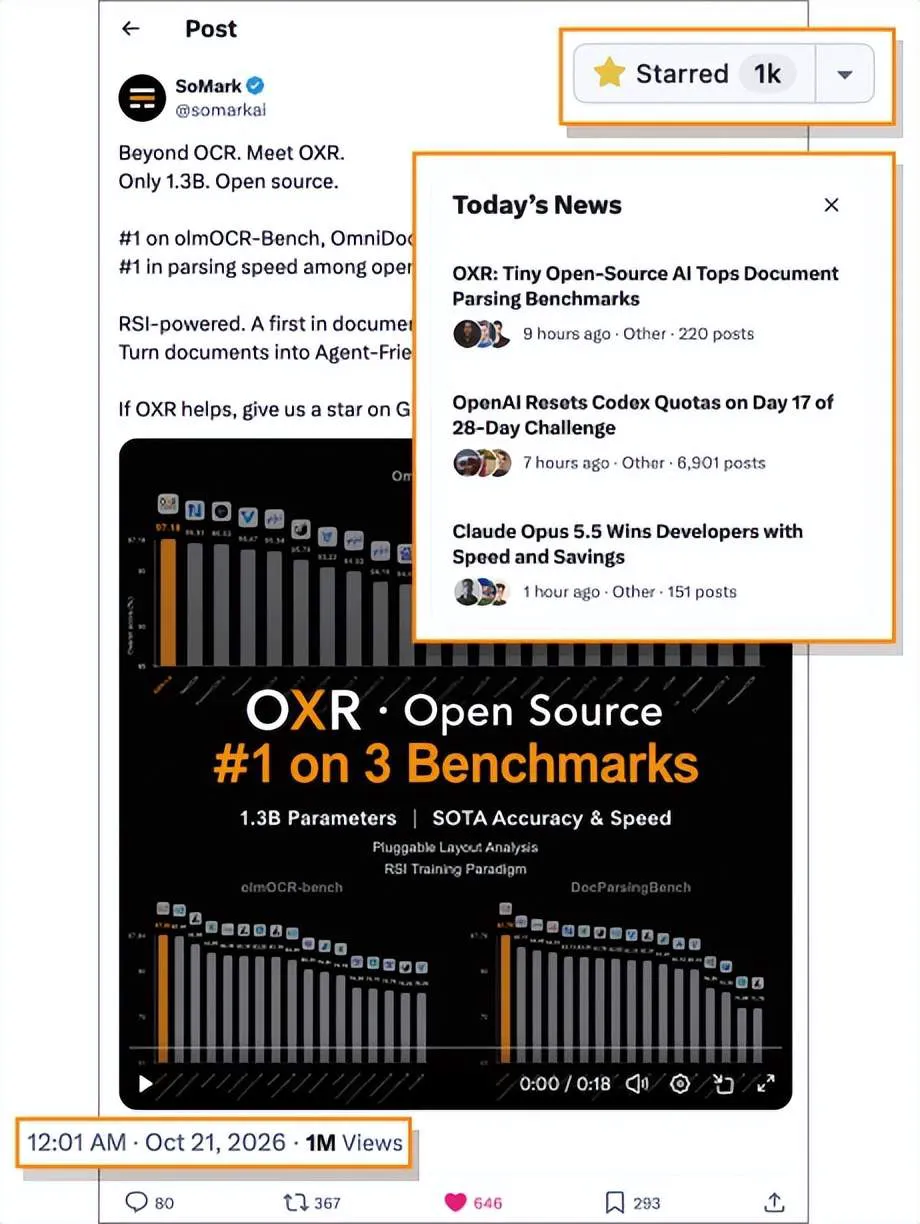
A powerful new contender has emerged in the document parsing landscape.
OXR is now officially open source. With a main model of only 1.3B parameters, it achieved top rankings across three major benchmarks: OmniDocBench, olmOCR-Bench, and DocParsingBench. Its full parsing speed also outperforms competitors like PaddleOCR-VL-1.6 and MinerU2.5-Pro, pushing both accuracy and efficiency for lightweight models to the forefront. The OXR model was developed by the SoMark team from a domestic startup deeply specialized in document intelligence. Having previously refined their parsing capabilities around their core product, SoMark, they have now released OXR as an open-source model.
The name OXR stands for Optical Everything Recognition. Moving beyond traditional OCR, OXR handles far more than just text. It can parse 13 types of document elements—including tables, formulas, and chemical structures—accurately restore reading order in multi-column layouts, output Markdown/JSON, and preserve layout coordinates. This transforms complex documents into data that Agents can effectively utilize.
1 High-Precision Parsing: Ranked First Globally Across Three Benchmarks
According to the evaluation results published by the team, OXR scored 97.18, 87.84, and 87.76 on OmniDocBench, olmOCR-Bench, and DocParsingBench respectively, ranking first in all three.

Beyond the scores, the true test lies in how OXR handles complex documents.
For tables with merged rows and columns, accurate text recognition is only the first step. If row/column relationships or merged cells are misaligned, numerical values may correspond to incorrect items. OXR preserves these structural relationships and outputs tables in HTML format for subsequent display and processing.

Scientific documents present even denser challenges: mathematical formulas involve subscripts, superscripts, and nested structures, while chemical content includes reaction equations and molecular structure diagrams. OXR outputs formulas in LaTeX, represents chemical equations using mhchem, and encodes chemical structures using SMILES. This converts graphical elements on the page into expressions that can be further processed.

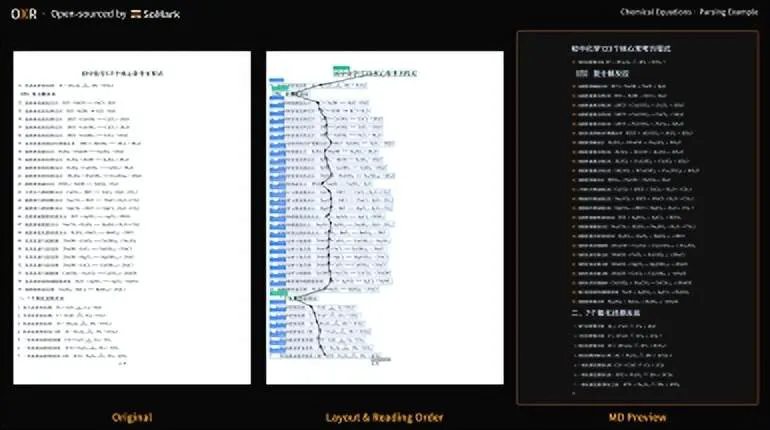
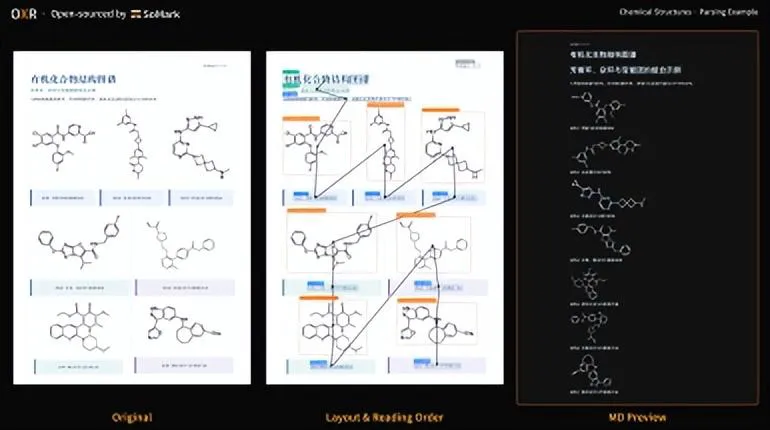
Multi-column papers, newspapers, and exam papers also test reading order preservation. Even if every region is recognized correctly, mixing left and right columns or confusing body text with side notes disrupts the original meaning. OXR determines the reading order while recognizing content and provides layout coordinates, preserving the position of elements within the page.
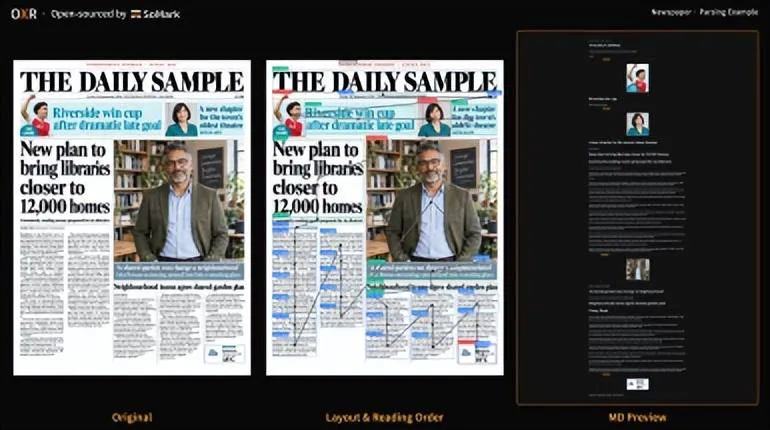
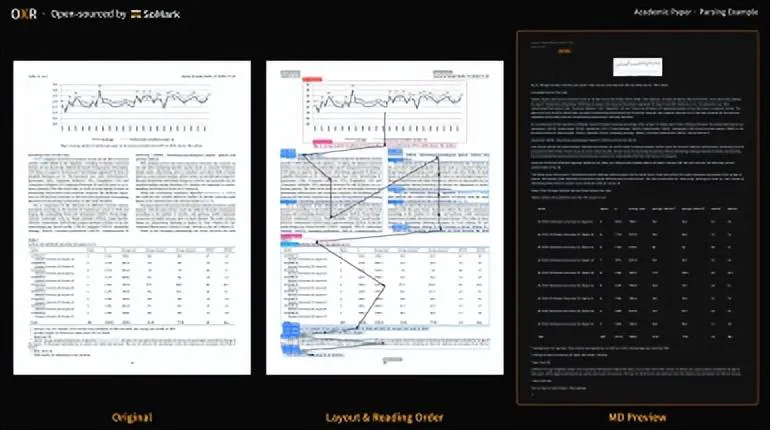
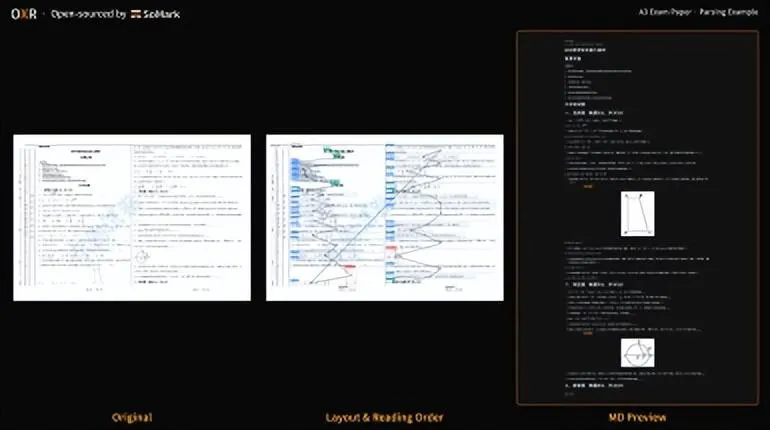
These capabilities collectively define the "Everything" in OXR: covering 13 types of document elements such as text, tables, formulas, chemical structures, and code blocks. It parses PDFs and document images into Markdown/JSON formats, ready for downstream workflows like Agents and RAG systems.
2 Dual SOTA in Accuracy and Speed: Not Just Precise, But Also Fast
When processing a single document, a few seconds' difference may not be noticeable. However, when tasks scale to batch ingestion of papers, archive organization, or research report analysis, processing efficiency directly impacts wait times and computational resource usage.

Based on full parsing tests conducted under identical conditions by the team, using a single RTX PRO 6000 Blackwell (96GB) GPU to parse 100 randomly selected pages from OmniDocBench, OXR took an average of approximately 101 seconds, whereas PaddleOCR-VL-1.6 and MinerU2.5-Pro required approximately 145 seconds and 255 seconds, respectively.
Small parameter count, high precision, and fast speed have converged in this single model.
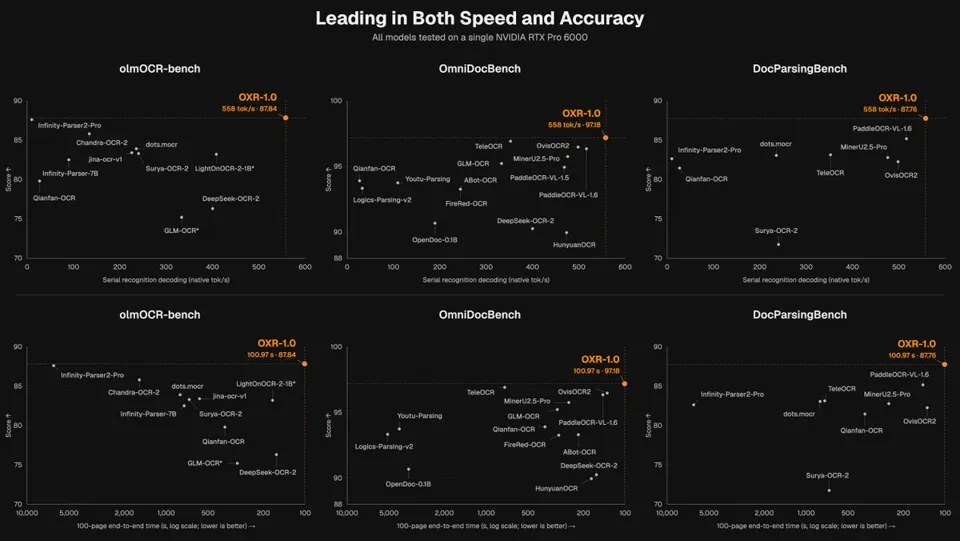
This performance is attributed to a clever design in task division within OXR: a lightweight layout analysis model locates content regions, while the main model performs content recognition and reading order determination.

By integrating ordering into the content recognition phase, OXR reduces the overhead of handling reading order separately and allows the model to determine sequence based on semantic context. This architectural choice enables OXR to balance parsing quality with efficiency.
3 RSI: Continuous Improvement Focused on Error Cases and Weak Samples
Behind its impressive results lies an equally noteworthy training methodology. As we know, document parsing cannot rely on a fixed set of samples to cover all scenarios. Scenes, languages, and layouts constantly evolve. How can a model consistently produce reliable parsing results when faced with unseen, complex documents?
OXR innovatively introduces a Recursive Self-Improvement (RSI) training paradigm for document parsing during the post-training phase for the first time, transforming erroneous and weak samples from parsing tasks into the basis for the next round of training.
This process can be understood as a collaborative "error-checking and remedial learning" effort involving multiple AI models:
- OXR first parses unlabeled documents to generate results pending evaluation.
- External models evaluate these results and analyze error causes on a per-sample basis, while an independent clustering model categorizes issues by their root causes.
- External models then generate targeted training data based on these identified issues, which is used for the subsequent round of OXR training.
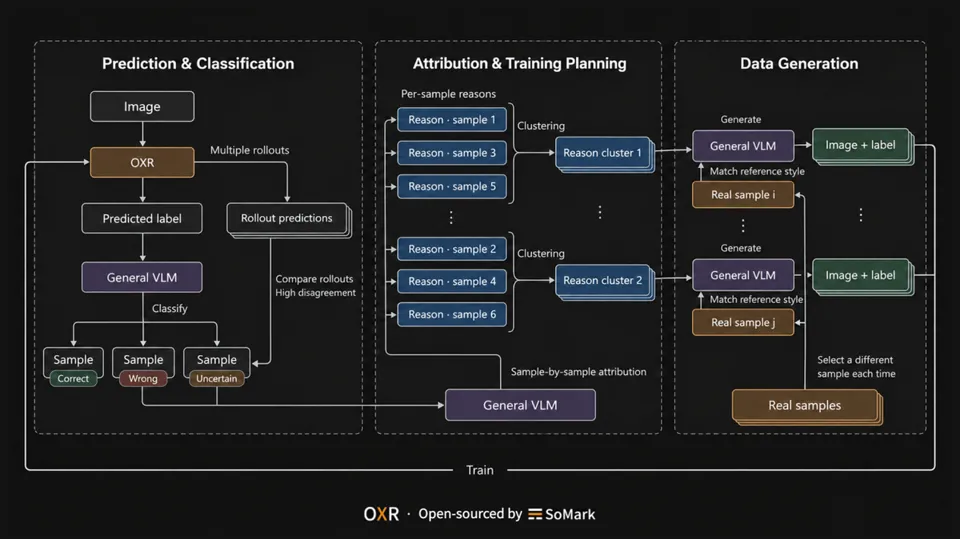
As a result, the preparation of training data becomes explicitly problem-oriented: data is supplemented specifically where the model shows weaknesses, accelerating the pace of model iteration. Additionally, the new training data generated within this closed loop requires no manual annotation, thereby overcoming the efficiency bottlenecks associated with manually prepared materials.
4. Pluggable Layout Analysis for Greater Business Adaptability
When a model misreads content, accuracy needs to be improved. However, in many cases, parsing results do not meet expectations because different business contexts define document structures differently.
For example, for the same set of images, archival systems may prefer to retain them as a whole, whereas image retrieval systems require extracting each image individually. Similarly, for a region containing titles, text, and borders, some businesses may split it by text elements, while others may treat the entire region as a table. Both requirements can be valid.

To address this, OXR designs layout analysis as an independent, pluggable module.
You can use the built-in layout analysis model directly or integrate other layout analysis models that align with your specific business standards. This allows you to adjust element categories, region boundaries, and content grouping while continuing to leverage OXR’s capabilities for content recognition and reading order determination.
For developers building RAG systems, Agents, and document workflows, OXR undoubtedly offers an open-source solution that balances parsing accuracy, processing speed, and layout adaptability.
Currently, OXR has released its code and model weights, along with an online Demo and free API, enabling developers to test performance using real-world documents:
- GitHub Repository: https://github.com/SoMarkAI/OXR
- Hugging Face Model Weights: https://huggingface.co/SoMarkAI/OXR-1.0
- Online Demo: https://free-oxr.somark.cn/
- Free API: https://free-oxr.somark.cn/api/v1
Teams with more production-grade document parsing needs can also explore SoMark, a document parsing engine driven by independent models developed by the same team.
SoMark Official Website: https://somark.cn/
From SoMark to OXR, this team shares the valuable experience accumulated through long-term exploration and practice with developers, reflecting their core value proposition: turning knowledge within documents into high-quality, AI-ready data that can enter more real-world business scenarios.
This article was provided by the SoMark team and reprinted with permission from QbitAI. The views expressed are those of the original authors.