Microsoft Launches Decision-1.1 Model for Enterprise Decision Tasks
Microsoft has launched Microsoft-Decision-1.1, a specialized model for high-frequency enterprise decision tasks, now available on Microsoft Foundry, OpenRouter and Vercel. Rather than generating free-form text, it selects among developer-defined allowed actions and returns calibrated confidence scores, abstaining or escalating to humans when uncertain. It scores 68 on the Artificial Analysis Decision Index v2.1, ahead of Gemini Decision 1 and GPT-6 Luna, and powers Copilot request routing at 2.2x the speed and 4.4x lower cost.
Full Report
IT之家 November 18 news, Microsoft announced yesterday (November 17) the official launch of the Microsoft-Decision-1.1 decision AI model, which is now available on the Microsoft Foundry, OpenRouter, and Vercel platforms.
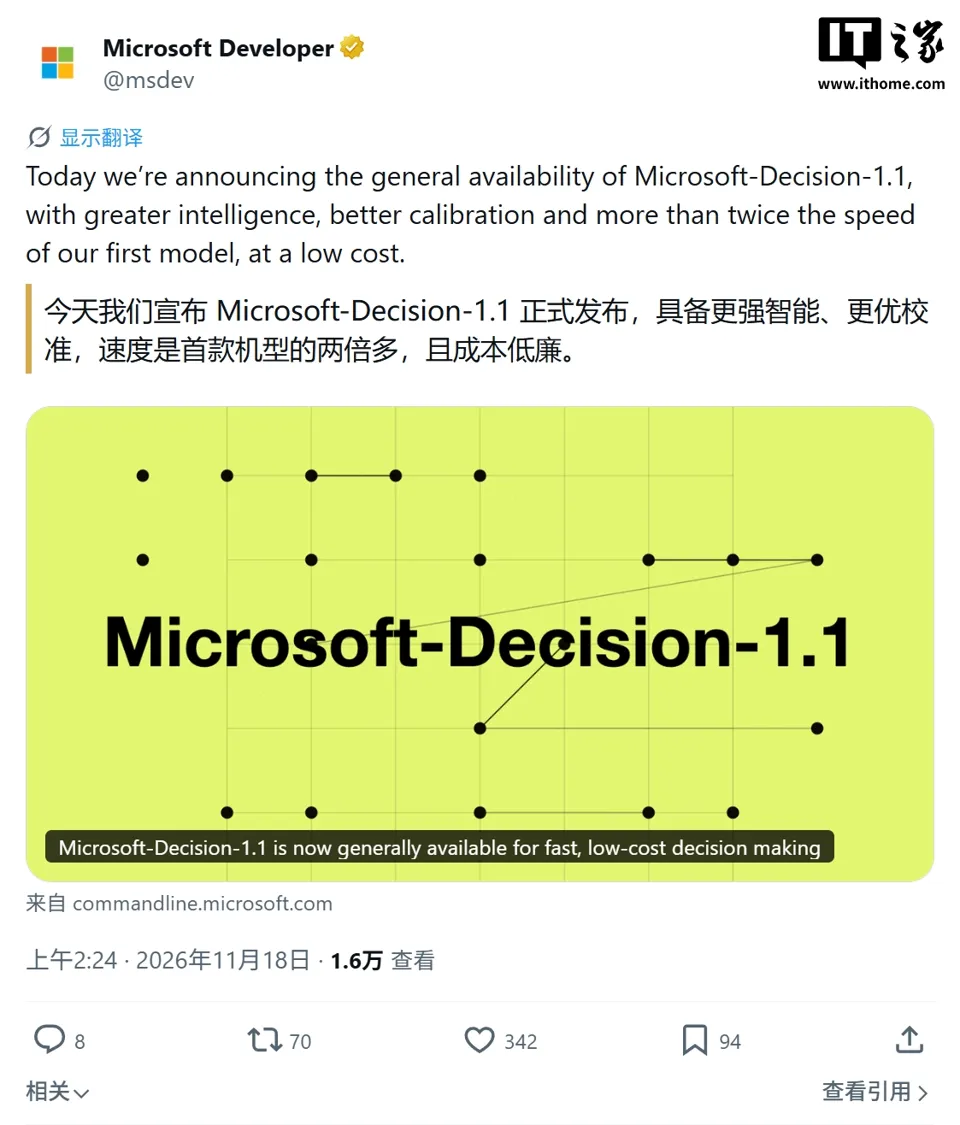
The model targets high-frequency decision-making scenarios in enterprise-grade software, helping applications quickly make structured judgments in tasks such as routing, classification, prioritization, content verification, and workflow control.
In terms of pricing, the global standard edition of Microsoft Foundry is priced at $0.042 per million input tokens (IT之家 note: approximately 0.28 RMB at current exchange rates), with output tokens free of charge; the US data region, EU, and Asia-Pacific data regions are priced at $0.046 per million tokens (approximately 0.31 RMB at current exchange rates) and $0.05 (approximately 0.33 RMB at current exchange rates), respectively.
Unlike traditional general-purpose large language models, Microsoft-Decision-1.1 focuses on choosing from allowed actions within rules and constraints set by developers. It also outputs calibrated confidence scores, and when information is insufficient or uncertainty is high, it can choose to "abstain" or prompt for human intervention, thereby reducing the risk of AI misoperations in critical business processes.
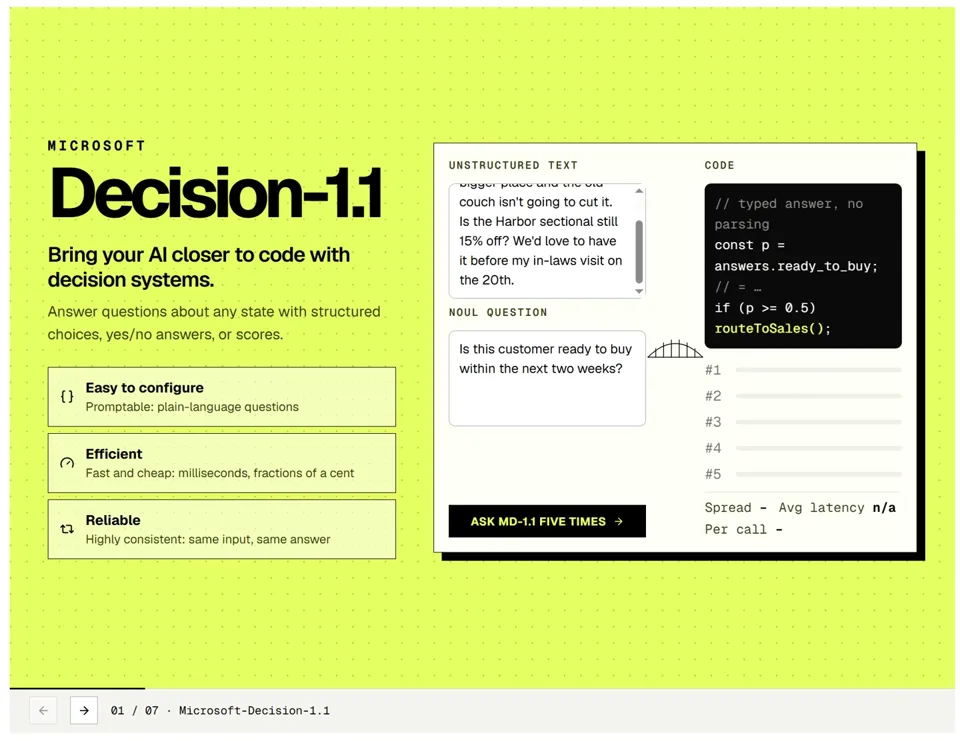
Microsoft says the new version has improved both intelligence and calibration capabilities, and while maintaining low cost, it is more than twice as fast as the previous generation Microsoft-Decision-1.
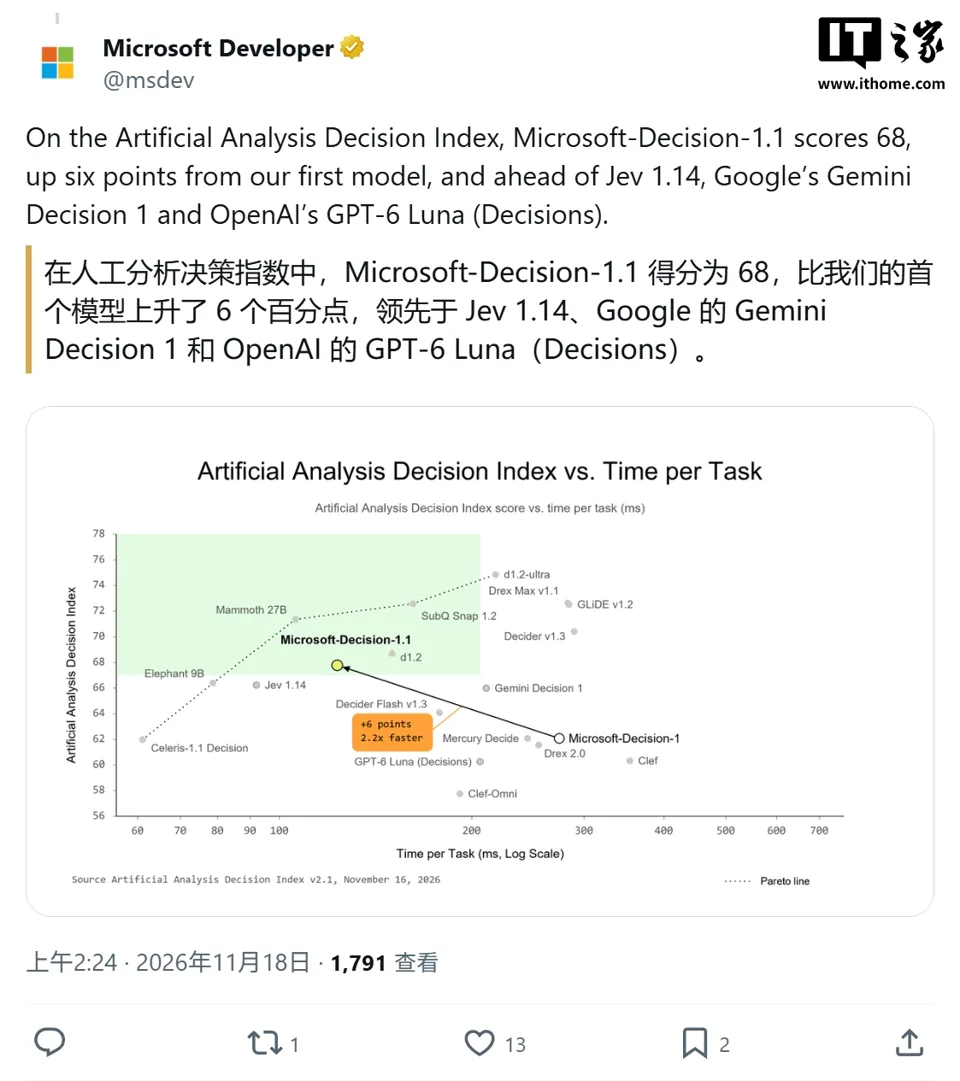
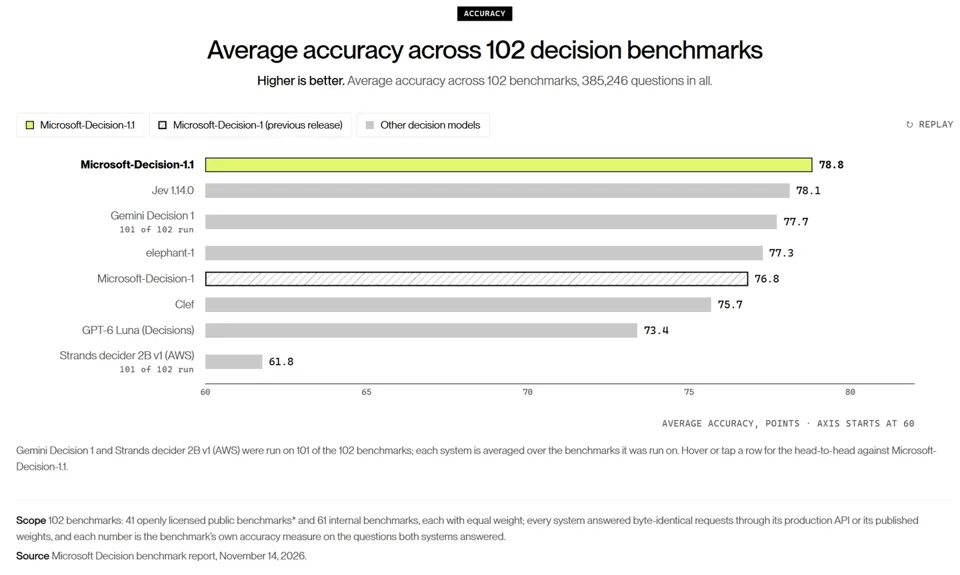
On the Artificial Analysis Decision Index v2.1 benchmark, the model scores 68, a 6-point improvement over the previous generation, and leads models such as Jev 1.14, Google Gemini Decision 1, and OpenAI GPT-6 Luna (Decisions).
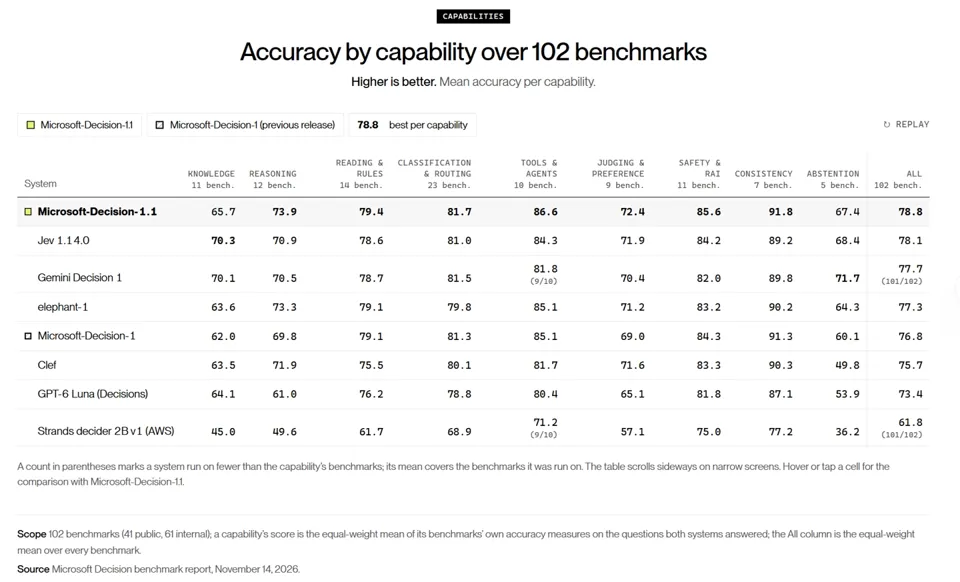
Microsoft-Decision-1.1 ranks eighth in the decision model leaderboard. On the Artificial Analysis Decision Index, Microsoft-Decision-1.1 is 2 points higher than Elephant 9B and Jev 1.14, but 1 point lower than d1.2. IT之家 attaches the relevant screenshots below:
To balance real-time performance and cost, Microsoft customized an inference engine for the model and optimized it based on the medium-sized mixture-of-experts model Gemma 4 26B A4B. The model can run on a variety of GPU hardware including A100, H100/200, and GB200/300, and reduces inference costs through intelligent request scheduling.
Microsoft also stated that the model's training combines supervised fine-tuning with reinforcement learning, using synthetic and licensed datasets covering tens of thousands of task types to improve its generalization capability in real-world business scenarios.
The model already supports multimodal input and can receive image information such as photos and screenshots. Since its public preview release, more than 4,000 customers have used it, with application scenarios including model routing, customer service ticket triage, business process automation, content tagging and classification, and more; early customers include Epic, Equinor, Atos Group, and Raiffeisen Bank.
Within Microsoft, the model has been used for request routing in Copilot: its judgment accuracy is comparable to that of large language models, but it is 2.2 times faster and 4.4 times cheaper. It is also used for dynamically adjusting task reasoning intensity in Cowork, as well as for quality and safety evaluations in Foundry Evaluations.