Ant Group Open-Sources Health Model Predicting 150 Disease Risks Over Six Years
Ant Group's Ling announced the open-source health prediction model LingSante Pulse, which unifies EEG, ECG, PPG and EMG signals to forecast the onset risk of 150 disease phenotypes over the next six years. Pretrained on over 150,000 hours of multi-scenario physiological sequences, it raises the count of reliably predictable phenotypes by about 42% over the prior best model, and retains strong prediction for 118 diseases using only ECG and chest-band respiration channels. The technical report and weights are released on GitHub and Hugging Face.
Related Entities
Full Report
AI applications in healthcare are extending from disease identification and health consultation toward longer-term health risk prediction. On November 24, Ant Ling announced the open-sourcing of the medical health prediction model LingSante Pulse, which can predict the risk of 150 disease phenotypes occurring within the next six years by understanding the physiological signals generated by the human body in daily life.
Unlike traditional models that are mainly trained for a single physiological signal or a specific disease, LingSante Pulse can uniformly process multiple physiological signals such as EEG, ECG, photoplethysmography, and EMG, and adapt to different combinations of sensors. The model is pretrained on over 150,000 hours of multi-scenario physiological sequence data, enabling it to extract human state features from different physiological signals and achieve long-term prediction of health conditions.
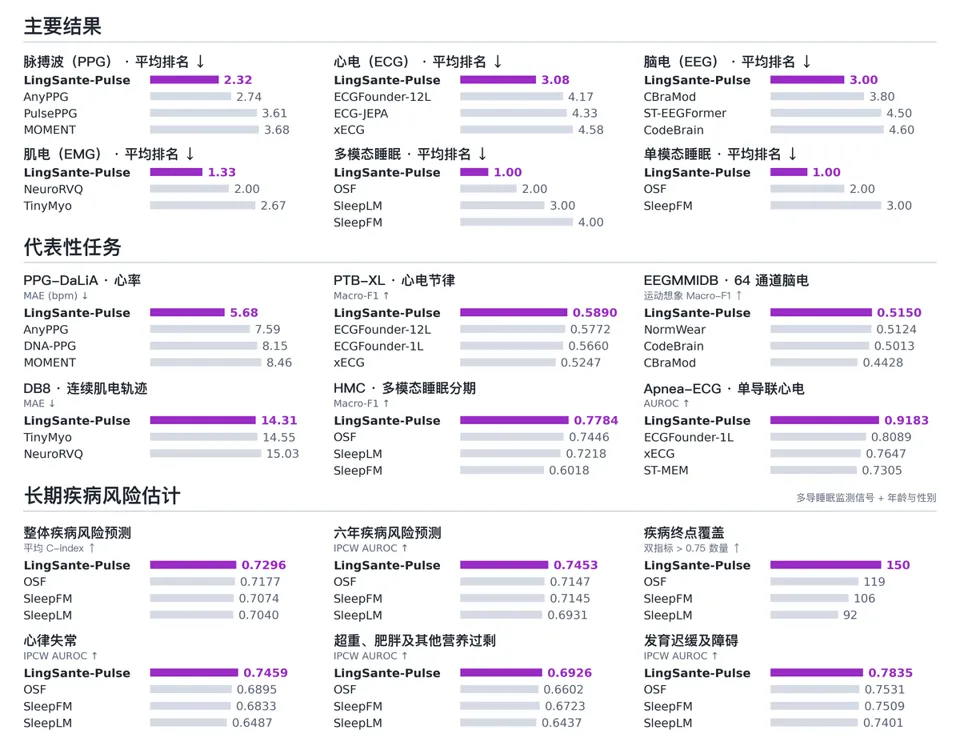
In relevant evaluations, the number of disease phenotypes for which it can achieve high prediction reliability increased by about 42% compared with the previous best model. Even when using only two relatively simple sensor channels—ECG and chest-band respiratory signals—the model still has strong predictive capability for 118 diseases, approaching the performance of external models that use full sleep monitoring equipment.
In other tasks, LingSante-Pulse also demonstrates strong generality. In 38 single-sensor prediction tasks covering the four major domains of EEG, ECG, pulse wave, and EMG, as well as evaluations of multimodal tasks such as sleep staging and sleep apnea screening, the model's overall performance leads existing single-sensor domain-specific models and multimodal physiological signal foundation models.
Currently, using AI to analyze physiological signals and carry out early disease identification and risk prediction has become an important research direction in the medical AI field. Many research institutions and companies at home and abroad are exploring ways to discover health changes that are difficult to detect in traditional diagnosis and treatment from ECG, sleep monitoring, and wearable device data.
It is understood that Ant has just released a full suite of medical health models, covering multiple directions such as medical reasoning, multimodal understanding, disease risk prediction, safety protection, and real-time agents. At the same time, the Afu App announced a new round of upgrades, unlocking AI real-time audio and video "inspection, auscultation, inquiry, and palpation" functions, upgrading AI health steward capabilities, and expanding into two major health hardware categories: screenless wristbands and rings. Currently, the LingSante-Pulse technical report and model have been made available on GitHub and Hugging Face.
This article is provided by Ant, and QbitAI is authorized to repost it. The views belong to the original author.