Zhipu Open-Sources GLM-5.3-Flash: Multimodal Model Matches Claude Opus at 1/40 Cost
Zhipu AI has open-sourced and launched GLM-5.3-Flash (320B-A18B), the first native multimodal model in the GLM-5 series. With an Artificial Analysis Intelligence Index score of 57, it matches Claude Opus 4.8 in coding capabilities while costing only 1/40 as much. By employing a hybrid sparse-linear attention architecture and halving active parameters, GLM-5.3-Flash achieves frontier-level intelligence at significantly lower computational costs.
Related Entities
Full Report
Contents4 sections
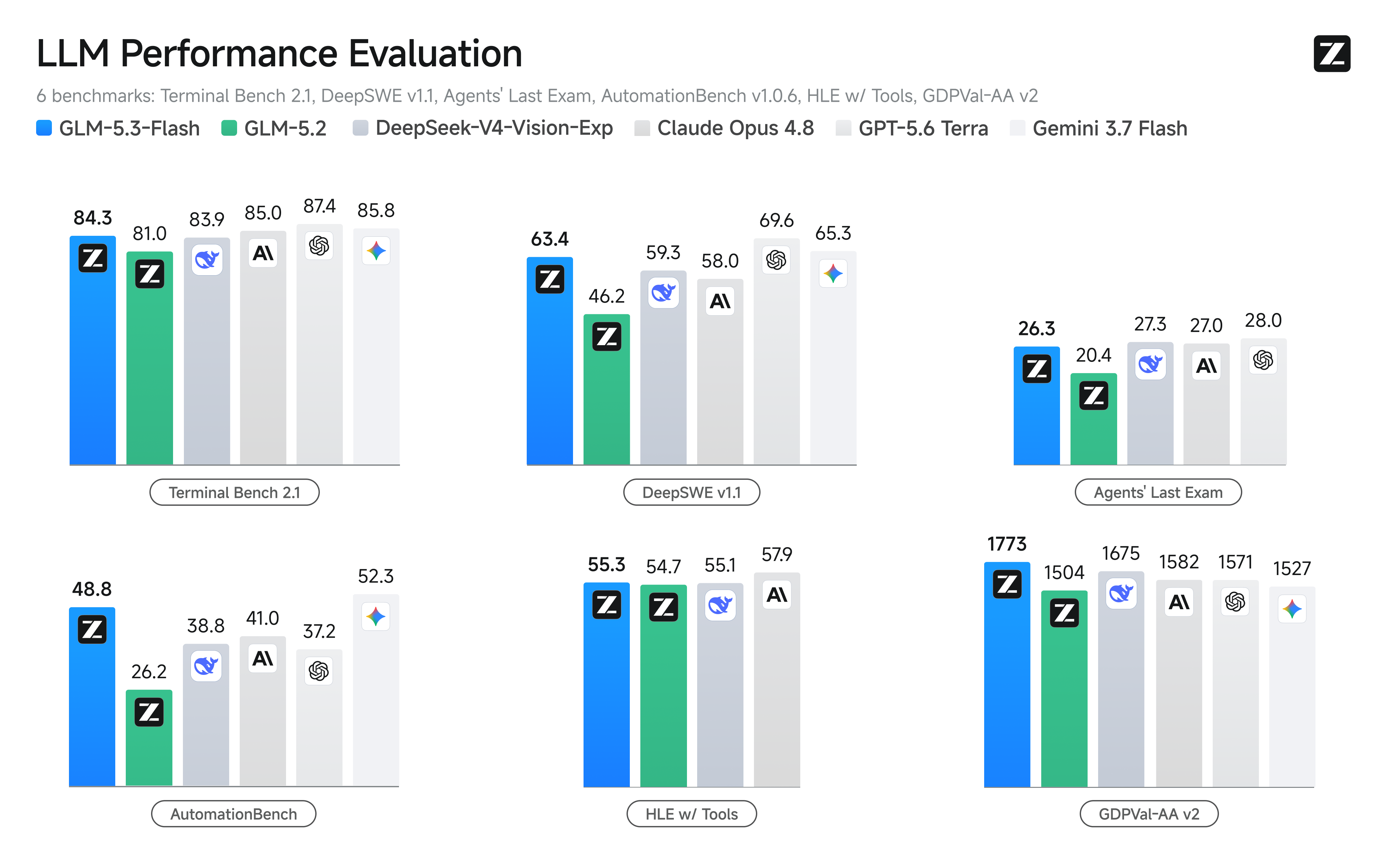
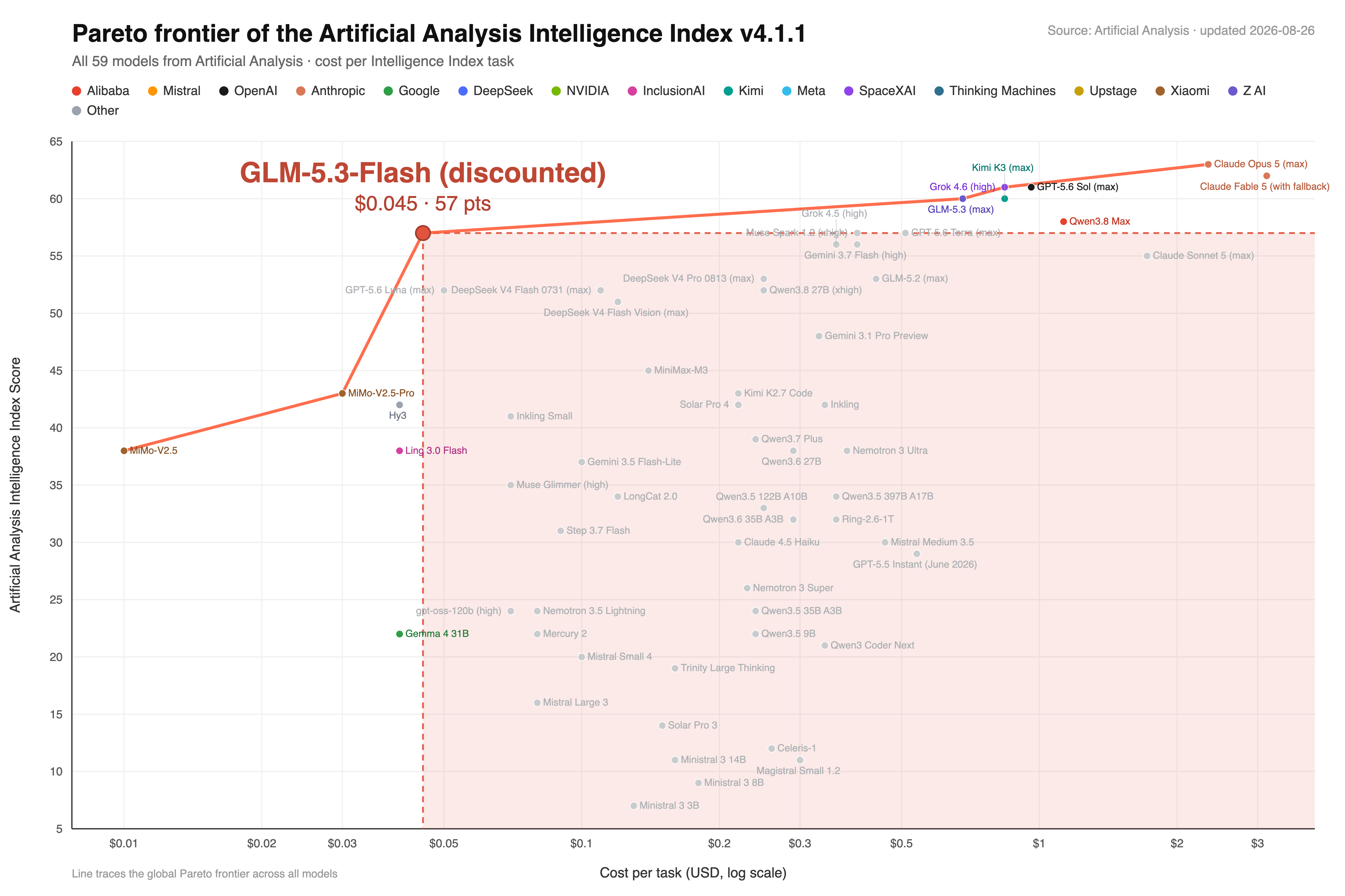
Today, we launch and open-source GLM-5.3-Flash (320B-A18B), the first native multimodal model in the GLM-5 series. It seems people have grown accustomed to associating frontier intelligence with frontier pricing, viewing it as an unavoidable cost of technological progress. Today, GLM-5.3-Flash arrives: with 320B total parameters, its capabilities surpass those of GLM-5.2. It scores 57 on the globally authoritative Artificial Analysis Intelligence Index (AA Composite Intelligence Index), entering the tier of global frontier models and matching the score of Anthropic’s most popular model, Claude Opus 4.8. In our proprietary Z.ai Code Bench subjective evaluation, its coding performance is comparable to that of Claude Opus 4.8.
Meanwhile, GLM-5.3-Flash is priced at 1/10th of GLM-5.3, dropping to 1/20th during a limited-time discount, which is 1/40th the price of Opus 4.8. Same intelligence, 1/40th the price—frontier intelligence no longer requires rationing for the first time.
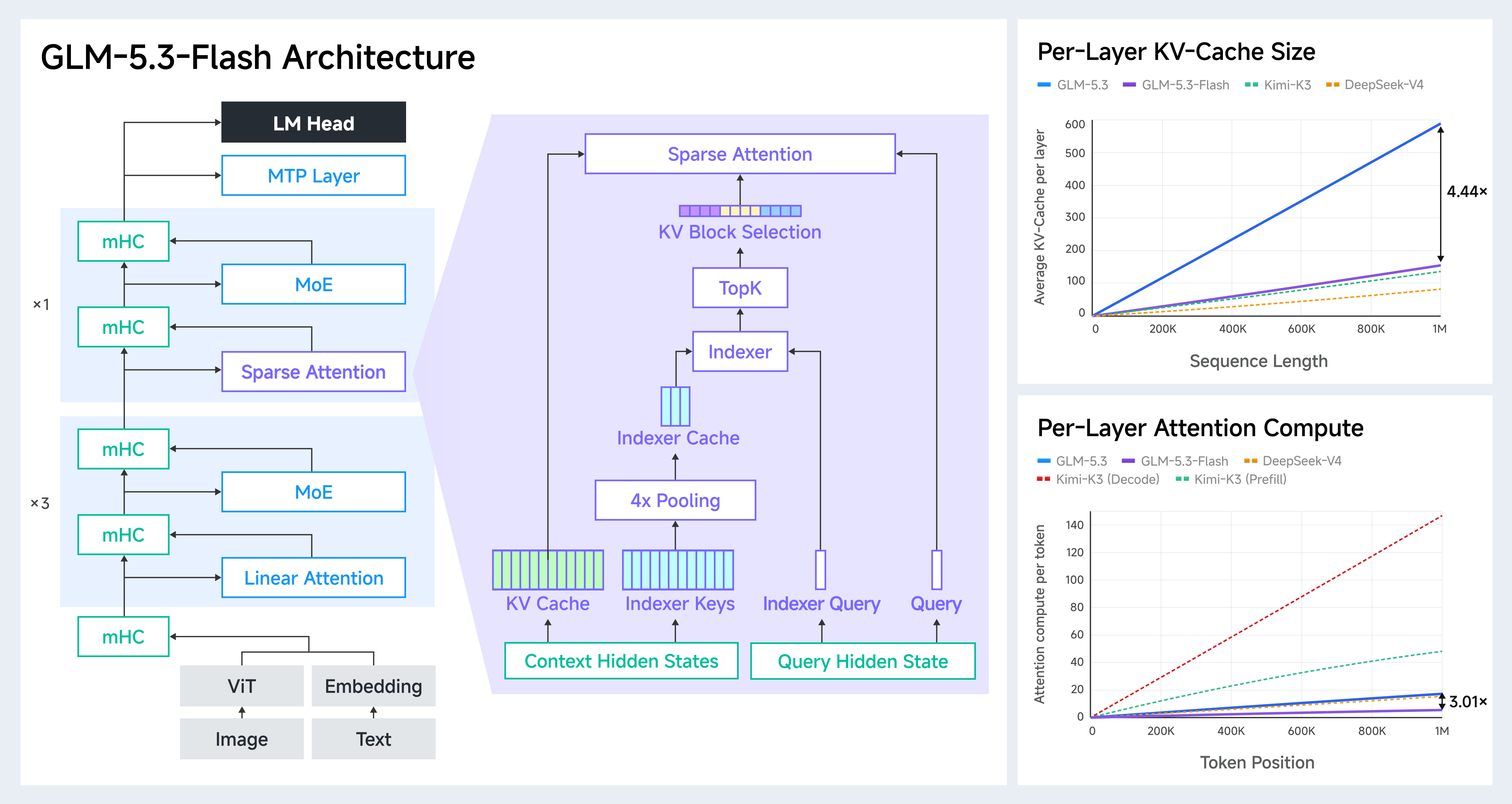
To gather broad and professional feedback from users, we conducted large-scale testing under the anonymous model name Ox-Alpha (referred to as "Niulai" in the Chinese community) on OpenCode and OpenRouter prior to the official release. Ox-Alpha quickly became the most popular model of the week, setting new records for call volumes across both platforms. All request traffic was supported by compute power from domestic chips. GLM-5.3-Flash comprehensively outperforms GLM-5.2—which has twice the parameter count—in various benchmarks and real-world usage, yet is priced at only 1/10th of the latter. This is thanks to its entirely new model architecture. The GLM-5.3-Flash architecture is designed specifically for ultra-low costs; while its total parameter count is comparable to GLM-4.5 (355B vs. 320B), its active parameter count (32B → 18B) and number of layers (92 → 45) are nearly halved. Combined with our latest 30T-token multimodal pre-training corpus, GLM-5.3-Flash achieves stronger performance with fewer computational resources. GLM-5.3-Flash also features multiple architectural upgrades, becoming the first open-source frontier model to adopt a hybrid architecture combining sparse attention and linear attention. This significantly reduces long-context serving costs while maintaining precise long-context capabilities. Additionally, it employs Manifold-Constrained Hyper-Connections (mHC) to enhance model scaling capabilities. For specific technical details, see the Blog: https://z.ai/blog/glm-5.3-flash.
Ultra-Low-Cost Architecture
To reduce attention costs in long-context scenarios, we adopted a hybrid architecture combining linear attention and sparse attention. Linear attention captures local dependencies through recursive mechanisms, while sparse attention retrieves global context via lightweight indexers. We introduced IndexPool to further reduce indexer latency and memory overhead in 1M contexts, compressing four cached vectors from the indexer into one through weighted pooling. To demonstrate architectural efficiency, we compared GLM-5.3-Flash with GLM-5.3, DeepSeek-V4-Flash, and Kimi-K3, focusing on per-token computation and KV cache size. To ensure fair comparison across different model scales, we displayed attention computation per head, per layer, and average KV cache size per layer (in BF16). Compared to GLM-5.3, GLM-5.3-Flash reduces attention computation and KV cache size by factors of 3.01 and 4.44, respectively.
Visual Feedback in Coding Loops
GLM-5.3-Flash is the first native multimodal model in the GLM-5 series. Visual Coding goes beyond mere image processing; it expands the boundaries of what programming can achieve. For tasks such as frontend development, game development, and 3D simulation, where final deliverables include user-perceivable interfaces, interactions, or virtual worlds, visual capabilities are natively integrated into the model. This enables the model to autonomously determine when "observation" is necessary and use visual feedback to guide subsequent actions. We developed a data synthesis pipeline specifically for Visual Coding, focusing on the model's self-visual judgment and test-time improvement. The resulting trajectories require the model to interact with the environment, inspect its own outputs, and perform iterative refinements. In frontend coding, we also explored reinforcement learning based on environmental feedback and strengthened GUI judgment capabilities through agent verification using real-world user workflows. This extends the scope of validation from functional correctness to rendering quality and interactive experience. Surprisingly, coding provides the model with a proxy to express and verify its world knowledge. Constructing a coherent scene in Blender requires translating knowledge of geometry, materials, lighting, and space into a 3D structure that remains consistent across different viewpoints. Without any external assets, GLM-5.3-Flash autonomously operated for 16 hours to build a professional chef's home and test kitchen spanning approximately 400 square meters. In ZCode, the Browser Use Agent (BUA) and Computer Use Agent (CUA) further extend multimodal capabilities, enabling the model to collaborate across code, browsers, and graphical interfaces while observing and verifying its own outputs—many issues only surface during rendering, interaction, or gameplay. Below is a collection of GLM-5.3-Flash benchmarks in ZCode: from images to runnable projects, from two-hour movies to eight-minute edits, and directly deliverable professional white-collar documents.
A Work Partner Beyond Coding
GLM-5.3-Flash demonstrates significantly improved performance in professional work compared to models of similar caliber. For Office and document-related tasks involving PPTX, PDF, DOCX, and XLSX, the newly added visual understanding capability allows the model to inspect and optimize its own outputs, exhibiting stronger aesthetic judgment. The model can compare its outputs against visual context and expected results, achieving more effective self-validation and optimization—including more accurate assessments of presentation quality and aesthetic judgment. We have specifically optimized for professional domains such as finance and law. In finance, GLM-5.3-Flash covers the entire workflow from source-based financial research and report generation to financial modeling and analysis, providing traceable references throughout the process. In law, it can review fee, account, and liability clauses in contracts, annotating them according to legal conventions. It can also draft lawyer letters, contracts, and litigation documents with formats and layouts compliant with practical standards, making them ready for delivery upon generation. Financial Research Reports · Performance Reviews Legal Documents · Contract Annotations & Revisions
Running on Domestic Chips
Over the past week, we attempted for the first time to serve large-scale traffic using domestic chip clusters connected via our proprietary high-bandwidth interconnects. To overcome the limitations in compute power and memory capacity of individual chips, we built a dedicated inference engine based on SGLang. Notably, the entire construction process was significantly accelerated by an infra agent driven by GLM-5.3, which assisted engineers in developing and optimizing operators, diagnosing performance bottlenecks, and improving deployment service stacks, creating a positive cycle of "models optimizing systems, systems hosting models." The primary bottlenecks for these chips lie in memory capacity and bandwidth, particularly challenging when supporting context lengths up to 1M tokens. This required aggressive memory optimizations tailored to the underlying architecture, including trading compute for bandwidth and communication for VRAM. Our tech stack combines intra-node tensor parallelism for linear attention and LM heads, ReplaySSM, W8A8 quantization, INT8/FP8/BF16 mixed cache quantization, and Layer Split techniques. At the cluster level, we adopted a production-grade Encode–Prefill–Decode (EPD) disaggregated architecture, splitting multimodal encoding, prompt prefilling, and token-by-token decoding into independently schedulable and scalable worker pools, thereby achieving efficient and reliable services on domestic accelerator chips. Compared to the initial baseline on the same hardware, end-to-end service performance improved by 3x, with hardware efficiency and per-token costs reaching levels comparable to mainstream NVIDIA GPUs. This proves that domestic chips can efficiently and economically support the inference needs of frontier models at scale. Now, GLM-5.3-Flash is officially open-sourced globally, integrated into coding platforms like ZCode, and included in the GLM Coding Plan (with 10,000 trial cards distributed daily), with API access simultaneously opened. 1. Official API Access
- BigModel Open Platform: https://docs.bigmodel.cn/cn/guide/models/vlm/glm-5.3-flash
- Z.ai: https://docs.z.ai/guides/vlm/glm-5.3-flash
- GLM Coding Plan: https://bigmodel.cn/glm-coding
- Online Experience
- Z.ai: https://chat.z.ai
- ChatGLM App: https://chatglm.cn
- Agent
- ZCode (Coding Tool): https://zcode.z.ai/cn