Alibaba Releases Qwen4-Max Cutting Cost per Task by 58%
Alibaba unveiled Qwen4-Max, a 2.4T-parameter base model with 71B activated parameters built on a new QSA-based MoE architecture, featuring native vision and million-token context. It cuts average cost per task by 58% versus its predecessor, ranks sixth globally in the CodeArena front-end blind test, and is now available via API on the Qwen AI platform, with smaller variants to be open-sourced.
Full Report
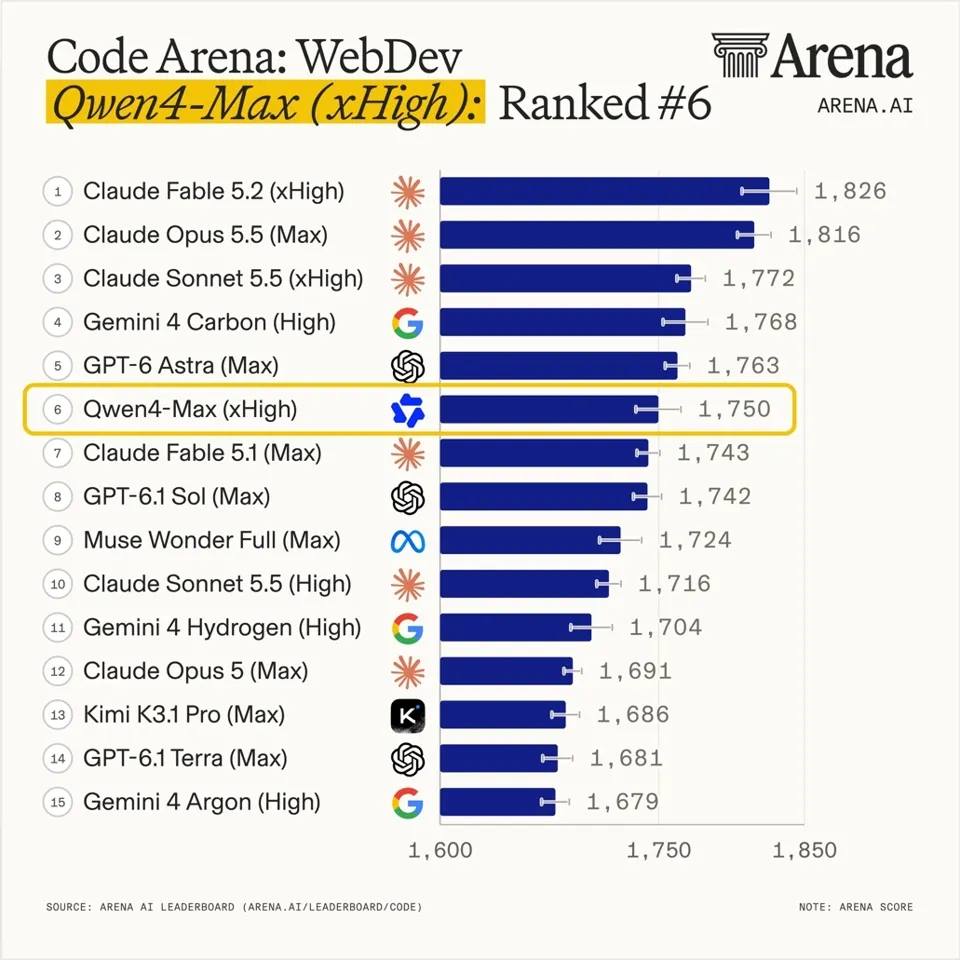
On November 16, Alibaba released its new-generation foundation model Qwen4-Max, with 2.4T total parameters, native vision capabilities, and support for million-token context. Built on an innovative model architecture and training optimizations, Qwen4-Max achieves higher performance with lower token consumption and continues to advance in key capability areas such as agents and coding: in the authoritative global front-end coding blind test CodeArena, Qwen4 ranks sixth; in third-party evaluations of agent capabilities and professional tasks such as Agents' Last Exam (ALE) and Vals Index, Qwen4 is in the leading tier. Qwen4 is deeply optimized for real-world tasks across domains, can better invoke professional tools to handle long-horizon tasks, and advances the deep deployment of AI in professional fields such as automotive manufacturing, game development, financial investment research, and scientific research.
Qwen4-Max is now available on the Qwen AI platform, providing API services, with cache hits costing as little as 0.5 yuan per million tokens, and the average cost of completing a single task plunging 60% compared with the previous-generation model; users can also call the new model through Alibaba Token Plan, or experience it directly in applications such as Qwen Office, Qoder, and the Qwen APP. It is reported that the small- and medium-sized models in the Qwen4 series will be open-sourced and released successively.
Qwen4-Max adopts a new MoE architecture based on Qwen Sparse Attention (QSA), with 2.4T total parameters and only 71B activated, 25% fewer activated parameters per token than the previous-generation model, and higher thinking efficiency: in the Terminal-Bench 4.0 professional coding evaluation, at the same Xhigh thinking level, Qwen4-Max's average token usage per attempt dropped from 289K to 151K compared with the previous-generation Qwen3.8-Max, a reduction of nearly 50%, while the evaluation score rose from 38.9 to 48.5, an improvement of nearly 25%. At the same time, thanks to the sharp drop in cache-hit pricing, evaluation results show that Qwen4-Max's average cost per task (Cost per Task) is 58% lower than that of Qwen3.8-Max.
The entirely new architecture combined with efficient training optimizations has comprehensively improved Qwen4-Max's performance. In the authoritative global blind-test leaderboard CodeArena, which focuses on coding, Qwen4-Max ranks 6th worldwide in front-end (Webdev), between GPT6-Astra and Claude Fable5.1, setting a new best result for Chinese models; in the "Agents' Last Exam" Agents' Last Exam (ALE), it achieved the highest score of 46.7, a substantial increase of 18.8 points over Qwen3.8-Max; in the Chartography evaluation, which assesses large models' ability to understand professional charts and reason, Qwen4-Max scored 54.2, an improvement of 12.2 points over the previous-generation model; in the professional work evaluation JobBench, the new model scored 68.5, surpassing GPT-6.1sol and trailing Claude Opus5.5; in the law-focused evaluation HLAB-Vals-1.1, Qwen4-Max scored 21.3, an improvement of 5.9 points over Qwen3.8-Max, placing it among the industry's leading models.
Whether for simple everyday needs or long-horizon complex tasks, Qwen4 can deliver reliably, making human-AI collaboration smoother and more efficient. Qwen4-Max implements a Live Delivery mechanism within the model, which can first generate a usable initial version and then continuously expand the content version by version according to user feedback until completion: for a design request for a physics classroom popular-science website, Qwen4-Max delivered 14 usable versions, ultimately expanding it into a polished website including 3D animations, interactive experiments, and detailed explanations of principles. At the same time, Qwen4-Max also possesses the ability to perform operations research modeling, solving, and verification around complex objectives and constraints, and through autonomous planning and continuous iteration, orchestrates agents to solve more complex tasks: based on Alibaba Cloud's AI infrastructure, Qwen4-Max autonomously and closed-loop optimized the runtime systems supporting its own applications, inference, and training, reducing model costs by 10% in data annotation scenarios and increasing the optimal solving speed in CPU offline rescheduling scenarios by more than 14 times.
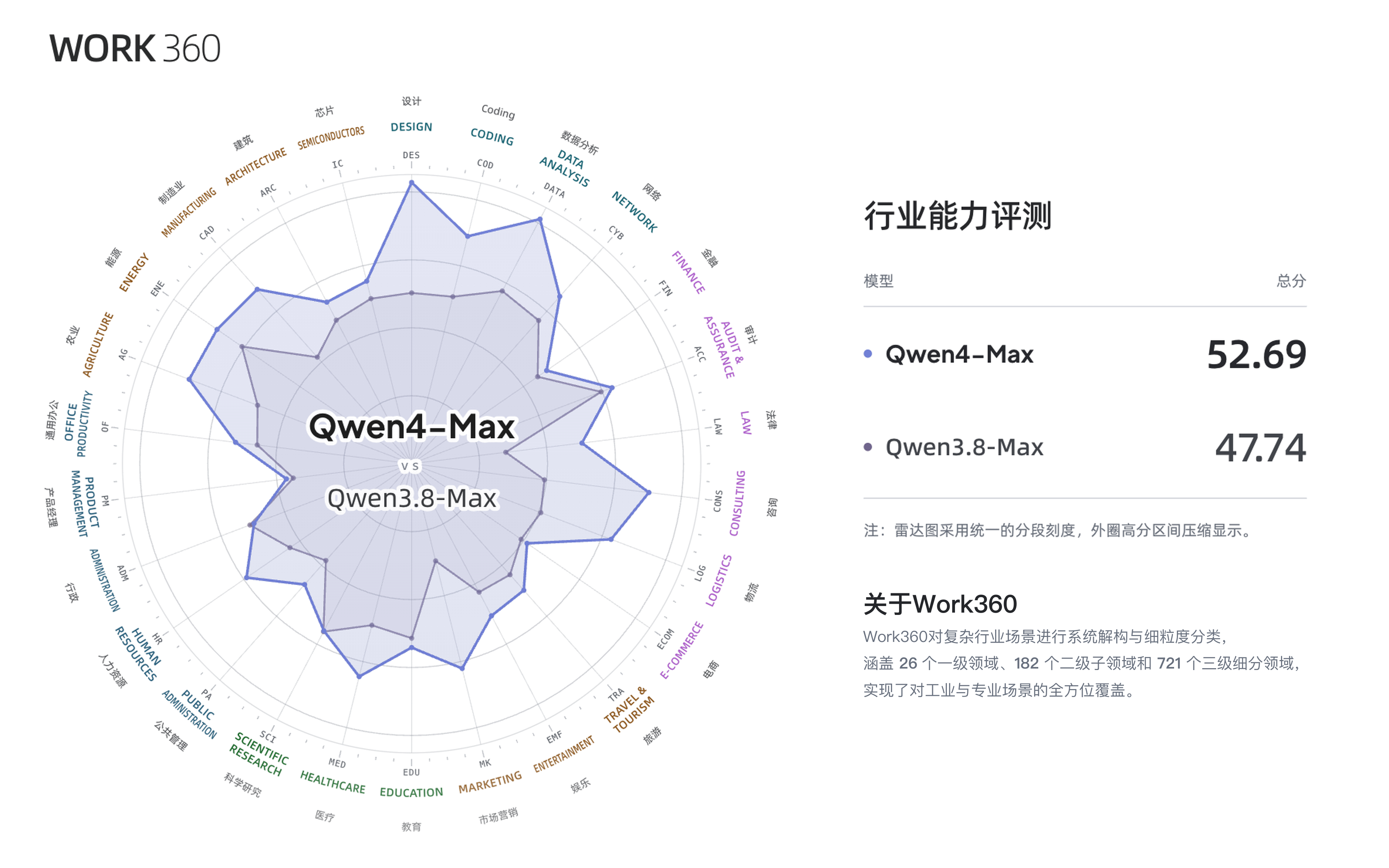
From professional collaboration (Cowork) to all-weather agents, Qwen4 is penetrating more real-world work tasks and production environments. The Qwen team built the Work360 full-scenario modeling system covering 721 subfields, and in systematic evaluations, Qwen4-Max scored 52.69, an improvement of more than 10% over the previous-generation model. In professional design fields such as game development, Qwen4 demonstrates strong 3D modeling capabilities and can better invoke professional tools such as Blender, generating a fun and cool 3D game with a single sentence. In the automotive manufacturing industry, Qwen4 has been applied throughout the entire process of production line planning, part design, and machining verification, drastically reducing the manual time for machining programming of a single workpiece from 475 minutes to 24 minutes, a reduction of 95%; in financial investment research scenarios, Qwen4 proficiently invokes 90 MCP professional tools to produce Excel workpapers and PPT reports, supporting dual traceability to ensure reliable conclusions.
In the frontier field of AI-assisted scientific discovery (AI For Science), Qwen4 has initially produced real results in materials and drug discovery. In the field of materials discovery, Qwen4 ran autonomously for 48 consecutive hours, selected candidate molecules from 2.7 million candidate molecules, and through four rounds of a "design—synthesis—test" closed loop, actually synthesized a new type of coolant material, providing a new approach to alleviating the data center cooling challenges brought by high-power chips; in the field of drug discovery, targeting a key target for Alzheimer's disease, Qwen4 completed 3,239 computational evaluations through 454 tool calls, designed and optimized 24 candidate molecules, and ultimately the nominal binding affinity of the preferred molecule to the target was about 3.6 times higher than that of the starting molecule, making it a more effective new option.