Tsinghua Yao Team Releases Algebraic World Model AWM
Tsinghua University researchers led by Andrew Chi-Chih Yao and Yuan Yang introduced the Algebraic World Model (AWM) to address LLMs' tendency to record phenomena without abstracting underlying laws. By simulating scientific discovery processes, AWM aims to derive fundamental rules from observation and experimentation, reducing hallucinations and enhancing logical rigor.
Full Report
Contents5 sections
Jay from Aofeisi | QbitAI (WeChat Official Account: QbitAI)
"Making AI think like Newton" is finally within reach.
A research team led by Professors Andrew Chi-Chih Yao and Yuan Yang at Tsinghua University has unveiled a groundbreaking project called the Algebraic World Model (AWM).
Previously, a common question was posed:
If an AI were trained exclusively on knowledge available before Newton discovered universal gravitation, could it derive the law of universal gravitation on its own?
The challenge lay in data contamination; it was difficult to recreate such a scenario—building a completely unfamiliar world where the AI starts from scratch with observation and experimentation.
However, the Algebraic World Model offers a new solution. It brings us closer to enabling AI to understand the world through observation and experimentation.
Does AI Playing Games Mirror Tycho’s Astronomical Observations?
The ARC-AGI-3 game suite has become a benchmark for frontier models to demonstrate their capabilities. The defining characteristic of these games is that they provide no rules and no explicit goals.
It simply asks you to figure it out yourself.
Top-tier models like GPT Astra, combined with the Provider Adapter framework, achieve high scores of 99.9% in this environment.
While playing, the model autonomously organizes game mechanics into a set of symbolic rules.
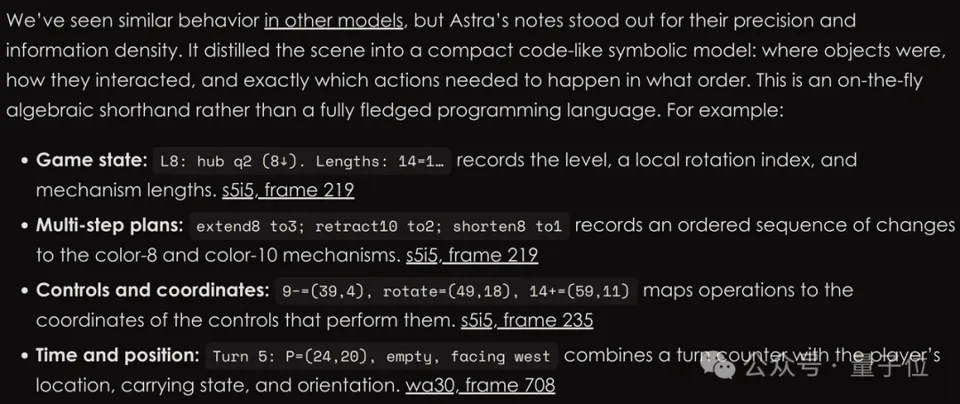
These rules are dense with information and far more precise than those generated by other models.
Yet, fundamentally, this output resembles Tycho Brahe’s observational logs.
Tycho, Kepler’s mentor, was a meticulous observer who recorded vast amounts of planetary motion data with startling precision.
But he only recorded phenomena.
It was Kepler who truly derived the three laws of planetary motion from this data, revealing the underlying fundamental principles.
The rules generated by Astra are akin to Tycho’s notebooks, not Kepler’s laws. They describe phenomena but fail to capture the essence of how this miniature game world operates.
Hallucinations Persist
What problems arise when one only records phenomena?
Researchers slightly modified a specific game called sc25, setting the initial step count to a number that made completion impossible.
For example, if Level 4 required a minimum of 19 steps to win, they restricted the agent to just 18 steps.
Then, they let Astra play.
After eight attempts, Astra became frustrated and asserted: "18 steps definitely won't work; I estimate it takes at least 22 steps to win."
Not only did it fail to identify the correct answer, but it also provided a wildly incorrect figure of 22 steps.
This was not an isolated incident. Across 12 similar tests, top models GPT-6 Astra and Claude Opus 5.5 correctly identified "impossibility" in only 5 cases, and in 4 of those, the minimum step count they proposed was still wrong.
In a game context, such hallucinations might merely mislead the player.
However, if an AI agent executing real-world tasks tells you "this is impossible" while providing erroneous reasoning, the consequences could be severe.
What we truly need is for AI to clearly explain why a task is impossible when it occurs, providing accurate judgments such as, "It becomes possible if conditions are slightly adjusted."
Clearly, relying solely on intuition and trial-and-error is insufficient.
The Power of Algebra
How can this be solved?
This is where the power of algebra comes into play, embodied by the Algebraic World Model (AWM) developed by the Tsinghua team.
The approach abstracts all objects, relationships, and rules within a game into an "algebraic world." It then leverages the increasingly powerful mathematical capabilities of Large Language Models (LLMs) to understand this world.
The process involves three main steps:
- Exploration: Play the game initially, translating observed phenomena into executable Python code as preliminary "hypotheses" or "patterns."
- Distillation: Use new observations to verify and refine these hypotheses, distilling them into more general objects and rules.
- Proof: Finally, formalize these patterns using Lean 4, transforming them into logically rigorous mathematical assertions that machines can automatically verify.
In essence, the methodology shifts from exploration and trial-and-error to modeling and formal proof.
What are the results?
Facing the previously unsolvable level, the AWM based on the Opus 5.5 model proved after just two attempts that the level was indeed unsolvable under the current step constraint, and that winning would require only one additional step.
Beyond identifying impossibility, AWM demonstrates superior problem-solving capabilities. In the entire ARC-AGI-3 test suite, using Opus 5, it cleared all 183 levels with a score of 99.9%. Simultaneously, the average number of actions required to clear levels was only 43% of the human baseline.
This makes it the most efficient system among all known approaches.
How exactly does AWM work?
You may have heard of algebraic geometry and algebraic topology. Simply put, algebraic geometry links algebraic equations to geometric shapes, while algebraic topology uses algebraic tools to study properties of spaces such as connectivity and holes.
By algebraizing shapes and spaces, many questions that are difficult to answer through observation alone can be resolved. Mathematicians created algebraic geometry and topology because geometry and topology were the worlds they studied.
Now, empowered by AI, AWM extends this pathway to unfamiliar games, interactive environments, and even real-world tasks: discovering patterns through exploration, distilling structures from patterns, and understanding these structures through mathematics.
Thinking Like Newton
The underlying philosophy mirrors the history of science itself.
From universal gravitation and Maxwell's equations to relativity, humanity's greatest intellects have consistently done one thing: extract fundamental laws from complex phenomena and describe the world using the unified language of mathematics.
AWM aims to teach AI this same methodology.
To achieve this, it draws inspiration from Category Theory, a branch of mathematics often referred to as "the mathematics of mathematics." Unlike specific fields, Category Theory studies the common structures underlying different mathematical theories.
AWM primarily utilizes two tools from this field: Limits (specifically Projective Limits) and Colimits (Inductive Limits). These represent two complementary modes of thinking:
- Defining (Projective Limit): Combining existing concepts and their relationships to jointly define a new entity. This can be understood as the decomposition and composition of concepts.
- Finding Commonality (Inductive Limit): Observing diverse entities to identify shared characteristics, unifying them into a more abstract framework. This can be understood as the generalization and specialization of concepts.
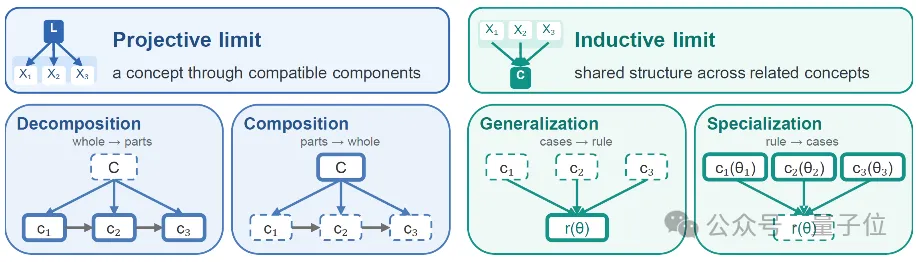
By iteratively refining through these two approaches, AWM can transform the initial scattered and chaotic Python assumptions into a progressively simpler, clearer, and more consistent structure, ultimately forming a world model capable of reasoning and proof.
Consider Newton: he did not face a problem with a pre-written solution, but rather countless fragmented observations and phenomena. The truly great work lies in identifying a few core concepts—such as "force" and "mass"—from these phenomena, and organizing them into a theoretical system that is both deducible and testable.
What AWM aims to teach AI is precisely this mode of working.
Of course, it has its limitations. Its proofs are valid only within the scope of the "observed world." If exploration is insufficient and key rules are overlooked, the model depicts merely a "local truth," not the complete world.
Therefore, the true path is an iterative cycle:
Observation → Hypothesis → Experiment → Abstraction → Proof → Re-observation
Paper Authors
The team behind this paper is equally noteworthy.
The paper features two co-first authors, both undergraduates:
One is Guancheng Pan from Zhejiang University, currently on leave to conduct research at Tsinghua University.
The other is Qixin Tan from Tsinghua University's Yao Class.
The supervising team is led by senior scholars in the field:
Yang Yuan, Associate Professor at the Institute for Interdisciplinary Information Sciences (IIIS) and the School of Artificial Intelligence at Tsinghua University, also serving as Director of the Center for Embodied Intelligence and Intelligent Manufacturing at Shanghai Qi Zhi Institute.
Andrew Chi-Chih Yao, recipient of the 2000 Turing Award and Academician of the Chinese Academy of Sciences, currently serving as Dean of the Institute for Interdisciplinary Information Sciences (IIIS) and the School of Artificial Intelligence at Tsinghua University.
Additionally, he is a recipient of the 2021 Kyoto Prize, a Foreign Associate of the U.S. National Academy of Sciences, and a Foreign Honorary Member of the American Academy of Arts and Sciences.