FaceMind Proposes General Looped Model to Trade Parameters for Compute Depth
Zhipu's GLM-5.4 is the first flagship model to adopt a Looped Transformer, running 28 layers twice to reportedly match 2-3 trillion parameter models, while OpenAI's Astra is said to pursue similar recurrent-depth techniques. FaceMind extends the idea with its General Looped Model, generalizing weight-shared looped computation from language models to world models and diffusion generation, offering a new scaling path that trades parameter count for compute depth.
Related Entities
Full Report
Contents7 sections

Through weight sharing and recurrent computation, achieve stronger model capabilities with fewer parameters.

Published by Machine Heart
On November 23, Zhipu released its new-generation flagship model GLM-5.4. Its most notable aspect is that it is the first flagship model to introduce the Looped Transformer architecture.
A 28-layer network, run for two rounds. Zhipu claims that its intelligence level is already comparable to models with 2 trillion to 3 trillion parameters.
Meanwhile, according to The Information, OpenAI's Astra model under development also adopts similar looped-depth technology.
For a time, looped architectures suddenly became a new hotspot in the large model field.
However, while the industry is still discussing how to apply looped architectures to language models, another Chinese AI company, FaceMind, has already extended its research scope to world models and diffusion generation, and proposed a more general framework:
After carefully investigating this company's research path, we found that the potential of looped architectures may go far beyond large language models.
01 Large Models Have Switched to a Different Scaling Approach
Over the past few years, the most direct way for large models to improve capabilities has been to expand parameter scale.
But as models enter the trillion-parameter era, VRAM capacity, memory bandwidth, and deployment costs have gradually become important factors constraining model development.
Looped architectures attempt to start from computational depth.
A traditional Transformer usually passes each network layer through computation only once in a single forward pass. A Looped Transformer allows the same set of network layers to participate in computation repeatedly, with each iteration continuing to process based on the hidden state from the previous round.
Because multiple rounds of computation share weights, the model can increase effective computational depth without increasing parameter count proportionally.
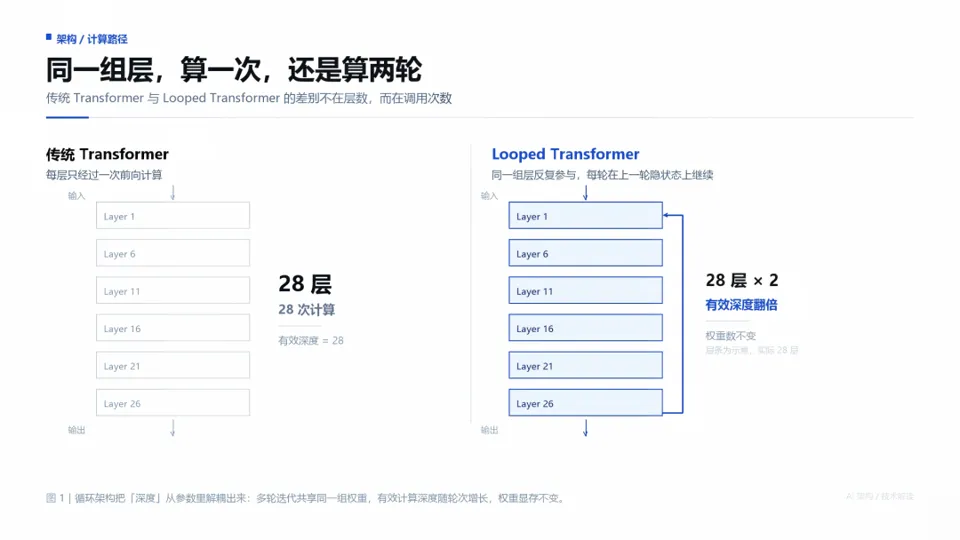
Parameter scale affects how much information a model can store and express, while computational depth affects the model's ability to handle complex problems.
As a result, some tasks can improve performance by increasing computational depth while reducing demand for weight VRAM and high-bandwidth memory (HBM).
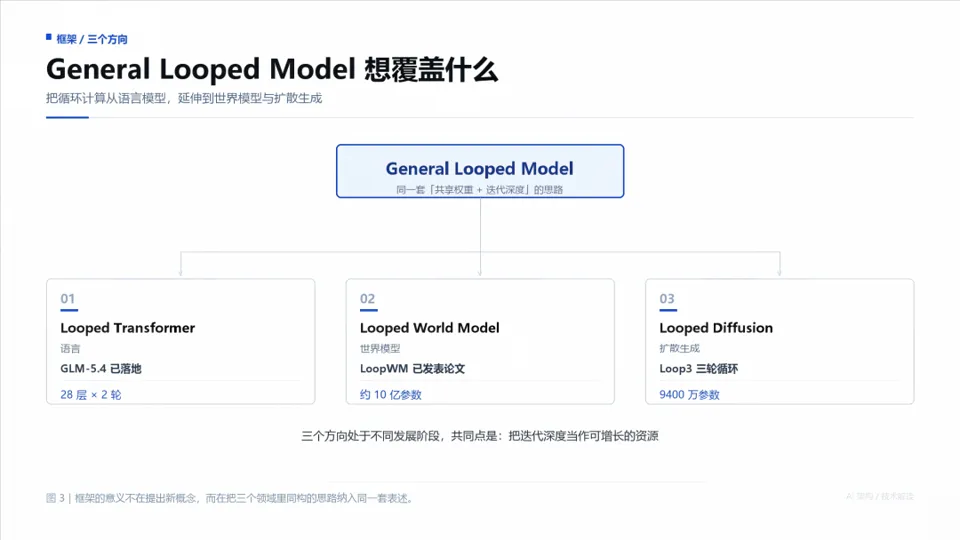
The General Looped Model proposed by FaceMind is precisely intended to extend this idea from language models to more types of AI models.
This framework currently involves three technical directions.
02 From Language Reasoning to World Simulation
Looped Transformer: Letting Language Models Think More Deeply
GLM-5.4 is an important attempt at bringing looped architectures into mainstream flagship language models.
In experiments published by Zhipu, a 30B model using the looped architecture achieved performance improvements with only about a 10% increase in training compute at the same parameter scale.
Zhipu also acknowledged that looped computation is not an entirely new research idea. The significance of GLM-5.4 lies in the fact that this architecture is beginning to be applied to large-scale flagship models.
The model scaling approach that originally relied mainly on parameter growth is evolving toward parallel development of parameter scale and computational depth.
Looped World Model: Letting AI Repeatedly Simulate the World
World models need to understand environment states and predict what will happen next based on given actions. This is a more complex task than those faced by language models. As the number of prediction steps increases, small errors that appear earlier may continuously accumulate and affect subsequent judgments.
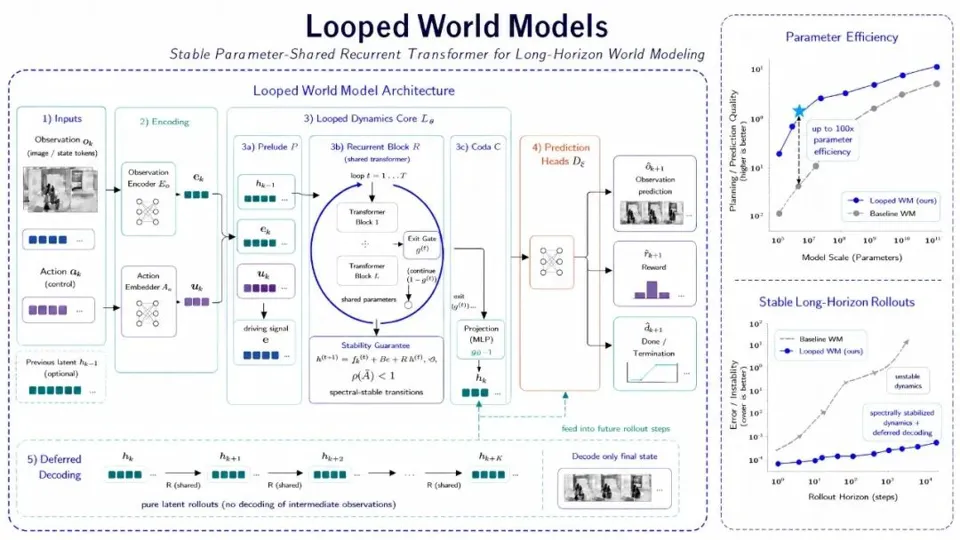
In June this year, FaceMind published the paper "Looped World Models," proposing LoopWM. The paper abstract describes it as the first looped architecture for world modeling.
Its core design is to use Transformer modules with shared weights to repeatedly update estimates of environment states and adjust computational depth according to the complexity of the prediction task.
In the ALFWorld multi-step state prediction experiment, LoopWM with about 1 billion parameters was compared with Claude Opus 4.6 Max.
Although its exact match rate was slightly lower, LoopWM gained advantages on some other metrics.
This set of data shows that small-parameter models, through looped computation, may also be able to compete with large models in specific world modeling tasks.
Looped Diffusion: Turning Parameter Efficiency into Deployment Advantages
Looped architectures have also shown potential in the field of diffusion generation.
According to FaceMind's internal technical report on October 8, in a unified local testing pipeline, a three-round looped model Loop3 with only 94 million parameters was compared with BWM with 5 billion parameters.
The parameter scales of the two differ by about 53 times.
Among 16 evaluation metrics, Loop3 surpassed the comparison on 7, was slightly worse on 3, and still lagged on another 5.

The difference in deployment is also obvious.
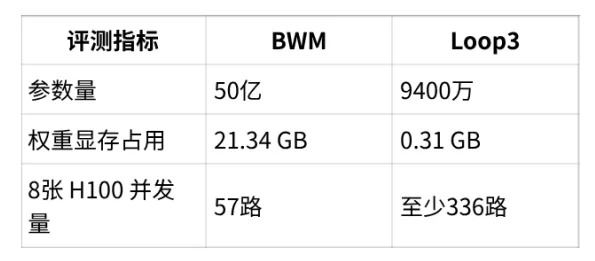
Weight VRAM usage dropped by about 98.5%, and concurrency capacity increased to nearly 6 times the original.
Of course, this set of data comes from a unified test environment with 128 × 128 resolution, 57 frames, and FP16 precision, and cannot be directly compared with WorldArena leaderboard results.
From the perspective of engineering deployment, substantially reducing weight storage overhead while maintaining a certain level of generation quality can create the conditions for high-concurrency deployment.
03 Looped Architectures Also Have Their Own Costs
Reducing parameters does not mean that computational cost will decline in tandem.
Although weight sharing can reduce the model's storage pressure, each additional round of iteration requires extra computation time.
GLM-5.4 has already exposed a similar problem. Zhipu mentioned in a technical blog that the model sometimes falls into excessively long repeated thinking, leading to increased response latency.

In addition, if the model forms an incorrect judgment in an early iteration, subsequent computation may also continue reasoning in the wrong direction.
How many times to loop, when to stop, and how to dynamically allocate compute based on task difficulty will all become engineering problems that such architectures need to solve.
These choices also affect computational efficiency. After parameter efficiency improves, computational efficiency may not necessarily improve along with it, and looped architectures still need to solve this problem before moving toward large-scale commercial deployment.
04 Will Loop Depth Become a New Scaling Dimension?
From Zhipu's GLM-5.4 to FaceMind's LoopWM and Looped Diffusion, looped architectures are being validated in different fields.
The significance of FaceMind proposing the General Looped Model lies in attempting to bring these technical directions into a single research framework.
Language models can use looped computation to improve reasoning depth, world models can improve state prediction through iteration, and diffusion models have the opportunity to achieve high-concurrency deployment with a smaller weight scale.
These explorations are currently at different stages of development. Bringing them into the same framework also allows FaceMind to conduct research around the same question: in different tasks, how much capability improvement and deployment benefit can be brought by increasing the depth of iterative computation.
Over the past few years, the industry has been accustomed to measuring the strength of a model by parameter scale.
In the future, how parameters are utilized may become more important.
© THE END
For reprinting, please contact this official account for authorization.
Submissions or report inquiries: [email protected]