Anthropic Launches Claude Haiku 5.5: Input Price Drops 90%, OSWorld Score Jumps to 72.4%
Anthropic released Claude Haiku 5.5, reducing short-context input prices by 90% and average running costs by ~75%. The model's score on the OSWorld 2.1 benchmark surged from 15.7% to 72.4%, and it introduces a five-level 'effort' control for cost-performance balancing. Additionally, Sonnet 5.5 cache read prices were halved, and Max/Team subscribers now receive monthly API credits.
Related Entities
Full Report
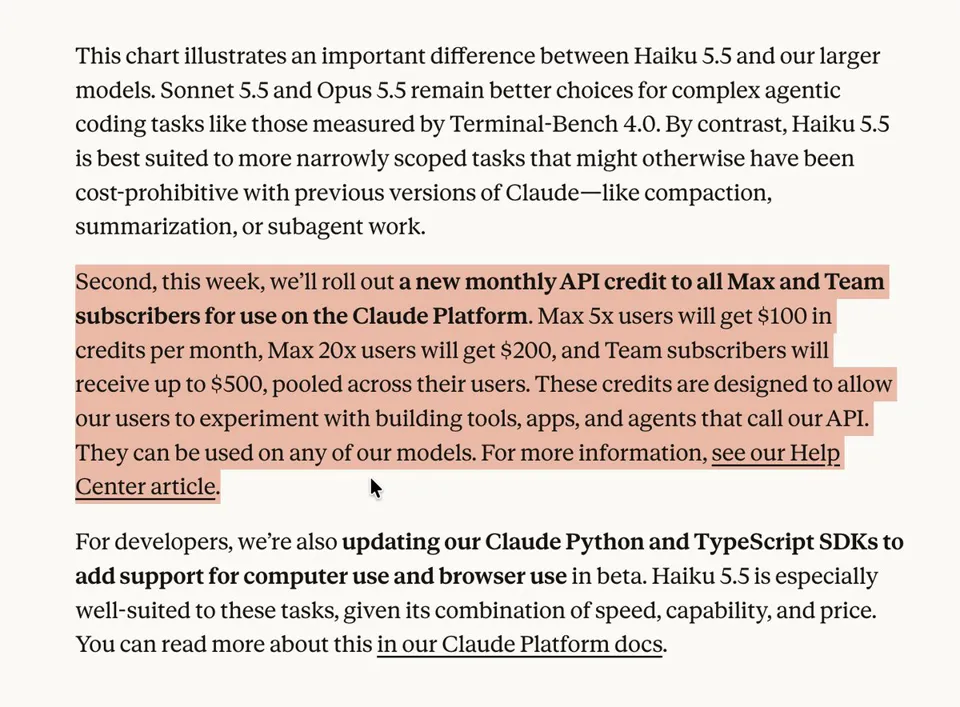
Starting this week, Claude Max and Team subscribers will receive a monthly API credit: $100 for Max 5x, $200 for Max 20x, and up to $500 for Team plans (shared among team members). This credit is exclusively usable on the Claude Platform.
https://www.anthropic.com/claude-haiku-5-5
↳ Quoting @dotey (Baoyu): Anthropic releases Claude Haiku 5.5: Small model pricing drops to one-tenth of the previous generation
Anthropic released Claude Haiku 5.5 today. Haiku is the smallest and most affordable tier in the Claude family, positioned below Sonnet and Opus, primarily designed for high-volume, cost-sensitive tasks.
The most significant change this time is pricing. For requests under 100k tokens, Haiku 5.5 costs $0.1 per million input tokens and $0.5 per million output tokens—a 90% reduction compared to Haiku 4.5. For long requests exceeding 100k tokens, the price is $0.5 and $2.5 respectively, representing a 50% decrease. Approximately 90% of requests received by the previous-generation Haiku were within the 100k token limit, so according to official estimates, average operational costs have dropped by about 75%.
100k tokens roughly equates to the length of a novella. Daily tasks such as customer service dialogues, document summarization, and classification tagging generally fall within this range.
While prices have dropped, capabilities have improved. In officially published benchmarks, performance on multi-step computer operation tasks (OSWorld 2.1) jumped from 15.7% in Haiku 4.5 to 72.4%; autonomous coding task completion via command line (Terminal-Bench 4.0) rose from 0 to 39.2%. Anthropic states it is currently the fastest model available (excluding Opus in fast mode), with Asana reporting a reduction in task completion latency of over 30% in real-world tests.
Officially recommended use cases fall into two categories. One involves batch repetitive work, such as summarization, classification, database queries, and scenarios requiring rapid response like real-time customer support or browser automation. The other involves supporting larger models: using Opus 5.5 or Sonnet 5.5 as the primary engine for coding while delegating fragmented subtasks to Haiku 5.5—effectively acting as a sub-agent.
Haiku 5.5 is also the first Haiku model to feature adjustable "effort" levels, ranging from low to highest across five tiers. Developers can select lower effort levels for simple tasks to save costs and higher levels for complex tasks to improve results.
Haiku 5.5 is available starting today via the Claude API, as well as on Amazon AWS, Google Cloud, and Microsoft Azure, under the model name
claude-haiku-5-5.Two additional announcements were made simultaneously.
Cache read pricing for Sonnet 5.5 has been halved, dropping to $0.1 per million tokens. Caching stores frequently reused content (such as lengthy system prompts or entire codebases) so it can be retrieved directly next time without recomputation. Since this overhead constitutes a major portion of agent-based tasks, officials estimate that this price cut reduces the cost of running most agent tasks with Sonnet 5.5 by approximately 20%.
Starting this week, Max and Team subscribers will receive a monthly API credit: $100 for Max 5x, $200 for Max 20x, and up to $500 for Team plans (shared among team members).