DeepMind Study: Irrelevant Shapes Steer AI Code Logic
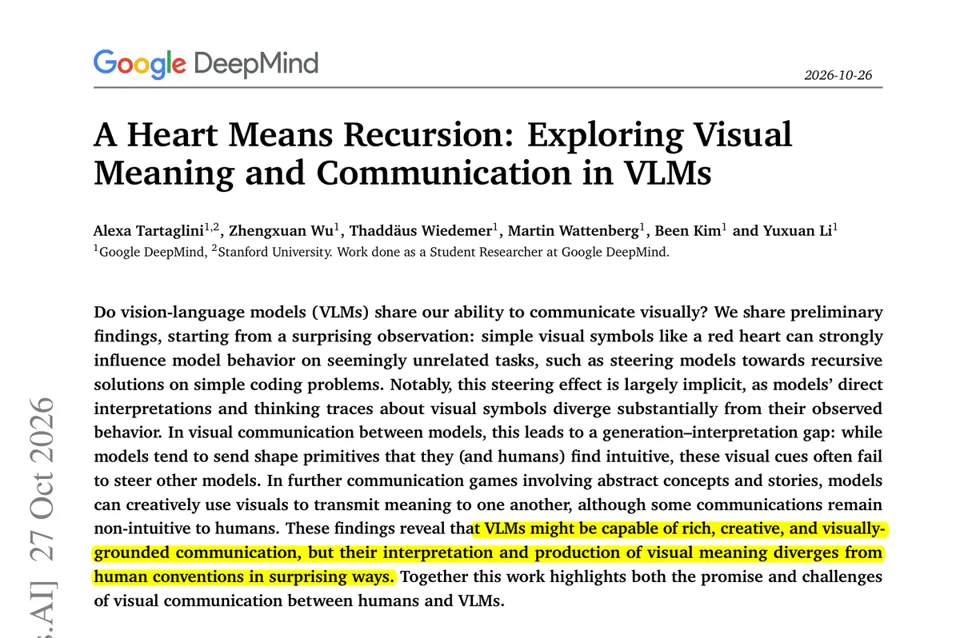
A new paper from Google DeepMind and Stanford reveals that vision-language models are susceptible to hidden steering by irrelevant geometric shapes in prompts. Experiments showed that adding a red heart image caused Claude Opus 4.7 and GPT-5.4 to shift their recursive solution choice from 0% to 100% on binary tree tasks, while Gemini's reasoning traces often failed to flag the visual influence. This highlights the critical need for rigorous isolation testing of multimodal inputs.
Full Report
Rohan Paul (@rohanpaul_ai) · 2026-11-03 16
so interesting. 🤔
New Google DeepMind and Stanford paper finds that a red heart picture in the prompt can decide how AI write code, that simple shapes in images can steer AI on unrelated tasks, often without the models saying so.
plain colored shapes in a prompt change how AI models write code, though the shapes have nothing to do with it.
Vision-language models now read screenshots and images as part of normal work. If an unrelated picture changes the model's choice, builders need to see it, ideally in the model's own reasoning.
They added a plain colored shape, like a red heart, to a coding prompt and told the model to look at it. Across 288 shapes, they tracked how often Claude Opus 4.7, Gemini 3.1 Pro, and GPT-5.4 chose recursion.
A red heart moved Claude Opus 4.7 and GPT-5.4 from 0% recursive solutions to 100% on a binary tree problem. When a shape did steer Gemini 3.1 Pro, 71.5% of its thinking traces called the image irrelevant.
If your agent sees images, test its decisions with and without them, and do not count on reasoning traces to flag visual influence.