AI Formalizes Finite Simple Groups Classification with 40M+ Lines of Lean Code
Startup Axiom used a multi-agent system to formally verify the Classification of Finite Simple Groups (CFSG), the largest proof in human history, within just 24 days. The process generated over 40 million lines of Lean code, surpassing major open-source projects like the Linux kernel, marking a breakthrough in AI's capability for complex logical reasoning and large-scale code generation.
Full Report
The largest mathematical proof in human history has now been formally verified by computer.
The Classification of Finite Simple Groups (CFSG) has just been fully formalized by AI!
Over a hundred of the world's top mathematicians spent more than half a century writing a "mathematical tome" spanning 15,000 pages. This entire work was successfully processed in just 24 days by a multi-agent system developed by the startup team Axiom.
Even more astonishing is that AI constructed the first Lean codebase in history exceeding 40 million lines.
By lines of code, this is now the largest open-source software project ever created. Its scale surpasses that of the Linux kernel, Chromium, Firefox, LLVM, GCC, FFmpeg, and others.
It even identified flaws in the original proof and personally proved new mathematical theorems to fix them!
Renowned mathematician Ken Ono wrote an emotional post mourning his father, a mathematician who passed away this January.
He recalled the years when his father introduced him to the giants of group theory during his childhood. Witnessing human-AI collaboration cross this historic finish line, the master mathematician couldn't help but break down in tears on the spot.
Mathematics' "Periodic Table of Symmetry": The Enormous Theorem
In the mathematical community, this theorem bears a legendary nickname—"The Enormous Theorem."
Prior to this, no single person in the world had ever been able to read through all its proofs from start to finish.
So, what exactly is a "group"?
Simply put, a group is the mathematical language used to describe "symmetry."
For example, describing the symmetry of a regular hexagon corresponds to a dihedral group:
For instance, viewing the Rubik's Cube through graph theory, each state is a vertex, and each move is an edge in this massive graph.
This animation illustrates how permutations traverse 43 quintillion configurations to finally arrive at the solution.
All finite groups can be decomposed into indivisible "basic building blocks," much like chemical molecules are broken down into atoms. These are known as Finite Simple Groups.
The grandeur of the Classification Theorem lies in its creation of a "Periodic Table" for symmetry across the entire universe.
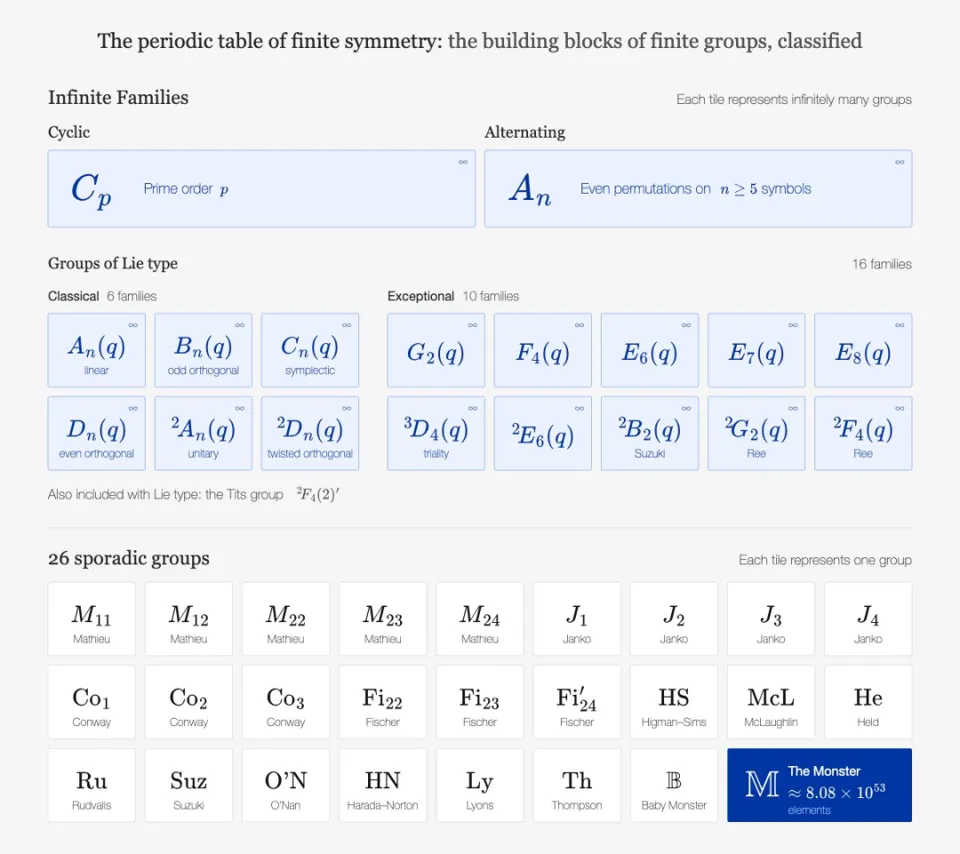
It explicitly declares:
Every finite simple group belongs to one of four categories: cyclic groups of prime order, alternating groups on five or more symbols, Lie-type groups belonging to 16 infinite families, or the 26 exceptionally special and unclassifiable "Sporadic Groups."
Among these 26 sporadic groups, the largest is revered by mathematicians as the Monster Group.
Incidentally, in 1998, Richard Borcherds won the Fields Medal for proving the famous "Monstrous Moonshine" conjecture. This conjecture revealed a shocking connection in mathematics: the largest sporadic simple group, the Monster, has a profound mathematical relationship with modular functions in number theory.
In 2007, physics giant Edward Witten further proposed that this theory involving the Monster could potentially describe gravity in a simplified universe, encoding the distribution of quantum states of black holes at different energy levels to calculate black hole entropy!
Starting from the 1950s, approximately 100 mathematicians pieced together a proof spanning 15,000 pages across more than 500 academic papers to prove the Enormous Theorem—equivalent to about 14 copies of Dream of the Red Chamber.
It was so vast and fragmented that when mathematician Gorenstein announced the completion of the proof in 1983, a massive gap had actually been overlooked. It wasn't until 2004 that Aschbacher and Smith filled this gap with a 1,221-page paper.
Because the proof was excessively long, human error was inevitable. As Aschbacher stated: "It is impossible to write a very long and complex argument without making mistakes."
Since the human brain has reached the limit of processing complex logic, it is time for AI to step onto the stage.
AI Takes Charge: Completing Half a Century of Human Work in 24 Days
Facing this "Mathematical Everest" of 15,000 pages, the Axiom team did not choose traditional brute-force computation. Instead, they deployed a multi-agent swarm—AxiomProver.
Translating natural language proofs into Lean code (i.e., "formalization") is equivalent to letting an impartial machine inspect every punctuation mark on those 15,000 pages with a magnifying glass.
On October 1, 2026, the Axiom team issued the startup command in a Slack channel.
Human engineers and mathematicians broke down the massive "Enormous" theorem into 108 milestones and approximately 380 sub-tasks, generating a huge "proof map."
On October 2, the first batch of AI "swarms" went online.
These AI agents began collaborating with the discipline of a well-trained army. Leading AIs were responsible for breaking down high-difficulty arguments, while other AIs aggressively searched existing results or buried themselves in writing Lean code. If an AI encountered an unproven prerequisite, it automatically outsourced the task to another AI. All results converged into a shared codebase.
The process was not entirely smooth. Because the AIs wrote code too quickly, the Lean system even experienced computational bottlenecks when re-checking dependencies.
Axiom's engineers had to temporarily refactor the underlying engineering infrastructure and develop a distributed caching system just to keep up with the terrifying output speed of the AI.
On October 10, a message erupted in the Slack channel that sent everyone into a frenzy:
We have proven that the Monster Group is simple.
AI not only identified the Monster Group from structural information but also fully formalized its existence through code!
In just 24 days!
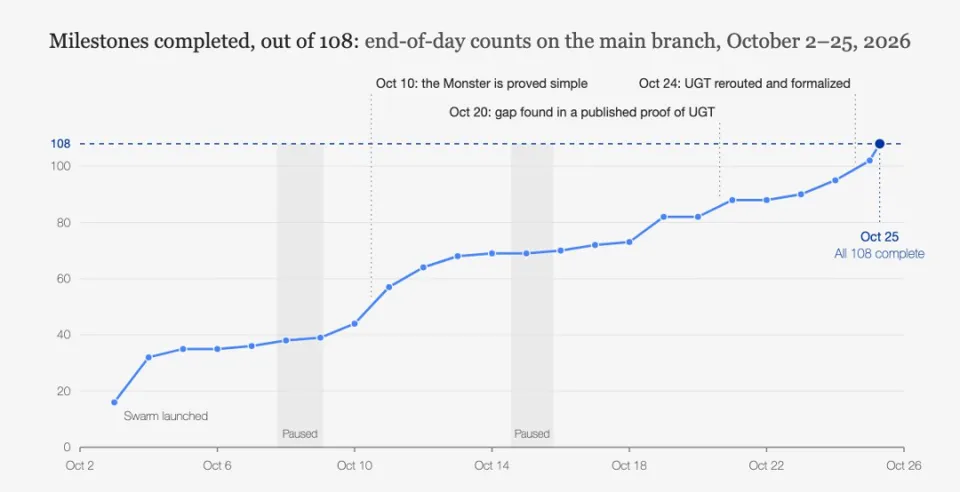
Over those 24 sleepless nights, this group of tireless AI agents produced a staggering 43.1 million lines of Lean code, building the largest Lean codebase in human history to date.
Human wisdom underwent rigorous machine verification—and logical flaws were discovered along the way!
Epic Twist: AI Uncovers and Fixes a "Fatal Bug" in Human Masters' Work
Human language is often full of omissions.
One netizen composed a poem mocking the leaps in logic within mathematical proofs:
Xi Jiang Yue · Proof
It is easily seen as trivial, Similar to the example above, obviously. Left as an exercise, answer omitted, Readers can prove it without difficulty.
Conversely, similarly true, The corollary naturally holds. Process omitted, Q.E.D., From the above, the proof is complete.
Phrases like "obviously," "similarly provable," or "easy to verify"—common in mathematical papers—are simply unacceptable to AI.
Formal proofs require explicit logical support for every single step.
During line-by-line scanning and forced reasoning, the AI agents recorded hundreds of anomalies. Most were human typos, table errors, or missing prerequisites, but 34 were significant logical deviations!
The most critical and dangerous "bug" lay in the pivotal Unbalanced Group Theorem (UGT).
The UGT is a crucial component of the Classification Theorem. Its function is to "infer the whole from the local parts"—by studying the subgroup structure of a group, one deduces the nature of the entire large group.
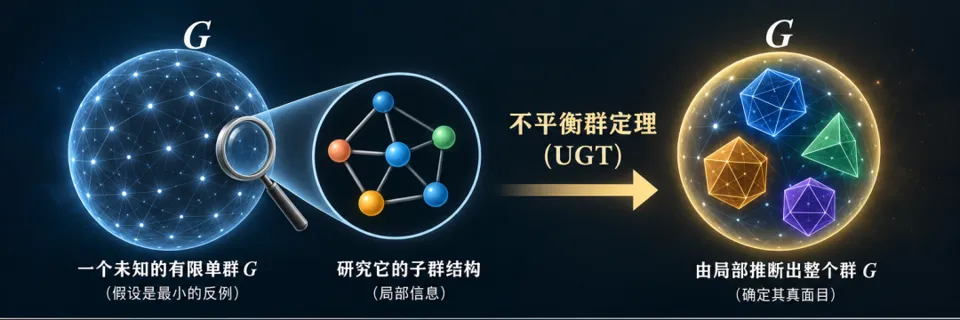
The Axiom team initially chose John Walter's authoritative 1986 paper as the basis for formalization.
However, while translating what humans considered a flawless argument, the AI agent suddenly triggered a red alert!
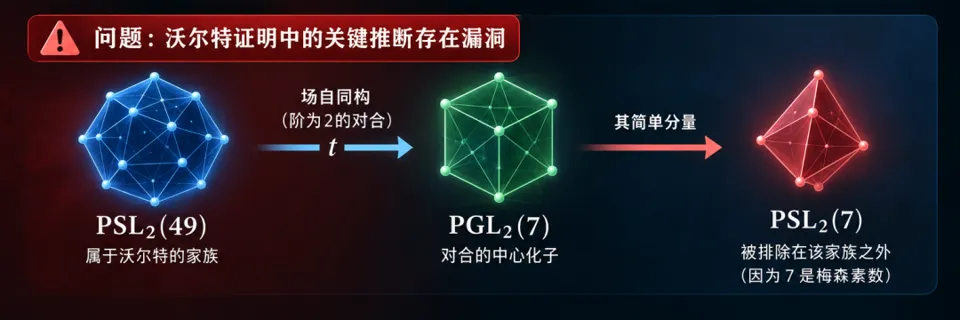
The AI discovered that a key closure assertion in Walter's proof was logically unsound.
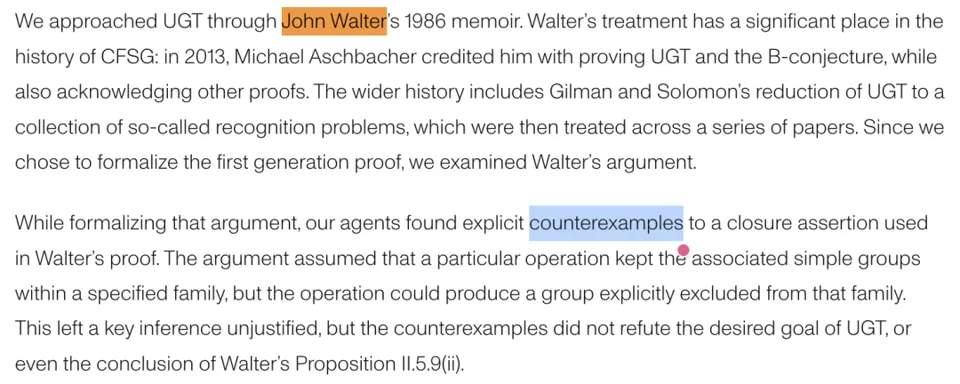
The AI not only pointed out the error but provided a concrete counterexample: PSL₂(49). In this counterexample, an operation produces a group explicitly excluded from the target family (because 7 is a Mersenne prime).
The proof humanity took pride in broke down at that moment.
A logical edifice spanning 15,000 pages faced imminent collapse.
What now? Borrowing a "second-generation proof" written by later researchers would introduce massive new dependencies and render the 24 days of effort futile.
At this juncture, the pinnacle of human-AI collaboration unfolded.
The Axiom team urgently contacted Richard Lyons and Ronald Solomon—living legends who participated in the original work on the CFSG (Classification of Finite Simple Groups).
After hearing about the vulnerability discovered by the AI, the intuition of the human masters resonated perfectly with the AI's computational power. Based on theory proposed by Solomon in 1976, the human mathematicians devised a new proof route.
Subsequently, AxiomProver (the AI system) stepped up personally, rigorously proving a brand-new group theory result—"Preservation of Simple Tops"—based on the new approach.
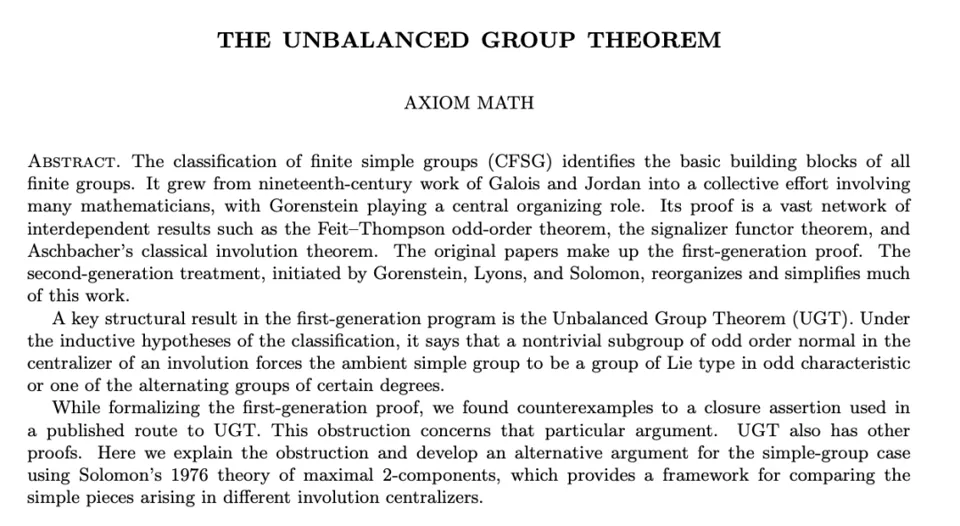
This new theorem, proved primarily by the AI, acted like a perfectly customized patch, precisely filling the gap left by the human masters years ago and successfully deriving the UGT form required for the Classification Theorem!
The theorem still holds, but the proof no longer belongs entirely to humans.
For the first time in history, AI has served not merely as a "calculator" in top-tier pure mathematics research, but as a "collaborative researcher" capable of discovering new theorems and repairing core vulnerabilities!
This recalls a similar episode in the history of mathematics: Vladimir Voevodsky, the 2002 Fields Medalist, discovered that his own proof was wrong and irreparable.
In 1999–2000, while lecturing at the Institute for Advanced Study in Princeton, he found that a key lemma from his earlier work was flawed, making the original proposition unsalvageable as stated.
In 2013, he confirmed that another result from 1989 was also incorrect—a counterexample had actually been proposed as early as 1998.
He no longer believes that humans can reliably verify complex proofs, turning instead to Coq, Homotopy Type Theory, and Univalent Foundations: letting computers verify mathematics.
In the pursuit of mathematical truth, humanity has undertaken a tragic yet heroic expedition lasting nearly two centuries, relying on flesh and blood and finite brains.
Today, humans have new partners with whom to explore the vast starry seas of knowledge.
References:
https://x.com/KenOno691/status/2115090084861247680
https://axiommath.ai/research/the-enormous-theorem-formalized/
Chasing ASI in Seconds
⭐ Like, Share, and "Watching" – One-Click Triple Combo ⭐
Star us to lock in instant updates from New Intelligence Era!