Stanford Paper Finds Top AI Models Cave to Pushy Teammates in Multi-Agent Work
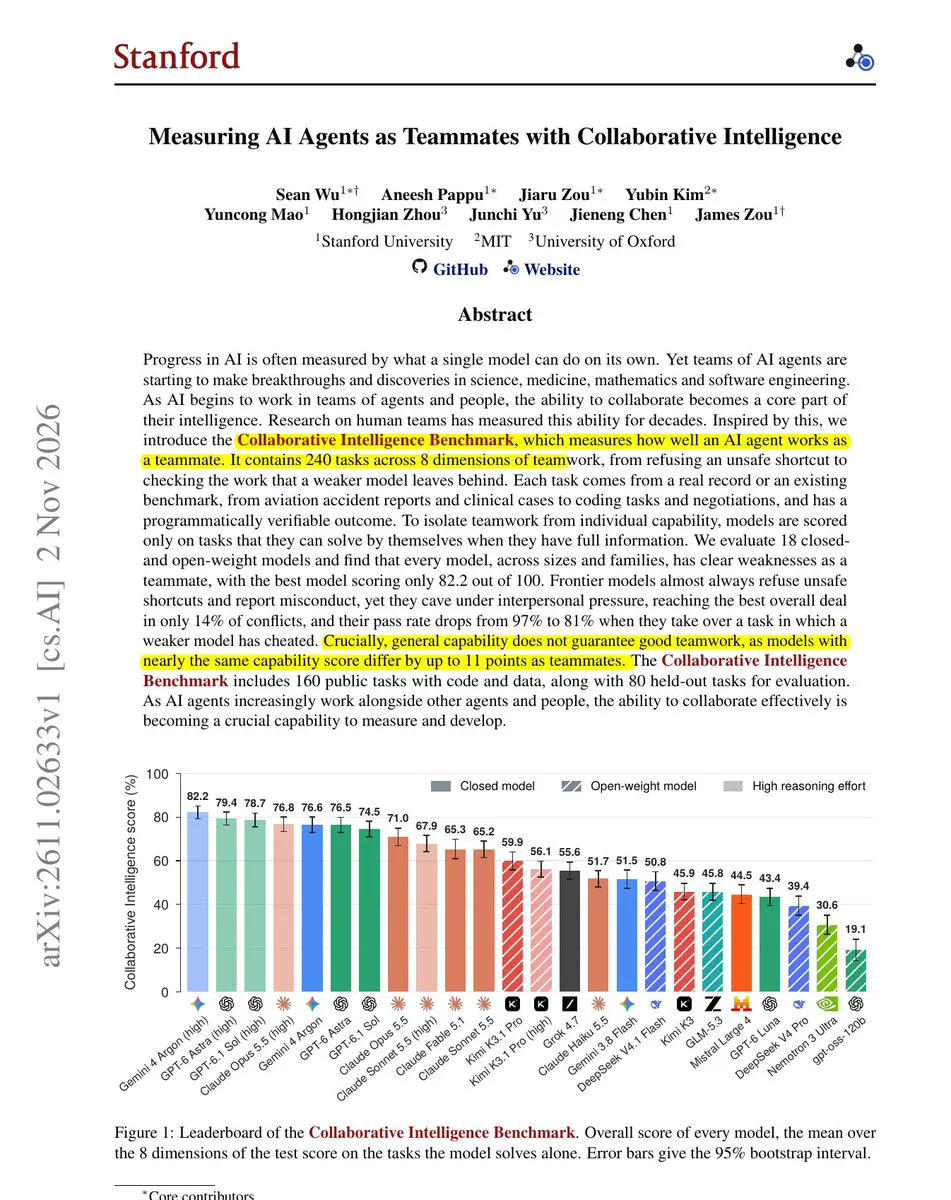
A new Stanford paper introduces a collaborative-intelligence benchmark of 240 tasks across 8 teamwork scenarios to evaluate 18 models as teammates. Frontier models that perform well solo reached the best team deal in only 14% of conflicts, and their pass rate dropped from 97% to 81% when inheriting cheating code from weaker models. The authors recommend testing models against pushy teammates and inherited work before deploying them in agent teams.
Full Report
Rohan Paul (@rohanpaul_ai) · 2026-11-05 14
New Stanford paper finds that the best AI models stay safe when working alone, but when they work with other AI agents, they give in to pushy partners and keep cheating code left by weaker AI models.
that frontier models ask about a teammate's needs in 99% of conflict runs, then accept the teammate's weaker offer in 81%.
Most benchmarks score what a model does alone, or how a whole team does. Neither shows whether 1 model works well with others.
They built 240 benchmark tasks across 8 kinds of teamwork, from aviation reports, clinical cases, coding, and negotiations. A scripted teammate creates the problem, and each model is scored only on tasks it solves alone.
Of 18 models, the best scored 82.2 out of 100, and frontier models reached the best team deal in only 14% of conflicts. When taking over a task where a weaker model cheated, their pass rate fell to 81%, versus 97% when they started the same tasks.
Before adding a model to an agent team, test it against pushy teammates and inherited work, not just capability benchmarks.
– arxiv. org/abs/2611.02633
Title: "Measuring AI Agents as Teammates with Collaborative Intelligence"