Ant Group Open-Sources Ling-3.1-flash for Personal Agent Tasks
Ant Group's Bailian team has open-sourced Ling-3.1-flash-1019 and its base model Ling-3.1-flash-base. The new version utilizes a hybrid linear MoE architecture (560B total/25B active) to enhance complex workflow handling and multi-step task performance, achieving significant score improvements in benchmarks like AA-Briefcase and AutomationBench, specifically targeting 'Personal Agent' scenarios.
Related Entities
Full Report
Contents2 sections
On October 28, Ant Group’s Bailing large model officially open-sourced Ling-3.1-flash-1019.
On October 28, Ant Group’s Bailing large model officially open-sourced Ling-3.1-flash-1019. The new version is further trained and optimized based on Ling-3.1-flash, achieving a score of 44 on the Artificial Analysis Intelligence Index v4.3.2, an improvement of 3 points over the previous version. Simultaneously, Bailing also open-sourced its base model, Ling-3.1-flash-base, laying the foundation for the knowledge, reasoning, and computational efficiency required for long-horizon tasks.
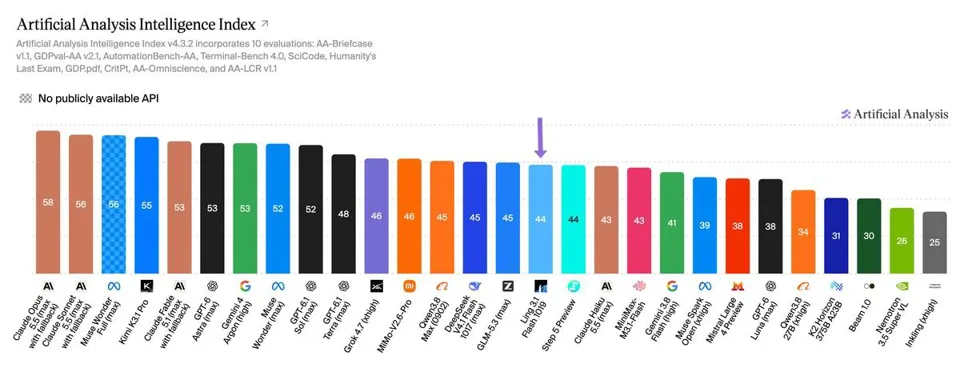
It is understood that the Ling-3.1-flash-1019 version targets Personal Agent scenarios, further enhancing the model's performance in handling complex workflows and multi-step tasks. Specifically, in evaluations, the new version’s score in AA-Briefcase (complex knowledge work) rose from approximately 1400 Elo to 1524 Elo; GDPval-AA improved from approximately 1618 Elo to 1644 Elo; AutomationBench-AA (process automation) scores increased from 62% to 68%; CritPt (scientific problem solving) scores jumped from 18% to 26%, and SciCode scores improved from 54% to 57%.
Reporters noted that this iteration and open-source release by Bailing are closely tied to Lingguang 2.0. On October 27, Lingguang 2.0 was upgraded to a "Personal AI Assistant capable of managing affairs." Leveraging capabilities such as cross-session memory, long-horizon task scheduling, and independent cloud hosts, Lingguang can proactively follow up on tasks and continuously manage complex life matters within the scope of user authorization. Even if users exit the conversation, related tasks continue to run. This places new requirements on underlying model capabilities.
From Answering Questions to Continuously Managing Tasks: What New Capabilities Do Models Need?
Unlike instant Q&A, personal agents need to work continuously around a goal. This requires products to have memory and task scheduling mechanisms, while also requiring the underlying models to understand goals, use tools, process new information, and advance tasks.
Lingguang 2.0 demonstrates the application of these capabilities in personal life. For example, planning a trip involves more than just generating an itinerary; it requires tracking weather, reservations, and pre-departure preparations based on departure times. Facing Double 11 shopping needs, the assistant must filter products according to budget, specifications, and personal preferences, organize lists, continuously monitor price changes, and remind users when agreed-upon conditions are met.
To address these needs, Bailing has been exploring the capabilities required for Personal Agents through continuous model training and application feedback. Ling-3.1-flash-base incorporated these requirements into its initial design. The model adopts a hybrid linear MoE architecture with a total parameter count of approximately 560B, activating about 25B parameters per token. This strikes a balance between model capacity, long-sequence processing, and single-step computational overhead, providing a foundation for subsequent training oriented toward real-world tasks.
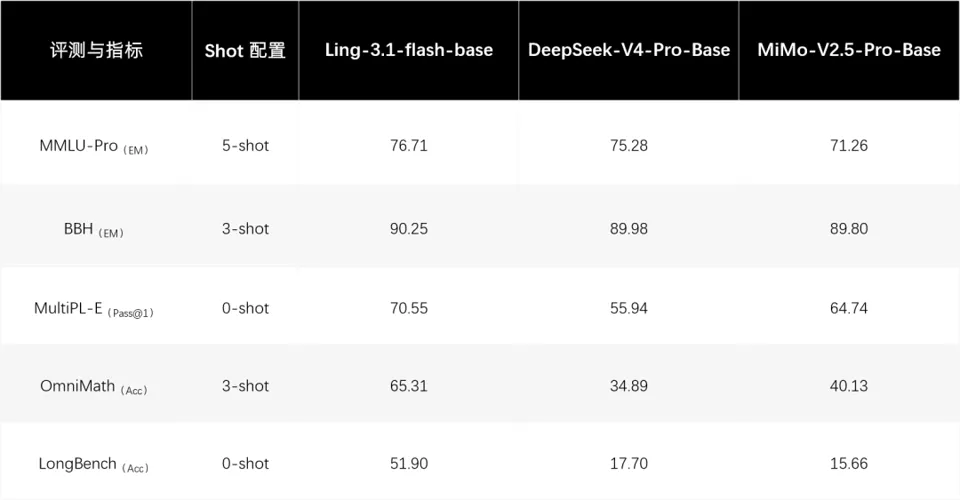
In benchmark tests across 8 domains comprising 47 items, Ling-3.1-flash-base achieved the highest scores in 32 items, surpassing DeepSeek-V4-Pro-Base and MiMo-V2.5-Pro-Base. Among these, evaluations in knowledge understanding, logical reasoning, code, mathematics, and long-context processing correspond to several foundational capabilities needed for personal assistants to handle complex affairs, serving as a critical starting point for managing intricate tasks. It is understood that Ling-3.1-flash-base is available to developers under BF16 base weights and the MIT license, allowing them to conduct continued pre-training, domain adaptation, and post-training based on their own knowledge, workflows, and tools.
Building upon these foundational capabilities, Ling-3.1-flash and the subsequent 1019 version utilize post-training to continuously strengthen reasoning, tool usage, and multi-step execution abilities, thereby improving model performance in actual workflows. Reporters observed that Bailing’s R&D focus has gradually extended from the base model to post-trained models, emphasizing how to adhere to goals, use tools, and advance tasks.
It is understood that to address the need for multimodal information processing in personal affairs, Bailing trained the vision-language model Ling-3.1-flash-VL based on Ling-3.1-flash. This adds visual understanding to existing reasoning, planning, and tool-use capabilities. It is currently being applied internally within Lingguang and will be released externally in the future.
From Real Tasks to Real Applications
Currently, Bailing is progressively refining the model capabilities required for Personal Agents. The evolution of capabilities at the model level is being further validated and explored in applications. It is understood that Ling-3.1-flash has undergone alignment training based on the needs and feedback from application scenarios such as Lingguang and Afu Doctor Edition, continuously improving the model’s capabilities in professional expression and communication.
"From real tasks to real applications," stated Bailing. They hope to enhance the model’s ability to understand goals, maintain task states, and respond to changes through a continuous cycle of model development and practical application. Furthermore, they intend to continue exploring more application possibilities with developers through open source.
Reporters noted that unlike simply pursuing larger model parameter scales, Bailing focuses more on integrating foundational model capabilities into real workflows to complete real tasks. Since the second half of this year, Bailing has accelerated model iteration and development centered on open source and real-world scenarios.
Previously, based on the next-generation base model Ling-3.0-flash, Bailing launched the finance-enhanced model Ling-3.0-flash-Fin and the healthcare-enhanced model Ling-3.0-flash-Sante, bringing foundational model capabilities further into specialized professional scenarios. Specifically, Ling-3.0-flash-Fin (total parameters 124B, activated 5.1B) enables AI to enter real investment research task flows, connecting the entire chain from finding materials and conducting analysis to forming research outcomes. It rivals frontier 3T-parameter models in high-difficulty investment research tasks, achieving leading open-source performance in comprehensive financial agent capabilities. Ling-3.0-flash-Sante brings "high intelligence-efficiency ratio" to healthcare scenarios, achieving optimal performance among models below 1.6T parameters with a scale of 124B, matching the overall performance of several flagship models.
This article was provided by Ant Group and republished by Quantum Bit with permission. Views expressed belong to the original author.