Stanford Paper Finds No Metric Is Fully Tokenizer-Agnostic
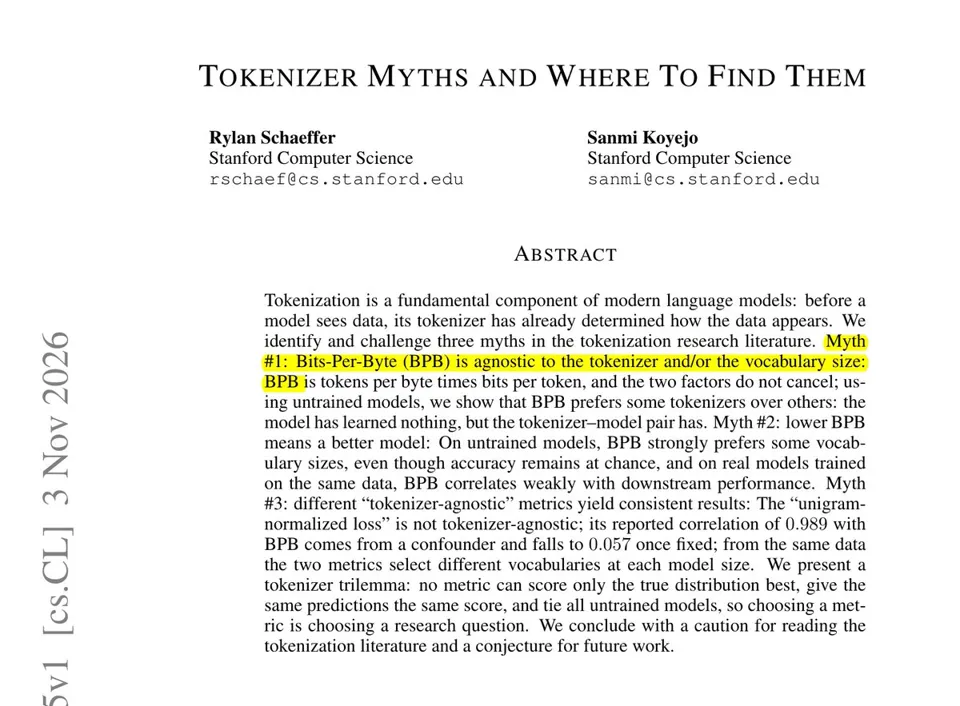
A new Stanford paper finds that no metric is tokenizer-agnostic in every sense, including bits-per-byte (BPB), which is widely treated as neutral. Untrained models showed different BPB across tokenizers, and BPB correlated with task accuracy only between +0.02 and −0.30. The authors advise checking task accuracy on the same text rather than trusting a single score when comparing tokenizers.
Full Report
Rohan Paul (@rohanpaul_ai) · 2026-11-05 20
New Stanford paper finds that no metric can be tokenizer-agnostic in every sense, so anyone comparing tokenizers should not trust a single score and should also check whether the model answers correctly.
To compare models with different tokenizers, researchers usually report bits-per-byte, or BPB, which divides the loss by bytes instead of tokens. Many papers call it tokenizer-agnostic.
They scored untrained models that guess uniformly, plus released models that share one recipe but use different tokenizers. They also rechecked a published claim that another supposedly tokenizer-neutral metric agrees with BPB.
Models that learned nothing still got different BPB by tokenizer, with English text scoring best near a 24K vocabulary, while accuracy stayed at chance. On models trained with different tokenizers, correlations between BPB and task scores ran only from +0.02 to −0.30.
When comparing tokenizers, don't treat lower BPB as proof of a better model, and check task accuracy on the same text before picking a vocabulary.