Zhipu AI Open-Sources GLM-ASR-Nano: 1.5B Model Hits 4.10 Error Rate
Zhipu AI has open-sourced GLM-ASR-Nano, a 1.5B parameter speech recognition model designed for robustness in real-world scenarios. It achieves an average error rate of 4.10, significantly outperforming Whisper V3 (6.93) on open-source benchmarks, with exceptional performance in dialects, low-volume speech, and code-switching. The model utilizes an asymmetric 'heavy perception, extreme compression' architecture and is already deployed in Zhipu's production input method.
Related Entities
Full Report
Contents10 sections
GLM-ASR-Nano-2512 is a robust, open-source speech recognition model with 1.5 billion parameters, specifically designed for complex real-world audio scenarios. Among open-source models, it achieves the lowest average error rate (4.10), significantly outperforming Whisper V3 (6.93). It demonstrates exceptional performance in dialect recognition and low-volume speech scenarios.
Design Philosophy
GLM-ASR-Nano adopts an asymmetric architectural design principle: "Heavy Perception, Extreme Compression, Lightweight Inference."
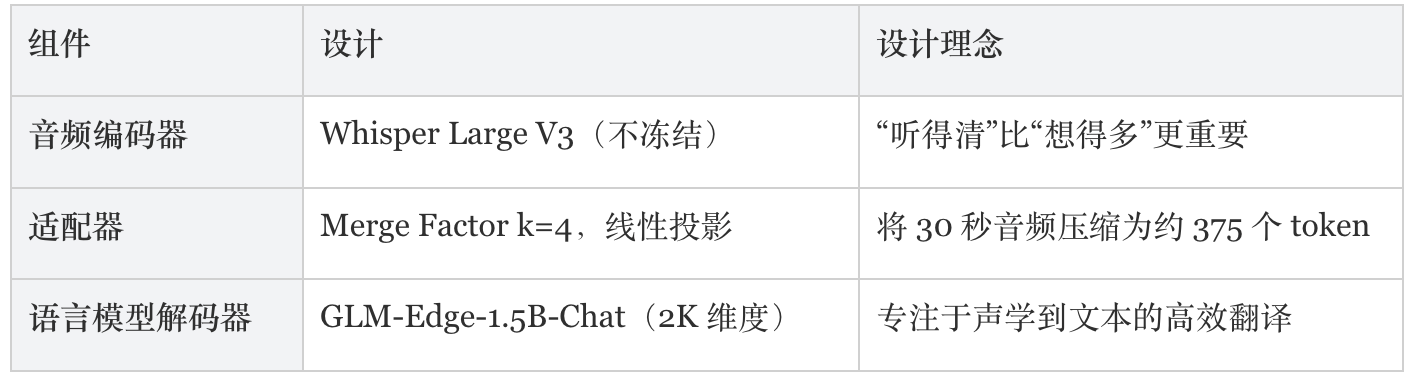
Model Architecture
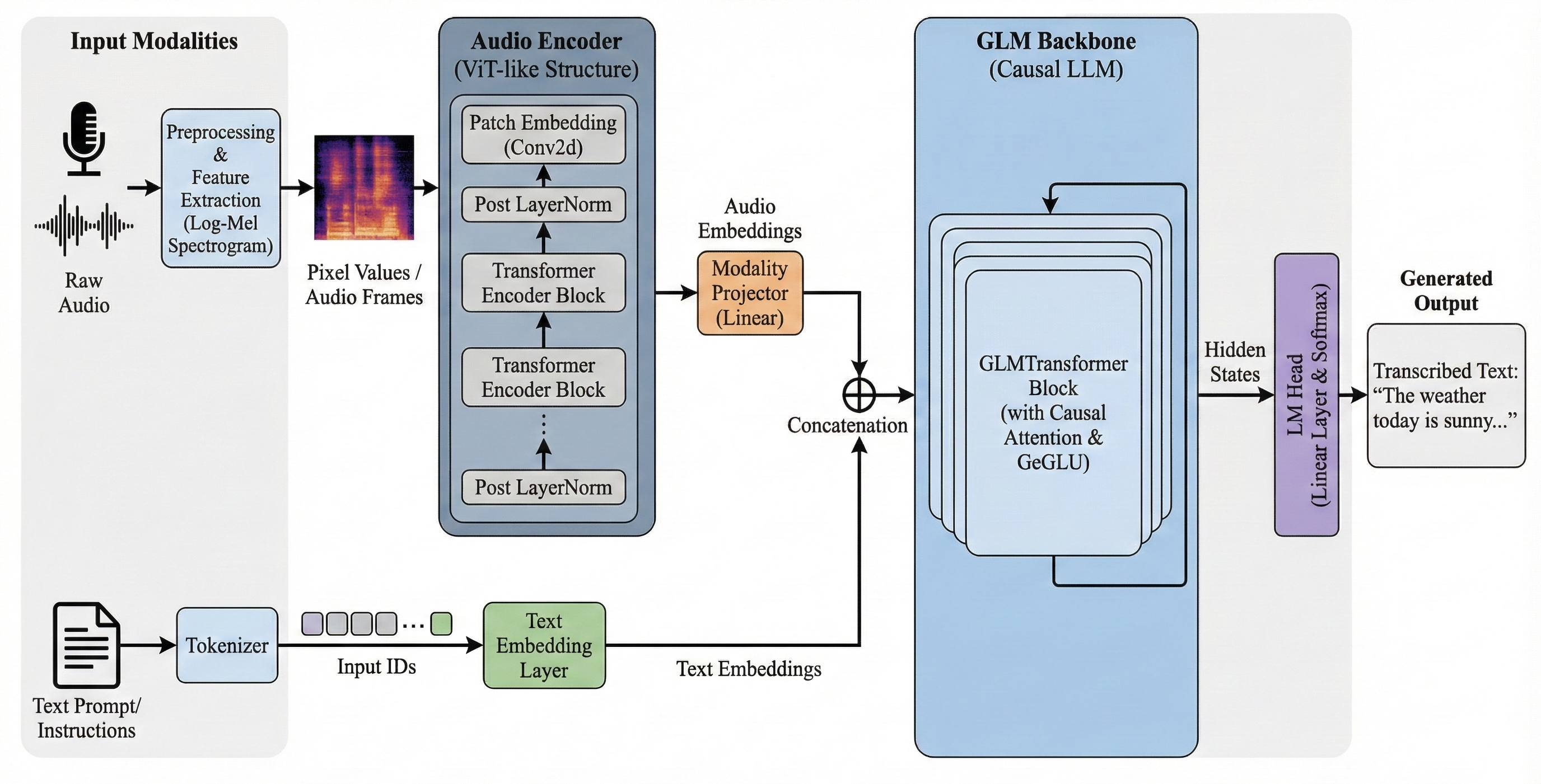
Architecture Specifications
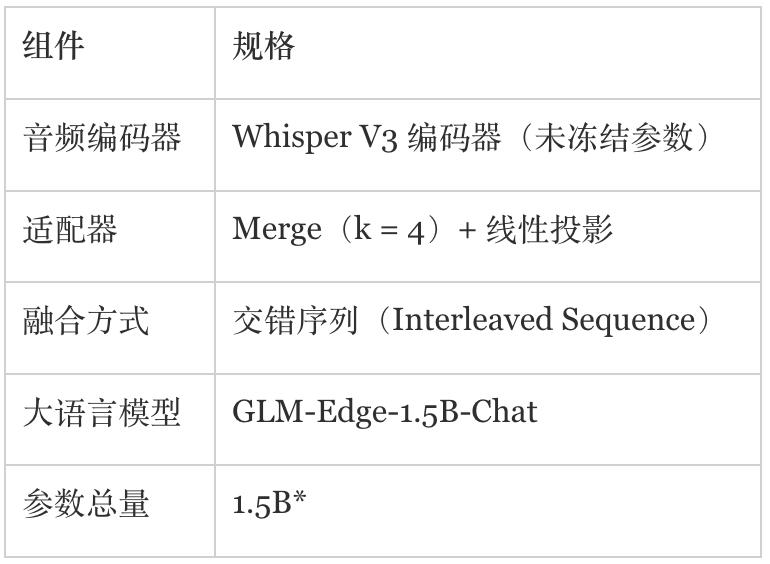
*Parameter counts are calculated according to official published standards. The audio encoder (Whisper V3), serving as the feature extraction module, contains additional parameters that are not included in the total 1.5B parameter count.
Benchmark Performance
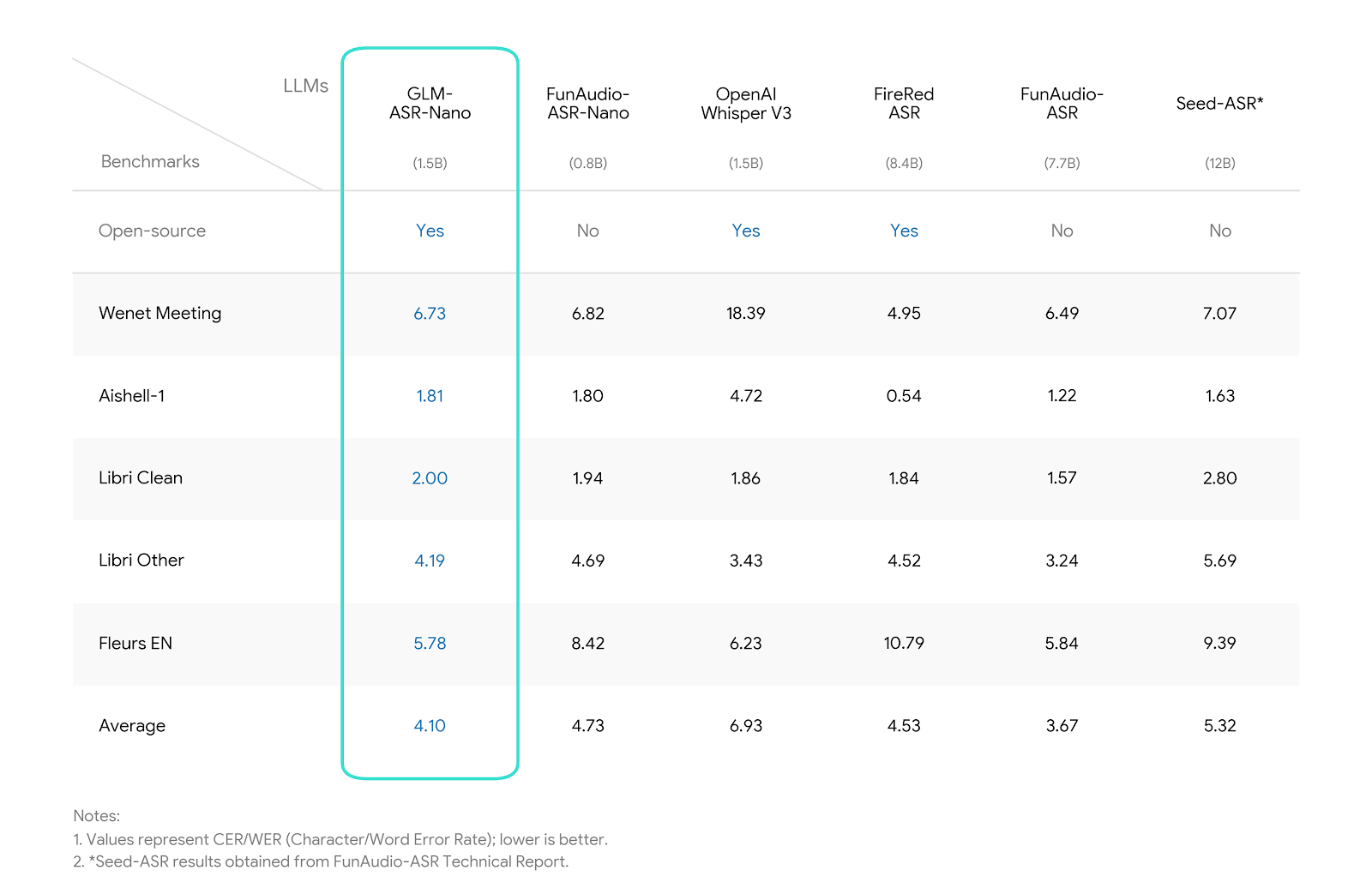
Key Conclusion: Among open-source models, GLM-ASR-Nano achieves the best performance with an average error rate of 4.10. With comparable parameter sizes, its performance significantly surpasses that of Whisper V3 (6.93).
Case Studies
Cantonese: Accurately recognizes natural and fluent Cantonese colloquialisms, including informal expressions and sentence-final particles, without forcing conversion to Mandarin. Your browser does not support the audio element.*你哋快啲啦,婆婆佢哋而家喺禮景站等紧你哋
Multilingual Speech: Exhibits strong robustness against mixed-language sentences (e.g., Chinese-English code-switching), naturally handling language switching within a single utterance. Your browser does not support the audio element.*事实是,我很 cool,而你很 cruel。
Low-Volume Speech: Maintains reliable transcription even when vocal energy is low or near whisper levels. Your browser does not support the audio element.*如图的这个界面,草莓发芽的这一个卡片呢也把它稍微拆分一下,就是呃将它去除背景,目前的描边呢改成只有上描边和下描边,然后这个描边的线条可以做一下装饰化处理。
Noisy Environments: Delivers stable performance in real-world noisy environments (such as streets, cafes, public transportation, etc.), with minimal impact from background noise on recognition accuracy. Your browser does not support the audio element.*这个确实就是我觉得某个事情可能他他不应该怎么样怎么样去做,但是别人会觉得可能大部分人吧会觉得嗯就应该这样。
Hotword Recognition: Accurately identifies custom keywords and rare vocabulary while maintaining overall transcription quality. Your browser does not support the audio element.*明着是大兴区黄村镇廊伐三村的医师
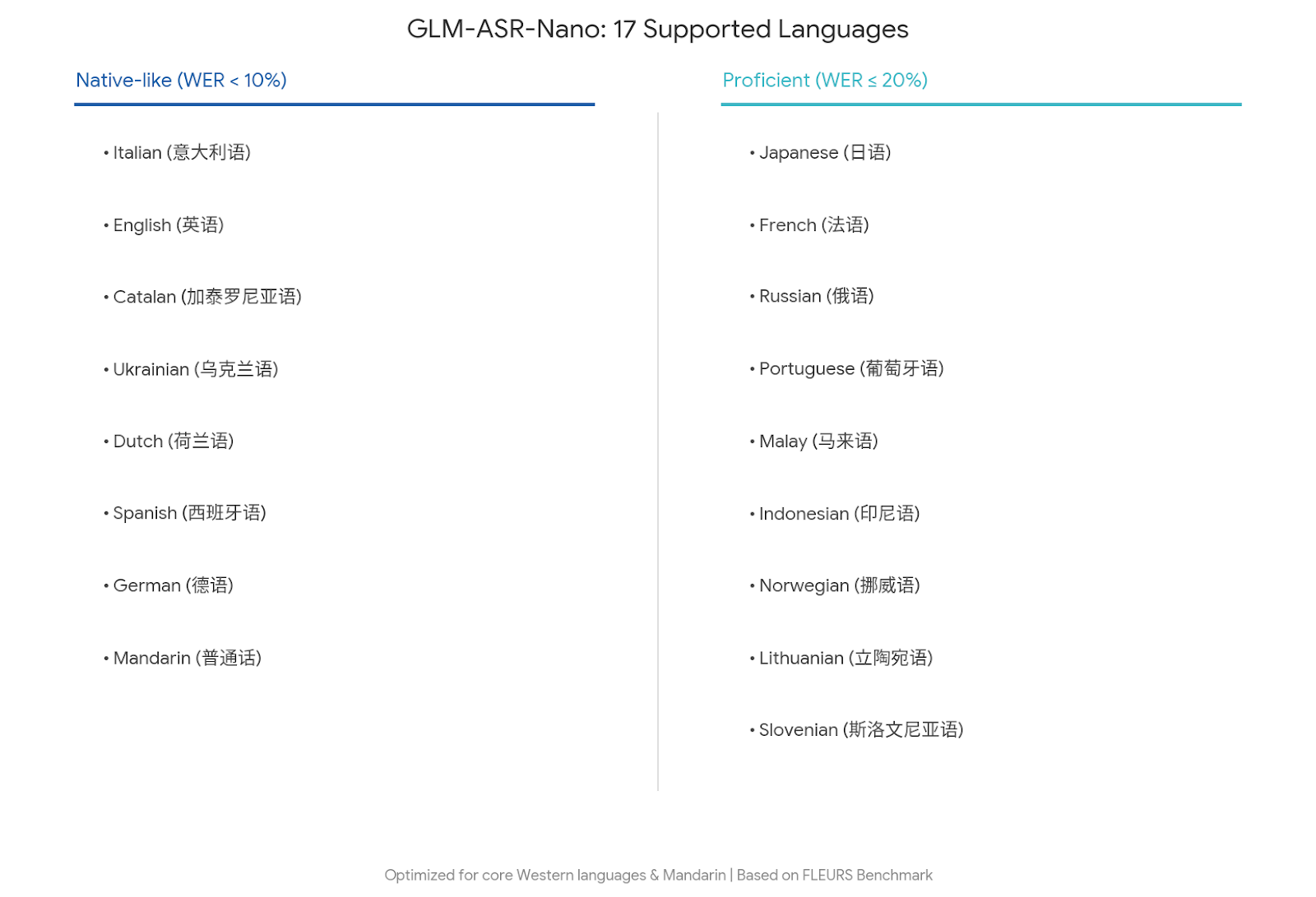
Supported Languages
GLM-ASR-Nano offers high availability support for 17 languages, with focused optimization for major Western languages and Mandarin Chinese.
Quick Start
Installation
Install transformers from source
pip install git+https://github.com/huggingface/transformers pip install torch pip install librosa pip install accelerate
Install ffmpeg for audio processing# macOS
brew install ffmpeg
Linux
sudo apt install ffmpeg
Quick Inference
from transformers import AutoModelForSeq2SeqLM, AutoProcessor

processor = AutoProcessor.from_pretrained("zai-org/GLM-ASR-Nano-2512")
model = AutoModelForSeq2SeqLM.from_pretrained(
    "zai-org/GLM-ASR-Nano-2512",
    dtype="auto",
    device_map="auto"
)

inputs = processor.apply_transcription_request("example_zh.wav")
inputs = inputs.to(model.device, dtype=model.dtype)

generated_ids = model.generate(**inputs, max_new_tokens=128)
transcribed_text = processor.batch_decode(generated_ids, skip_special_tokens=True)[0]
print(transcribed_text)
Powered by GLM-ASR-Nano: Zhipu AI Input Method
Zhipu AI Input Method represents the first large-scale deployment of GLM-ASR-Nano. Leveraging the cloud-based version of GLM-ASR-Nano, this product delivers industry-leading voice input capabilities, achieving significant improvements in both accuracy and speed compared to traditional solutions.