Tool Use Nearly Doubles Model Scores on Visual Reasoning Benchmark
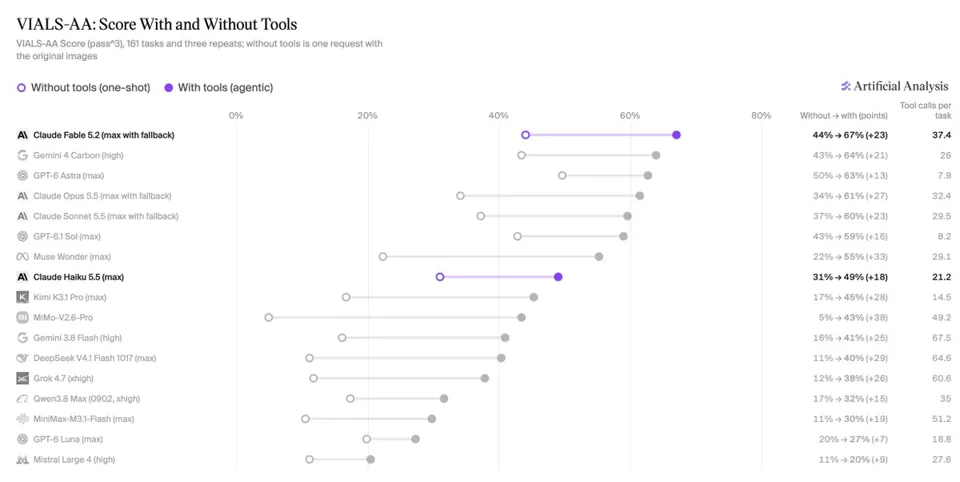
Artificial Analysis reran its VIALS-AA life-sciences visual reasoning benchmark in a one-shot, no-tools format and found tool use nearly doubles scores on average, from about 25% to about 47%. Claude Fable 5.2 leads at 67% with tools but costs $4.20 per task and drops to 44% without them, while Claude Haiku 5.5 reaches 49% with tools at just $0.07 per task, beating the larger model's tool-free result at roughly a tenth of the cost. The takeaway is that cheaper models in an agent harness can outperform single-shot frontier models on both cost and performance.
Full Report
Artificial Analysis (@ArtificialAnlys) · 2026-11-11 23
Take away its tools, and Claude Fable 5.2 scores below Claude Haiku 5.5 with tools on VIALS-AA; across models tool use nearly doubles scores, from ~25% to ~47% on average
VIALS-AA is our implementation of @joinHandshakeAI's VIALS benchmark for visual reasoning in life sciences research. By default, models work as agents: they think, run code and view images in a sandbox. We reran VIALS-AA in a one-shot format: one request with the question and images, and no tools.
Lower cost models in an agent harness can beat single-shot large models on both cost and performance in visual reasoning and interpretation of scientific artifacts.
Claude Fable 5.2 (max) leads VIALS-AA at 67% with tools, at a cost of $4.20 per task; without tools it scores 44% at $0.73 per task. Claude Haiku 5.5 (max) scores 49% with tools, at $0.07 per task: higher than Fable without tools, at about a tenth of the cost.