Google Launches Gemini Decision 1 with Free Output Tokens
Google has launched the Gemini Decisions API, powered by Gemini Decision 1, its first multimodal decision model built for closed-ended choice tasks. It natively supports Yes/No, multiple-choice with up to 255 options, and rubric-based scoring, handling 1,000 questions per call at $0.10 per million input tokens with output tokens free of charge. The model leads benchmarks with the lowest calibration error, marking a shift from generative output toward structured decision interfaces.
Full Report
New AI Era Report

After a long wait, Gemini 4 Hydrogen never arrived.
What Google served up last night was Gemini Decision 1, a multimodal decision model.
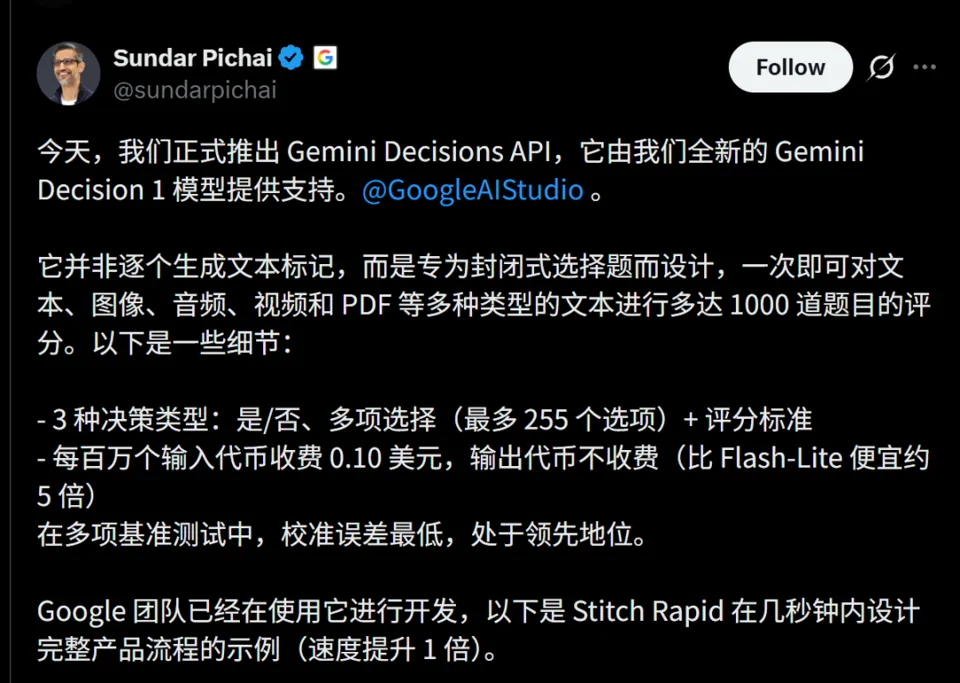
Sundar Pichai announced: today, Google officially launched the Gemini Decisions API, powered by the Gemini Decision 1 model.
Stitch Rapid uses the Decisions API to design an entire product flow in seconds
The "Jev" wave has finally reached Google.
It is built specifically for "closed-ended multiple-choice questions," with ultra-low latency, native multimodality, and the ability to handle 1,000 questions at once.
It has 3 native decision types: "Yes/No," "Multiple choice (supporting up to 255 options!)," and "rubric-based scoring."
It costs only $0.10 per million input tokens, and output tokens are completely free! (Just 1/5 of Flash-Lite.)
Across multiple benchmarks, it holds an absolute lead with the lowest calibration error.
Disrupting decision models with multimodality
TypeSafe AI's Jev set off a wave in Silicon Valley, and other giants quickly followed suit. Google has finally entered the decision-model arena.
Since Jev has already pushed the price of text-only decisions down to $0.042 per million tokens, how should Google respond?
The answer is: use multimodality to crush text-only models.
You can feed it up to 256K tokens of massive data at once (whether text, images, audio, video, or PDFs), and then fire 1,000 soul-searching questions at it simultaneously!

Whether you are doing tool calling, policy risk control, dynamic model routing, or context scoring, the Decisions API can directly give you the most decisive answer.
Gemini Decision 1 instantly scores all options through a single efficient "forward pass."
Topping the benchmarks: "intuition" is ultra-precise
Of course, a decision model needs not only speed but also accuracy!
In top-tier benchmarks covering agent routing, logical reasoning, information ranking, and multimodal understanding, Gemini Decision 1 tops the charts across the board.
More importantly, it has the lowest calibration error across the board!
So how confident it is is how accurate it actually is, and its hallucination rate is very low.
Because it does not need to decode token by token, when Gemini Decision 1 processes multimodal contexts of up to 16K tokens, the model's median compute latency is kept at 50-100 milliseconds, and end-to-end latency is only 150-250 milliseconds.
And no matter whether you ask 1 question or 100 questions at once, the speed is almost exactly the same—no lag at all.
Because it is nearly 5 times cheaper than the currently recognized "king of cost-effectiveness," Gemini 3.5 Flash-Lite (using the interactive API model), this is an absolute price killer.
Native multimodality + three major decision modes: let the model go all the way in one shot!
Built on Gemini's powerful native multimodal architecture, whether it's documents, audio recordings, or videos, it can directly "see and understand" them in a single forward pass.
You can mix and match various modalities—for example, combine "customer service call recordings" with "account data," or package a "PDF claim form" together with "damage photos" and hand them over.
You can even freely adjust audio and video resolution to control visual detail and token cost.
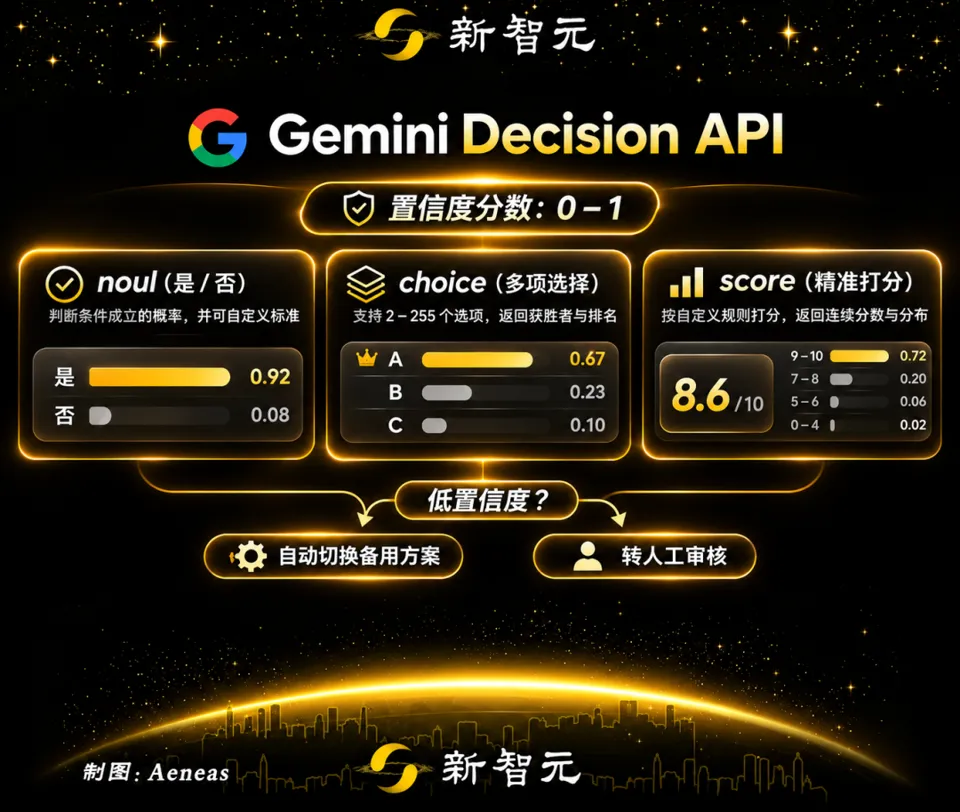
In a single request, you can mix and match three core decision modes.
And every time, it thoughtfully returns a "confidence score (0 to 1)." When things are ambiguous, your code can directly hand it off to a fallback or human review—very robust.
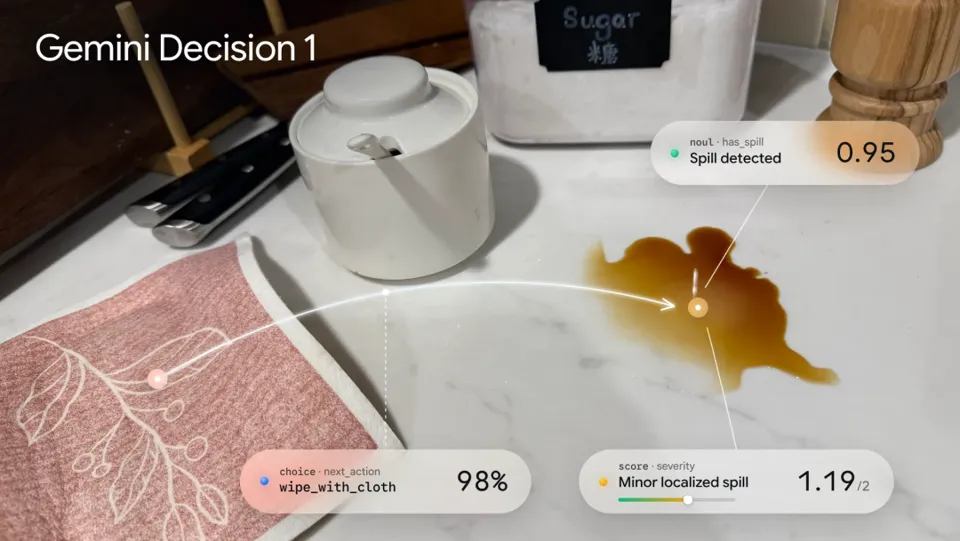
noul (yes/no): It determines the probability that a yes/no condition holds, and you can also choose the "true/false" description standard.
choice (multiple choice): Supports 2 to 255 options! It directly tells you who the winner is, along with the probability ranking of all candidates.
score (precise scoring, ordered rating scale): It scores the input content according to the rules you define (starting from 0), giving a continuous weighted score and the probability for each level.
The interface is extremely friendly, using the familiar Content block format.
Take a look at the following extremely elegant code—how to use a single request to have the AI look at a photo of an office bar counter and complete three different types of judgments at the same time.
from google import genai
client = genai.Client(http_options={"api_version": "v1beta"})
result = client.decisions.create(
    model="gemini-decision-1",
    # Shared input: hand it an image + a sentenceinput=[{
            "type": "image",
            "uri": "https://storage.googleapis.com/generativeai-downloads/images/spill.jpg",
            "mime_type": "image/jpeg",
        },
        {
            "type": "text",
            "text": "Lounge bar counter check before the 9 a.m. client meeting.",
        },
    ],
    # Fire off 3 questions at once!
    questions={
        "has_spill": {
            "type": "noul",
            "instructions": "Is there any uncleaned liquid spill on the bar counter?",
        },
        "next_action": {
            "type": "choice",
            "instructions": "Which cleanup measure is most suitable for the current scenario?",
            "criteria": {
                "wipe_with_cloth": "Small spill on the bar counter, and a cloth is already nearby.",
                "dispatch_janitorial": "Large hazardous area on the floor, broken glass, or ongoing water leakage.",
                "ready_for_meeting": "The bar counter is clean and ready.",
            },
        },
        "severity": {
            "type": "score",
            "instructions": "Assess the severity of the bar counter's messiness.",
            "criteria": [
                "Clean and ready.",
                "Minor localized spill.",
                "Major spill or safety hazard.",
            ],
        },
    },
)
How are top teams inside Google actually using it?
Right now, top teams across Google have long treated it as a "low-latency control hub."
No more time-consuming effort training custom classifiers, and no more waiting for a large model to slowly generate. Define the options, and the following capabilities go live immediately!
For example, it can be dynamic model routing in Gemini Notebook.
In Notebook, the Decisions API can act as a "traffic cop." As soon as a user's question comes in, it can classify the intent within milliseconds.
Simple questions go to a lightweight model (latency drops by 40%!), while complex questions are handed to a deep-thinking model.
It can enable blazing-fast design iteration in Stitch: This is absolutely a job-disrupting application!
Stitch's rapid canvas can generate a "runnable wireframe" of an entire product flow in just a few seconds.
Changes you make by voice or click take effect instantly. When the flow reaches the ideal state, you can switch to full design mode with one click.
You can also use it to instantly pick emojis in CC. In Google Labs' CC social app, it can select the most suitable one from more than 200 emojis in less than a second. The emoji pops up instantly—very smooth.
It is also the security layer for MCP tools in Search. Google Search uses the Decision API to detect adversarial behavior and adversarially evaluated content with high efficiency.
The free API is here
And this time, Google AI Studio has also prepared a free API tier for us to prototype to our heart's content.
Its billing logic is extremely generous: shared input is charged only once no matter how many questions you ask! (Each question is charged only for its own instructions and standard tokens.)
There are no output fees, no wildly fluctuating "thinking token" assassins, and no separate charges for audio transcription or OCR.
Not only that, Google's entire AI ecosystem is following suit across the board! Integrations for OpenRouter, LangChain, Vercel, LiteLLM, Pydantic AI, Pipecat, LiveKit, OpenCode, and the google-genai SDK are all being rolled out rapidly.
A Battle of the Titans: In 17 Days, the Giants Frantically Catch Up
This "decision model" storm triggered by Jev has completely torn up the old billing rules of large models—a single forward pass directly produces the result, costs plummet, and output is entirely free.
The whole of October could be called the "crazy month" of AI decision models. In just 17 days, multiple top AI labs released similar models.
Amazon: Directly open-sourced a decision model called Strands Decider 2B.
Cloudflare: Launched the Clef and Clef-flash models, open-sourced under the Apache 2.0 license.
Perplexity: Opened up the Decisions API, fine-tuned based on a 27B open-source model.
Liquid AI: Launched d1-ultra.
Giants such as Microsoft and OpenAI also quickly adjusted at the API level, trying to fend off this wave.
In the short 17-day battle among the giants, Google's approach with Gemini Decision 1 is: don't compete on pure-text price differences, but go straight for "native multimodality + massive concurrency of a thousand questions."
The current landscape of the track is: for extreme low prices on pure text, choose Jev; for complex multimodality and high concurrency, look to Google; for ecosystem compliance, leave it to OpenAI.
The future Agent architecture is already clear: the decision model (System 1) is responsible for making judgments at extreme speed and low cost, while the large model (System 2) retreats to the second line to handle deep "slow thinking."
The second half of the agent frenzy has arrived.
References:
https://blog.google/innovation-and-ai/technology/developers-tools/gemini-decisions-api/
Chase ASI in Seconds
⭐Like, share, and watch—one-click triple combo⭐
Light up the star, and lock in New Intelligence's instant push!