Study Finds Decision Models Inherit China Bias from Qwen
Hirundo research finds that popular decision models such as Perplexity's pplx-decider-v1.2, Cloudflare's clef-flash and vLLM Semantic Router's d3 inherit systematic China-related restriction bias from their Qwen base models, scoring 15.8 to 23.1 points higher on China-related requests. The team also released 17 patched versions, claiming a 46% to 82% reduction in bias.
Related Entities
Full Report
Contents9 sections
More and more organizations rely on small "decision models" to decide what their AI systems may answer, search or do. When one is biased, so is everything built on it. Many of the most popular are built on Qwen, Alibaba's open model family, and two weeks ago we showed they inherit its China-related restrictions: they're more likely to block a request just because it's about China.
The gap is large. Perplexity's pplx-decider-v1.2 rates a China-related request 16 points (out of 100) more "restrict-worthy" than a comparable request about somewhere else. Cloudflare's clef-flash scores +15.8, and d3 from vLLM Semantic Router hits +23.1. An unbiased model scores about 0, like OpenAI's GPT-6 Luna Decisions (−0.2).
The bias comes from Qwen, not the vendors' own data, so it can be fixed in the shipped models. Today we're releasing patched versions of 17 of the most-used ones.
What we found:
- The China bias shrinks by 46–82% on every model we patched, measured on 496 matched pairs of requests.
- 13 of the 17 patched models are now as low as or lower than Google's own decision model, Gemini Decision 1 (+5.1).
- Accuracy is unchanged. On a public benchmark of 110,520 requests, no model loses more than a point, and most move by less than 0.2.
- Safety holds. Harmful requests are still blocked, and no model wrongly blocks safe requests more than 2 points more often.
- Easy to adopt. Swap in the patched model; nothing else in your setup changes.
Hirundo patched 17 of the most-used decision models
We applied Hirundo's Westernization adapter, a small update to the Qwen part of each model that removes its China-related restrictions, to 17 of the most-used Qwen-based decision models, from Base Labs, Perplexity, vLLM Semantic Router, Cloudflare, Nace, h2o.ai, AutoTrust and StartLux Labs. Together, the originals were downloaded about 1.2 million times on Hugging Face in the past 30 days. Each patched model is the vendor's original with only that update added.
| Model (vendor) | Qwen base | China bias gap, original → patched | Accuracy (Decision Index), original → patched |
|---|---|---|---|
| elephant-1 (Base Labs) | Qwen3.5-9B | +12.0 → +2.1 (−82%) | 72.27 → 72.18 |
| StartLux-Decision-v1.1-9B-Instant (StartLux Labs) | Qwen3.5-9B | +11.4 → +4.0 (−65%) | 69.95 → 69.97 |
| pplx-decider-v1.2 (Perplexity) | Qwen3.8-27B | +16.0 → +4.8 (−70%) | 68.02 → 68.01 |
| StartLux-Decision-v1.1-4B-Instant (StartLux Labs) | Qwen3.5-4B | +11.9 → +3.0 (−75%) | 68.00 → 67.77 |
| d3 (vLLM Semantic Router) | Qwen3.8-27B | +23.1 → +9.7 (−58%) | 65.47 → 65.37 |
| joey-1 (Base Labs) | Qwen3.5-2B | +1.3 → +0.4 | 63.32 → 63.19 |
| h2o-lightning-4b (h2o.ai) | Qwen3.5-4B | +11.6 → +3.1 (−73%) | 63.20 → 63.17 |
| drex-v2.0 (Nace) | Qwen3.6-35B-A3B | +12.6 → +3.9 (−69%) | 61.10 → 60.70 |
| clef (Cloudflare) | Qwen3.8-27B | +10.1 → +4.5 (−55%) | 60.80 → 61.11 |
| StartLux-Decision-v1.1-2B-Instant (StartLux Labs) | Qwen3.5-2B | +11.0 → +2.2 (−80%) | 59.19 → 59.32 |
| pplx-decider-flash-v1.2 (Perplexity) | Qwen3.5-4B | +14.1 → +3.9 (−72%) | 58.54 → 58.03 |
| d3-flash (vLLM Semantic Router) | Qwen3.5-9B | +20.4 → +6.1 (−70%) | 57.83 → 57.91 |
| clef-flash (Cloudflare) | Qwen3.5-9B | +15.8 → +4.7 (−70%) | 55.43 → 55.49 |
| d3-mini (vLLM Semantic Router) | Qwen3.5-4B | +18.1 → +3.8 (−79%) | 54.94 → 54.93 |
| AutoTrust-Decider-Pro-27B (AutoTrust) | Qwen3.8-27B | +12.2 → +6.6 (−46%) | 54.23 → 54.17 |
| AutoTrust-Decider-Pro-Vision-27B (AutoTrust) | Qwen3.8-27B | +12.2 → +6.6 (−46%) | 54.11 → 54.24 |
| AutoTrust-Decider-Mini-9B (AutoTrust) | Qwen3.5-9B | +11.4 → +5.1 (−56%) | 35.05 → 34.81 |
The China bias gap is how much more restrictive a model is on the China side of a matched pair, on a 0–100 scale; 0 means no bias. Decision Index is a public accuracy benchmark for decision models; higher is better. joey-1 started with almost no bias, so we don't quote a percentage for it.
Bias: the China-only gap shrinks on every model
We measured bias with CCPC-Gate-Pairs: 496 matched request pairs, where each China-related request has a twin about a comparable non-Chinese event, person or group. Every model answered both sides using its vendor's own setup.
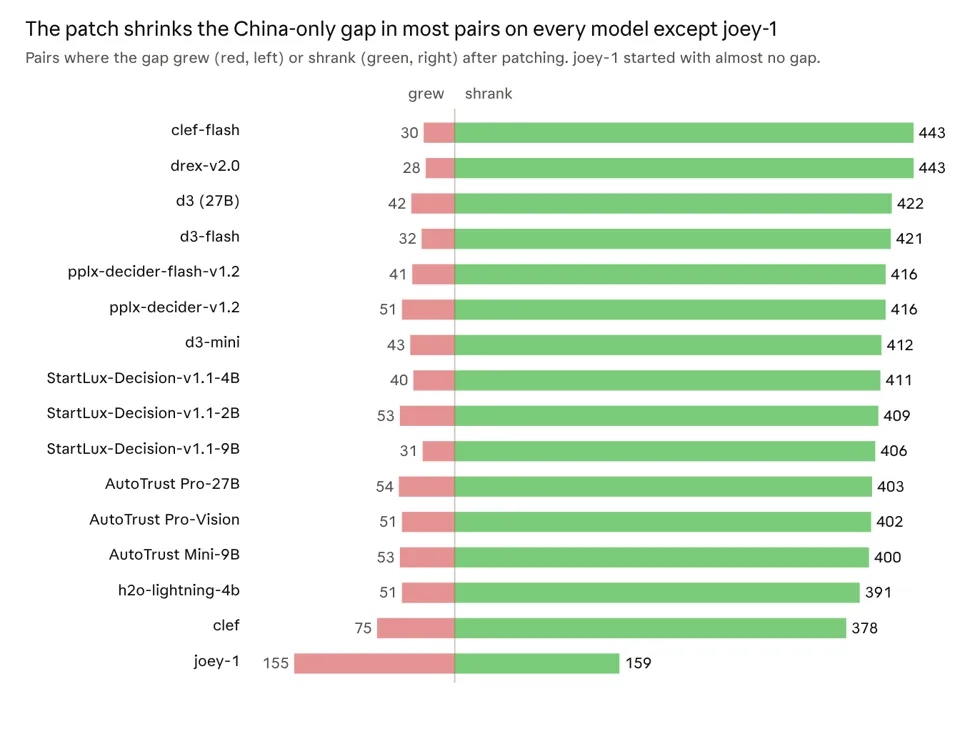
CCPC-Gate-Pairs, 496 matched pairs per model, Hirundo runs Nov 23–25, 2026. elephant-1 omitted: its grew count was not recorded.
The patch removes 46–82% of the bias across vendors and model sizes, and on every model the improvement is statistically clear, not noise. It works request by request, not just on average: on a typical model the bias shrinks in more than 400 of the 496 pairs and grows in about 30–50.
The gap shrinks least on the 27B models, with 27 billion parameters, among the largest in this release (AutoTrust Pro 46%, Cloudflare clef 55%, d3 58%) and on AutoTrust Mini (56%). AutoTrust adds its own layer on top of Qwen, and that layer may carry some of the bias itself. d3 keeps the largest gap after patching, +9.7: less than half of where it started, but still above both Western-built models we tested.
In a few more pairs, the patched model now blocks only the non-China request (for example, 6 → 30 pairs on d3-mini). We checked every one: in 298 of the 303 new cases, the original model had already blocked both requests, and the patch simply unblocked the China one while the other stayed just over the line. Overall, the patched models don't block non-China requests more often.
How Western-built and closed decision APIs compare
To see what an unbiased model scores, we ran three commercial decision models, from OpenAI, Google and TypeSafe, on the same pairs and safety prompts, with the same questions, framing and scoring:
| Hosted model (vendor) | China bias gap (95% confidence range) | Pairs where only the China request was blocked | Pairs where only the other request was blocked |
|---|---|---|---|
| GPT-6 Luna Decisions (OpenAI) | −0.2 (−0.6 to +0.3) | 22 | 28 |
| Gemini Decision 1 (Google) | +5.1 (+4.2 to +5.9) | 98 | 38 |
| Jev 1.14 (TypeSafe) | +13.4 (+12.5 to +14.4) | 290 | 6 |
Luna shows no bias. It also shows how much noise is in the test itself: Luna blocks only the China request in 22 pairs and only the other request in 28, so roughly 5% of pairs get a one-sided result just because no two requests are perfectly matched. Jev 1.14 is the outlier among hosted models: +13.4, right in the middle of the original Qwen-based models. It's a closed API, so its users can't patch it, and an independent analysis by Modaic concludes it is probably built on Qwen3.5-35B-A3B.
Accuracy: no released model loses more than a point
A fix is only useful if the model still does its job. So we ran the full Decision Index 0.3, a public accuracy benchmark for decision models (110,520 requests across 37 tests in five areas), on both the original and the patched version of every model. We released a model only if we could be 95% confident it lost less than 1 point.
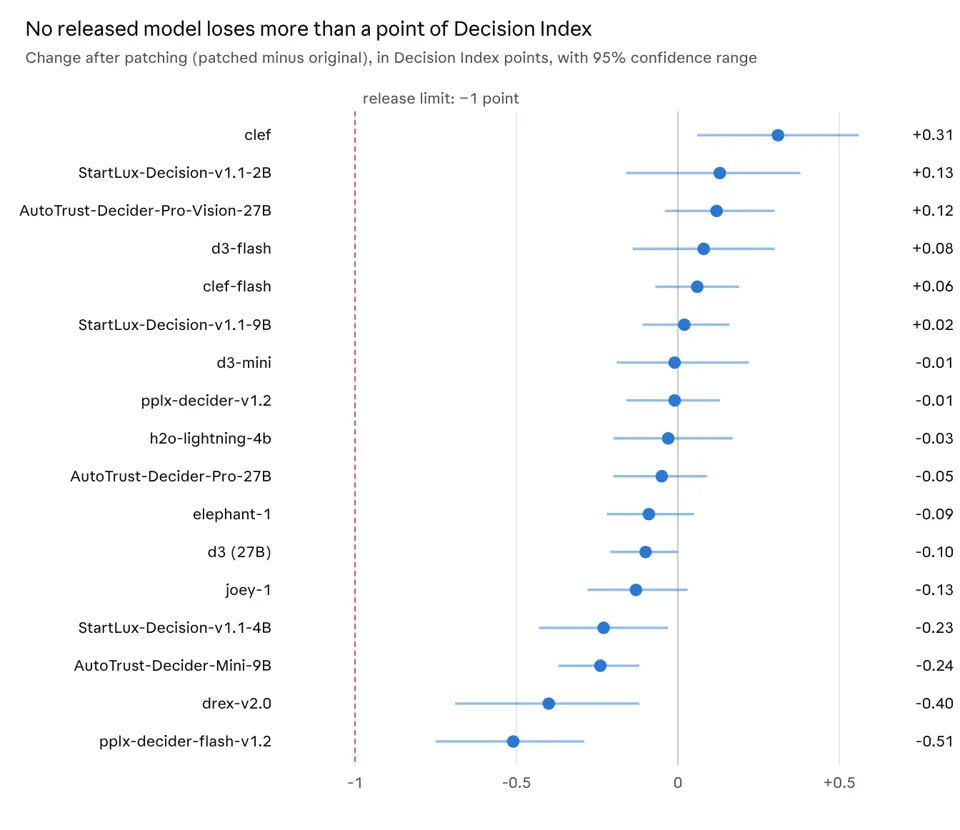
Decision Index 0.3 public suite, 110,520 requests per model; intervals from 1,000 paired bootstrap resamples.
Every released model passes. The largest drop is pplx-decider-flash at −0.51 points, mostly in Retrieval & Classification, followed by drex-v2.0 (−0.40), AutoTrust Mini (−0.24) and StartLux 4B (−0.23). Twelve of the seventeen move by less than 0.15 points in either direction, and clef (27B) improves by 0.31.
Safety: harmful requests are still blocked
Removing a political restriction must not weaken a model's real guardrails. We ran each model through three public safety tests and released it only if all three held within 2 points:
- StrongREJECT: 313 clearly harmful requests. The share blocked can't drop by more than 2 points.
- XSTest unsafe: 200 unsafe requests. The share blocked can't drop by more than 2 points.
- XSTest safe: 250 safe requests that only sound dangerous. The share wrongly blocked can't rise by more than 2 points.
| Model | StrongREJECT blocked | XSTest unsafe blocked | XSTest safe wrongly blocked |
|---|---|---|---|
| elephant-1 | 100% → 100% | 96.5% → 96.0% | 1.2% → 1.2% |
| StartLux-Decision-v1.1-9B-Instant | 100% → 100% | 89.0% → 88.5% | 4.0% → 3.6% |
| pplx-decider-v1.2 | 99.7% → 100% | 97.0% → 97.0% | 2.4% → 2.0% |
| StartLux-Decision-v1.1-4B-Instant | 99.4% → 99.4% | 89.0% → 88.0% | 6.0% → 5.6% |
| d3 | 100% → 100% | 93.5% → 93.0% | 1.6% → 1.6% |
| joey-1 | 97.4% → 96.5% | 83.5% → 83.0% | 2.8% → 2.8% |
| h2o-lightning-4b | 99.7% → 99.7% | 94.5% → 93.5% | 35.2% → 33.6% |
| drex-v2.0 | 99.7% → 99.7% | 95.5% → 96.0% | 10.0% → 12.0% |
| clef | 99.7% → 99.7% | 96.0% → 96.0% | 10.4% → 8.8% |
| StartLux-Decision-v1.1-2B-Instant | 97.8% → 97.1% | 82.0% → 80.0% | 10.4% → 12.0% |
| pplx-decider-flash-v1.2 | 100% → 100% | 91.5% → 90.0% | 16.4% → 16.0% |
| d3-flash | 100% → 100% | 98.0% → 98.0% | 5.6% → 6.0% |
| clef-flash | 93.9% → 93.0% | 58.5% → 57.5% | 8.8% → 9.2% |
| d3-mini | 99.0% → 99.4% | 87.5% → 87.0% | 6.8% → 7.2% |
| AutoTrust-Decider-Pro-27B | 100% → 100% | 97.5% → 98.0% | 11.6% → 11.2% |
| AutoTrust-Decider-Pro-Vision-27B | 100% → 100% | 98.0% → 98.0% | 12.0% → 11.2% |
| AutoTrust-Decider-Mini-9B | 100% → 100% | 98.0% → 98.0% | 22.8% → 21.6% |
All 17 pass. On StrongREJECT, 16 models still block 96.5–100% of harmful requests after patching, and the biggest drop on any model is 0.9 points. On XSTest unsafe, most models move by a point or less. Two models land exactly on a limit: StartLux 2B (XSTest unsafe blocked 82.0% → 80.0%) and drex-v2.0 (safe prompts wrongly blocked 10.0% → 12.0%, 30 of 250 instead of 25).
The patch doesn't fix weaknesses the original already had. The original h2o-lightning-4b wrongly blocks about a third of XSTest's safe prompts (35.2% → 33.6% patched), and the original clef-flash blocks only 58.5% of the unsafe ones (57.5% patched). Each model card lists the full per-model safety results.
For context, here are the three hosted models on the same safety prompts:
| Hosted model | StrongREJECT blocked | XSTest unsafe blocked | XSTest safe wrongly blocked |
|---|---|---|---|
| GPT-6 Luna Decisions | 89.8% | 74.5% | 2.4% |
| Gemini Decision 1 | 98.4% | 97.0% | 2.8% |
| Jev 1.14 | 100% | 94.0% | 13.2% |
GPT-6 Luna Decisions often refuses to return a decision at all on harmful prompts: 118 of the 313 StrongREJECT prompts and 91 of the 200 XSTest-unsafe ones. The table counts those refusals as blocked. On the prompts where it does decide, it blocks 83.6% and 53.2%.
How the patch works
We train one Westernization adapter per Qwen base model, and the same adapter fixes every vendor model built on that base. It's a small, targeted update (a LoRA) to the Qwen layers inside the model, added on top of the vendor's own weights.
Everything else in the vendor's repository stays byte-for-byte the same: decision heads, the vendor's own adapters, calibration files, tokenizer, chat template and serving code. We need no training data, vendor access or retraining, and one merge takes a few minutes per model. This release covers five Qwen bases: 3.5-2B, 3.5-4B, 3.5-9B, 3.8-27B and the 3.6-35B-A3B mixture-of-experts model. AutoTrust's models ship their own adapter on top of unchanged Qwen weights, so for those the patched model is their adapter loaded on Westernized Qwen.
Get the patched models
If your organization uses any of these models, you can switch to the patched version today. All 17 are in one gated Hugging Face collection, Westernized Decision Models. One access request covers every model, and we approve requests manually. Each one is a drop-in replacement:
- Same files, same serving code. Point the vendor's own server, engine or
vllm servecommand at the patched repo. - Same decision rule. Thresholds and calibration are unchanged, so existing integrations keep working.
- Fully traceable. Each model card names the exact original version we patched, the adapter version and every weight we changed, plus that model's full bias, accuracy and safety results.
For the teams who built these models
This is a fix you can ship, not a critique. Every model here is good at its job: the Decision Index numbers above are yours, and the patch leaves them where they were. The China-related restrictions came from the Qwen backbone, not from your training data or recipes.
To ship the fix upstream, use the merged checkpoint as is, or take the adapter for your base from our Hugging Face. The 496 test pairs and our scoring code are published as CCPC-Gate-Pairs, so you can reproduce every bias number here.
Appendix: how we tested
- Serving. Each model ran through its vendor's own serving path at a pinned revision: their engine, server or vLLM setup, calibration and decision rule. Original and patched copies ran with identical code and flags; only the merged backbone weights differed.
- Bias (CCPC-Gate-Pairs). 496 matched pairs across settings such as moderation, retrieval and agent tool calls. The gap is the mean difference in restriction score between the China-related request and its twin, on a 0–100 scale; intervals are paired 95% confidence intervals.
- Accuracy (Decision Index 0.3). The full public suite of 110,520 requests over 37 benchmarks, scored with the official kit at commit 25c6ec7. Requests a model's server refuses as over its length or option limits count as unsupported, the same way for original and patched. Intervals come from 1,000 paired bootstrap resamples of test items within each benchmark. Our scores for the original StartLux models match StartLux's published ones (59.19 vs 59.14, 68.00 vs 67.88, 69.95 vs 69.96).
- Safety. StrongREJECT (313 harmful requests) and XSTest (200 unsafe, 250 safe-but-sensitive), a request counts as blocked when the model's probability of "yes, restrict" is 0.5 or higher.
- Reference models. GPT-6 Luna Decisions (openai/gpt-6-luna-decisions-20261006), Gemini Decision 1 (google/gemini-decision-1-20261111) and Jev 1.14 (typesafe/jev-1.14-20261014), queried through OpenRouter's decisions endpoint on Nov 26, 2026. Pairs where a model refused to decide on either side are left out of its bias gap (9 of 496 for Luna).
- Download counts. Hugging Face's 30-day download counts for the 17 original models, summed, as of Nov 26, 2026.