Google Launches Gemini 4 Carbon Topping Intelligence Index with Enhanced Security
Google released Gemini 4 Carbon, topping the Artificial Analysis Intelligence Index with a score of 59. The model significantly improves long-horizon agentic tasks and cybersecurity capabilities, leading in vulnerability discovery benchmarks, though access is currently restricted to trusted experts.
Full Report
Contents5 sections
Google has reclaimed the top spot on the large language model leaderboard.
Just about two weeks after Gemini 4 Argon was made available to a broader user base, Google launched its next-generation frontier model, Gemini 4 Carbon. This time, Google is not only targeting the number one position in overall LLM intelligence but also placing programming, long-horizon agentic tasks, and cybersecurity capabilities at the core of its strategy.
Google Releases Gemini 4 Carbon
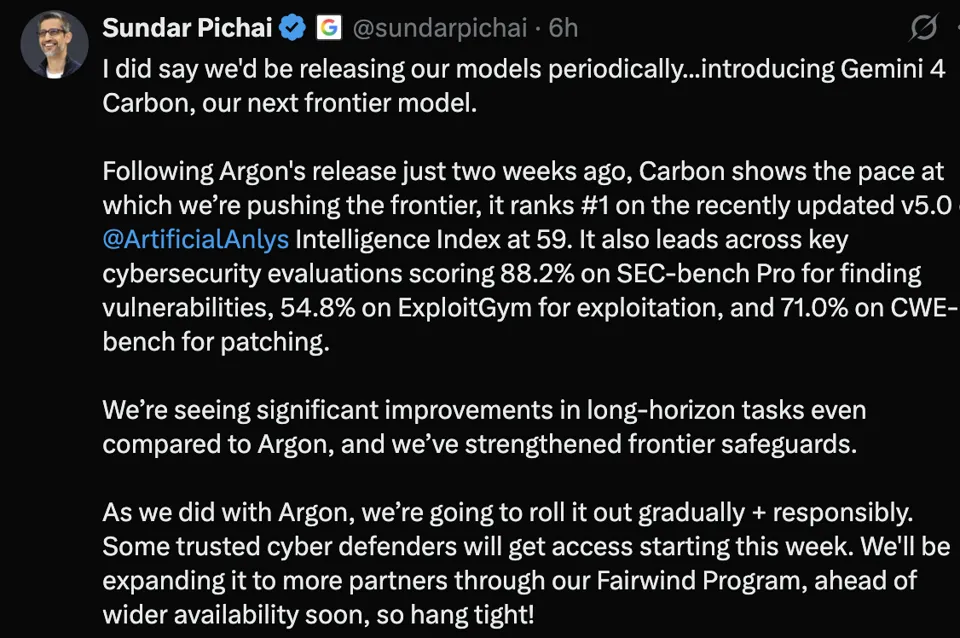
On October 28, Google CEO Sundar Pichai announced the news on X (formerly Twitter). He stated that following the launch of Gemini 4 Argon two weeks prior, Gemini 4 Carbon once again pushed the boundaries of model capability. It secured the top rank on Artificial Analysis’s latest v5.0 Intelligence Index with a score of 59, while also achieving leading results in three key cybersecurity tests: vulnerability discovery, exploitation, and patching.
Compared to Argon, Carbon offers further improvements in long-horizon task execution and security safeguards. Access has currently been granted to a select group of trusted cybersecurity defense experts. Through the Fairwind program, access will gradually expand before eventually becoming available to the general public.
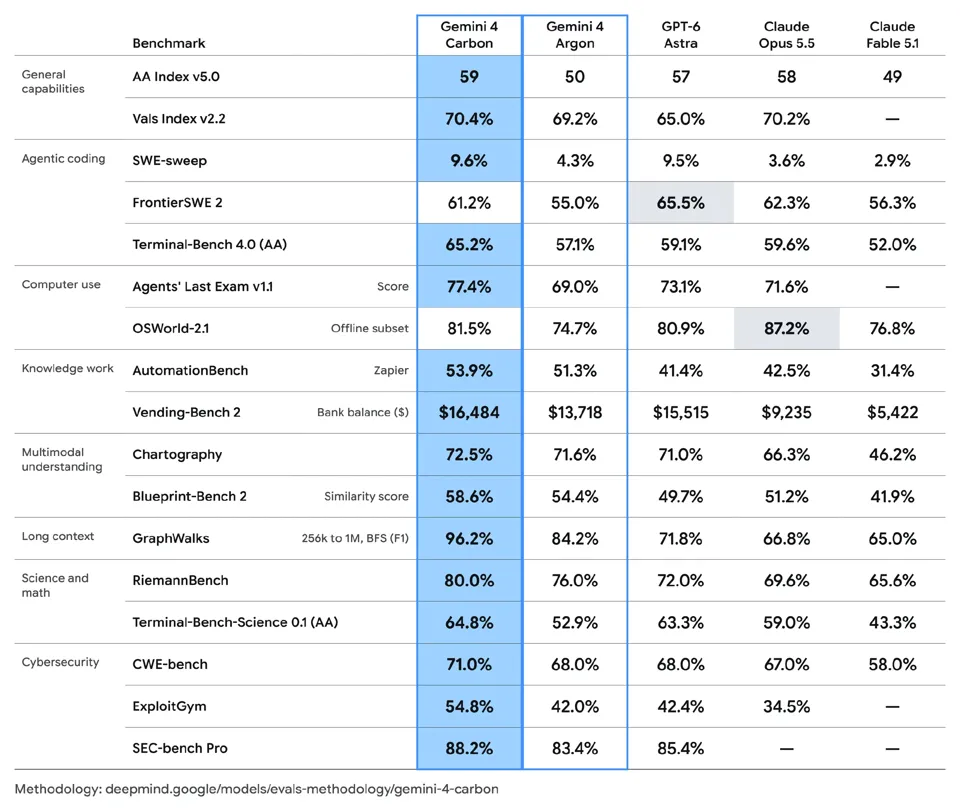
Google states that Carbon was designed to tackle more difficult and longer-duration engineering challenges, built specifically for sustained agentic workflows. Internally, Google teams witnessed Carbon running continuously for days, overcoming numerous hurdles to solve complex, multi-step engineering tasks—such as identifying and fixing subtle bugs within large codebases and underlying systems.
This new release focuses on enhancing performance across multiple domains, including coding, agentic tasks, scientific research, full-stack web development, and multimodal understanding.
On the Artificial Analysis Intelligence Index v5.0, Gemini 4 Carbon took first place with a score of 59, surpassing Claude Opus 5.5 (58) and GPT-6 Astra (57). Compared to the previous generation, Gemini 4 Argon, which scored 50, Carbon represents a nine-point improvement.
However, its programming capabilities are even more noteworthy. Independent evaluations by Artificial Analysis show that Gemini 4 Carbon has jumped to second place on the Coding Agent Index, trailing Claude Opus 5.5 by just three points.
In the realm of cybersecurity, the figures released by Google are equally striking: an 88.2% success rate in vulnerability discovery, 54.8% in exploitation verification, and 71.0% in vulnerability patching. Google claims that Carbon leads in all three critical benchmarks.
Interestingly, despite topping the overall scores and possessing stronger vulnerability mining capabilities, this model is not yet accessible to ordinary developers.
Google has decided to initially open Carbon to a small group of cybersecurity defense experts, then gradually expand testing through the Fairwind program.
On one hand, there is intensifying competition in model performance; on the other, a more cautious approach to deployment. The release of Gemini 4 Carbon highlights another facet of the frontier LLM race: as AI becomes increasingly capable of independently completing complex engineering tasks, controlling actual model behavior becomes ever more critical as capabilities grow.
Topping the Overall Leaderboard, Just Three Points Behind Claude Opus 5.5 in Coding
The most immediate highlight of this Gemini 4 Carbon release is regaining the lead in third-party comprehensive evaluations.
Artificial Analysis recently updated its Intelligence Index, upgrading it to v5.0. The new index integrates nine evaluations covering professional knowledge work, complex programming, scientific reasoning, factual knowledge, and agentic automation. It aims to measure model capabilities using more complex, real-world tasks rather than relying solely on knowledge Q&A or single-turn reasoning.
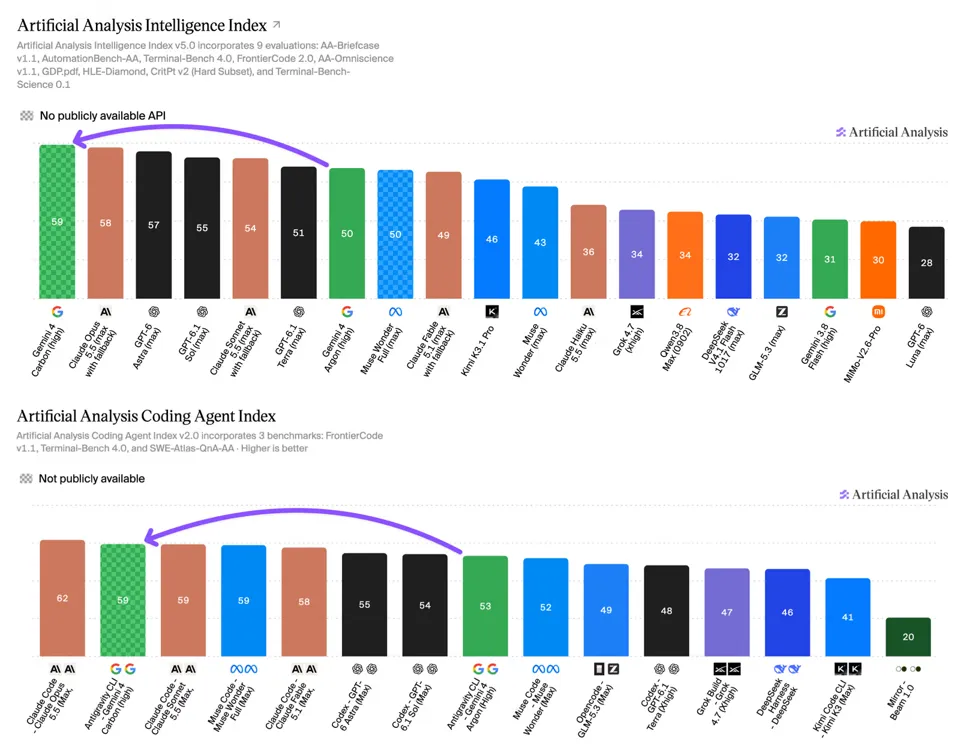
According to Artificial Analysis’s evaluation, Carbon ranked first in four of the nine tests, including HLE-Diamond, Terminal-Bench-Science, AA-Omniscience, and AutomationBench-AA.
These tests cover high-difficulty knowledge and reasoning, terminal operations in scientific environments, factual knowledge, and cross-tool automation tasks.
However, holding the top spot on the overall leaderboard does not mean Carbon outperforms competitors in every specific capability.
On the Artificial Analysis Coding Agent Index, Gemini 4 Carbon using the Antigravity CLI with high-reasoning configuration scored 59, while Claude Code paired with Claude Opus 5.5’s highest reasoning configuration scored 62. Carbon ranks second, narrowing the gap to just three points.
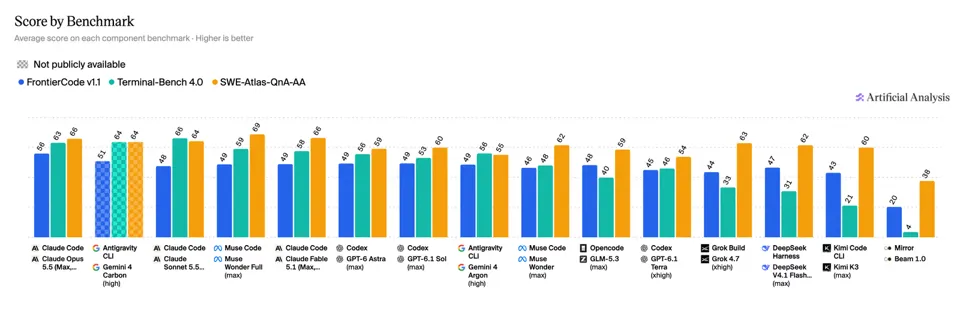
Specifically, in the FrontierCode v1.1 test, Carbon achieved 51%, whereas Claude Opus 5.5 reached 56%. This indicates that Anthropic maintains an advantage in certain real-world software engineering tasks.
On the other hand, in the AA-Briefcase benchmark, which measures professional knowledge work, Carbon scored 1609 Elo, an increase of 126 points from Argon’s 1483 Elo. Within this category, presentation tasks improved by 293 Elo, and analysis quality rose by 120 Elo.
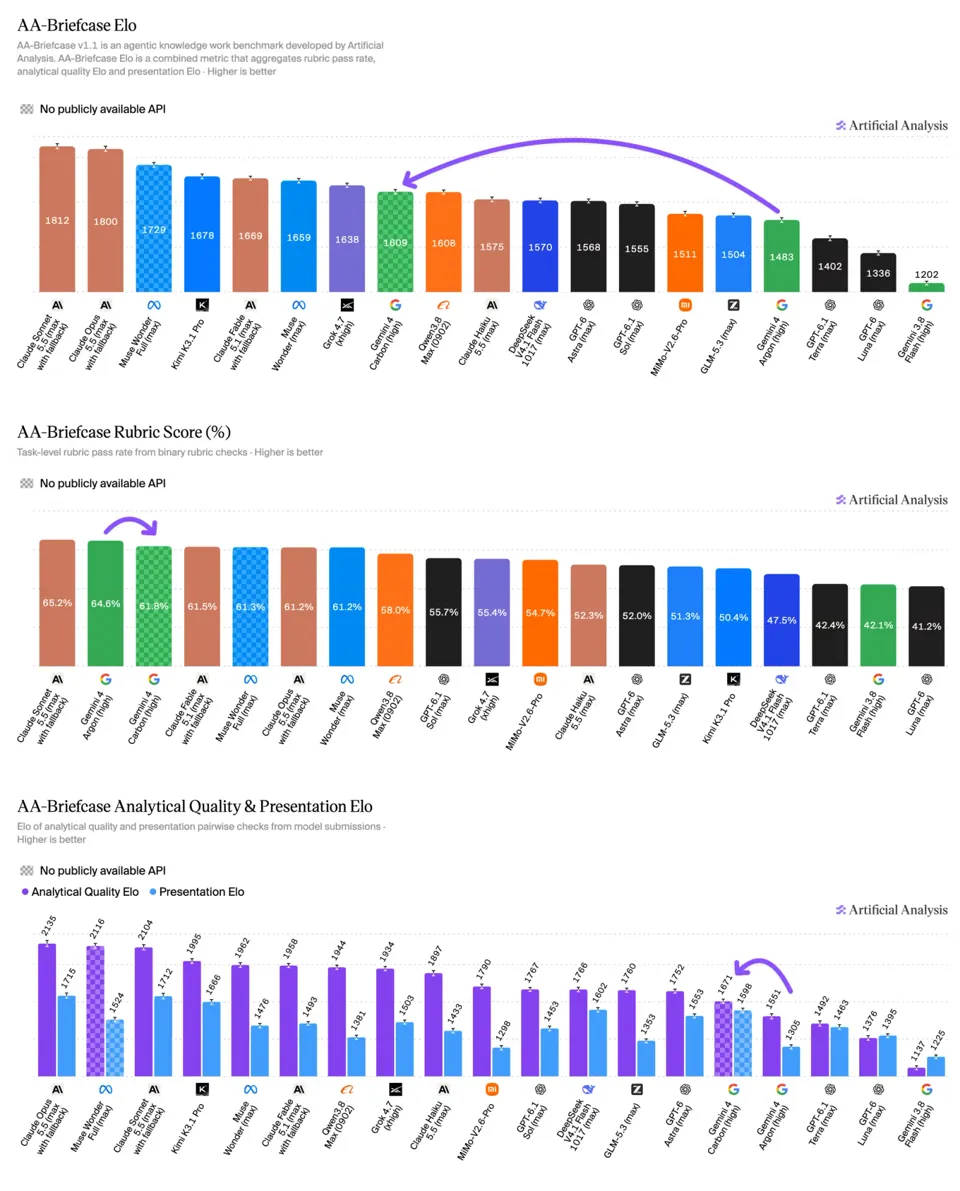
Nevertheless, Carbon still trails some competing models in this test, including Grok 4.7, Muse Wonder, and Kimi K3.1 Pro.
In other words, while Google has secured the top position on the overall intelligence index, leadership in niche areas such as coding agents and professional knowledge work remains fiercely contested.
Notably, Google’s official announcement specifically highlighted Carbon’s web development capabilities.
On the WebDev Arena, Carbon’s Elo rating increased by 89 points compared to its previous version, reaching approximately 1768 and ranking fourth. Google attributed this improvement to enhanced quality in model-generated web outputs, as well as advancements in full-stack development, multimodal understanding, and complex engineering capabilities.
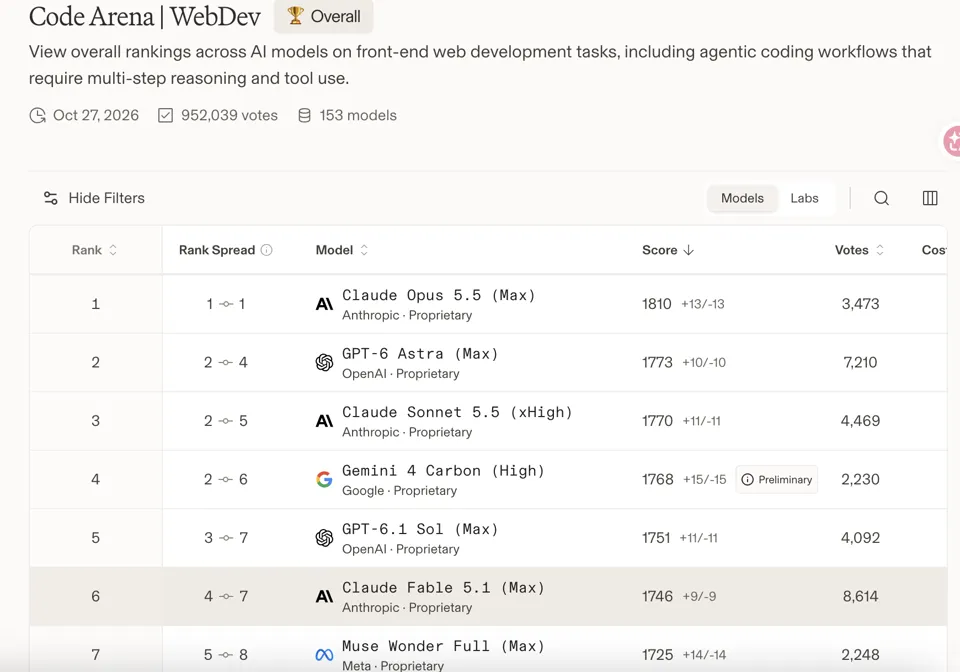
From code generation to terminal execution and complete software engineering tasks, Carbon’s direction of improvement is clear: it no longer aims merely to generate a snippet of correct code, but rather enables the model to continuously accomplish tasks within real-world development environments.
This shift is becoming central to the current competition among flagship models.
Google Claims Carbon Can Work Continuously for Days
Over the past two years, large language models have undergone significant changes in their programming capabilities.
Initially, developers focused on whether models could write a function or fix a bug. The focus gradually shifted toward enabling AI to understand codebases, invoke tools, execute tests, and even independently deliver complete software projects.
Today, frontier models face a more complex challenge: if an engineering task requires hours or even days to complete, can the AI persist through repeated failures, debugging, and modifications?
This is precisely the area Carbon has prioritized in this update.
In its official technical introduction, Google disclosed that researchers have observed Carbon running continuously for days within internal engineering environments. It can track subtle bugs in large codebases, analyze underlying system issues, and attempt to formulate viable fixes.
Such tasks typically lack a clear path to resolution. Developers may need to read extensive amounts of code, reproduce issues, try different fixes, and adjust their judgments based on test results.
For agents, the true difficulty lies not just in generating code, but in maintaining long-term understanding of task objectives, execution states, and engineering constraints.
Google stated that Carbon has been specifically optimized for these long-horizon tasks, emphasizing the model’s ability to continue analyzing and seeking solutions after encountering failure paths, rather than simply terminating the task.
This capability largely reflects the trend in AI programming tools.
In traditional code completion scenarios, developers can instantly check model outputs; however, in long-horizon agent tasks, models often need to perform dozens or even hundreds of tool calls independently. If an early judgment deviates, subsequent execution may gradually drift from the original goal.
Therefore, the model’s ability to promptly detect errors, replan after failures, and clearly identify unfinished tasks is becoming as important as raw programming capability. From this perspective, Carbon’s technical focus is on enabling AI to complete longer, more reliable work loops in complex engineering contexts.
If complex programming is the capability most closely watched by developers, cybersecurity is likely the most strategically significant aspect of Google’s release.
Google published some internal engineering data.
In secure code generation tasks, Carbon achieved a success rate more than twice that of Argon. Internal tests by the Chrome team also showed that Carbon delivered over ten times better performance in generating high-quality patches compared to another lab’s large frontier model.
Top Performance, Unchanged Prices
While model performance continues to improve, Google chose to maintain Argon’s initial pricing for Carbon.
According to the official announcement, Carbon’s initial API pricing is $2 per million input tokens and $10 per million output tokens, with a 95% discount on cached inputs.
However, there is an easily overlooked detail: this is only the introductory promotional price, not the permanent pricing.
Google explicitly noted in a footnote of the official announcement that after the introductory period ends, Carbon will revert to $4 per million input tokens and $20 per million output tokens. Google has not yet announced the specific end date for the promotional period.
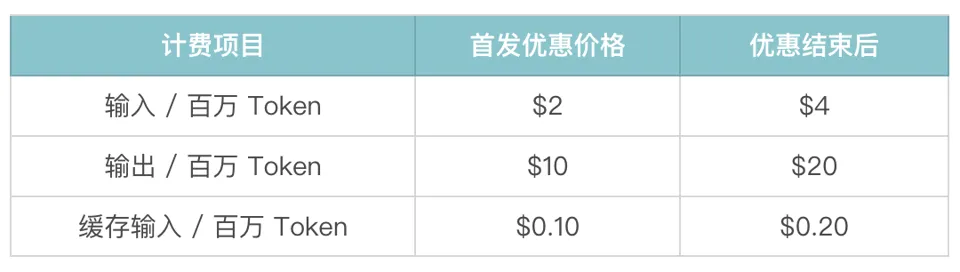
Looking purely at prices, Carbon has not increased unit token costs compared to Argon, while offering noticeable performance improvements.
However, for developers running complex agent tasks, token unit prices do not fully reflect actual costs.
Whether the model completes a task in one go, how many revisions are needed, how many inference tokens are consumed during execution, and the cost of tool calls and runtime all impact overall expenses.
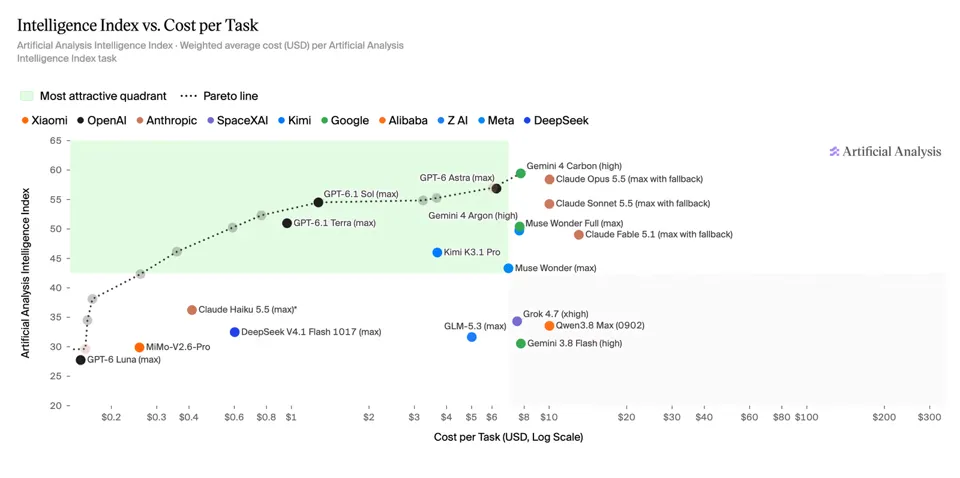
Artificial Analysis’s evaluation provides a more concrete perspective. In its comprehensive intelligence index test, calculated using standard pricing, Carbon’s average cost per task was approximately $7.76, whereas Claude Opus 5.5 under maximum reasoning configuration averaged about $10.04.
This means that under these specific test conditions, Carbon’s average cost per task is approximately 23% lower than that of Claude Opus 5.5.
Can Carbon Regain Capital Market Trust for Google?
Dramatically, on the very same day Google released Gemini 4 Carbon and reclaimed the top spot in global LLM comprehensive performance rankings, its parent company Alphabet faced a cold reception from capital markets.
On the day of the model release, Alphabet reported its Q3 2026 earnings. Data showed quarterly revenue reached $127.58 billion, up 25% year-over-year, but fell short of Wall Street’s expectation of approximately $127.97 billion. Net income was $26.17 billion, down about 25% year-over-year. Following the earnings report, Alphabet’s stock price dropped more than 10% in after-hours trading.
It is worth noting that Google’s AI business is growing. In Q3, Google Cloud revenue reached $30.71 billion, up 103% year-over-year, setting a new growth record. Google CEO Sundar Pichai also revealed that the user base for the Gemini app has surpassed 1 billion.
What truly concerns investors is the continuously escalating cost of AI investment and when these expenditures will translate into substantial profits.
According to Reuters, Alphabet’s free cash flow in Q3 was negative $9.07 billion, worsening from negative $5.9 billion in the previous quarter. The company also expects capital expenditures to increase significantly in 2027. Meanwhile, Google Search revenue growth slowed from 17% in the previous quarter to 12%, raising concerns about the growth prospects of its advertising business.
Of course, Alphabet’s decline in profits cannot be entirely attributed to AI investments. The company also recognized approximately $8.7 billion in equity investment losses during the quarter, which had a noticeable impact on net income and earnings per share.
However, this situation still highlights the real-world contradictions currently facing the AI industry.
On one hand, the release of Gemini 4 Carbon demonstrates that Google retains the capability to lead in frontier model competition; on the other hand, training more powerful models, building larger-scale compute infrastructure, and maintaining rapid technological iteration all entail increasingly high capital expenditures.
For Google, topping large model leaderboards and winning the trust of capital markets are becoming two distinct competitions.
References:
https://blog.google/innovation-and-ai/models-and-research/gemini-models/introducing-gemini-4-carbon/
https://artificialanalysis.ai/articles/gemini-4-carbon-new-number-1