Google Opens Android Studio to Third-Party AI Agents and Unveils New Gemini APIs
At the Android Dev Summit, Google announced that Android Studio now supports over 40 external coding agents, including Claude and Codex, via a new 'Bring Your Own Agent' feature. The company also unveiled the Gemini Nano 4-powered Agentic API and Model Context Protocol interfaces, enabling developers to run agent functions locally on mobile devices and integrate app services directly into Google Search and the Gemini app. Additionally, Google partnered with XREAL to launch the AURA smart glasses, which run Android XR and use Gemini to analyze real-world environments for virtual workspace experiences.
Full Report
Contents6 sections
Google opens Android development to third-party AI agents and unveils new Gemini APIs
[Maximilian Schreiner](https://the-decoder.com/author/maximilian-schreiner/) [View the LinkedIn Profile of Maximilian Schreiner](https://www.linkedin.com/in/maximilian-schreiner-b6a5171aa/) Oct 28, 2026 Nano Banana Pro prompted by THE DECODER Key Points
- Google is opening its Android Studio development environment to more than 40 external coding agents like Claude and Codex via the "Bring Your Own Agent" feature, while expanding terminal tools to cut down on development time and token usage.
- Using interfaces like the Gemini Nano 4-powered Agentic API and the Model Context Protocol, developers can run agent functions locally on mobile devices and plug app services directly into Google Search and the Gemini app.
- Google and hardware maker XREAL also unveiled the XREAL AURA, a $1,099 pair of smart glasses running Android XR that displays virtual workspaces and uses Gemini to analyze the real-world environment.
Ask about this article… Search
Google is centering its development environment around AI agents at the Android Dev Summit. The updates include integrations for Anthropic and OpenAI models, new APIs for local smartphone agents, and a pair of smart glasses.
Google introduced updates for its developer tools and system APIs at this year's Android Dev Summit. Opening up the Android Studio development environment was the main focus.
With Android Studio Rabbit 2, Google is launching a "Bring Your Own Agent" (BYOA) feature. Developers are no longer limited to Google's own AI tools. Instead, they can use the open Agent Client Protocol (ACP) to run more than 40 different coding agents directly in the IDE.
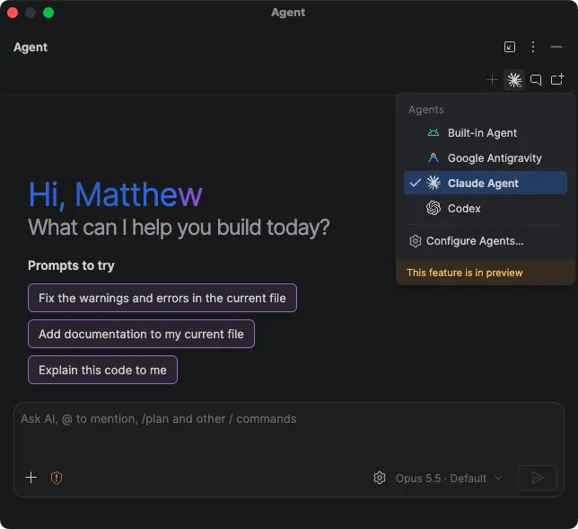 Developers can now choose between various AI agents in Android Studio, including Claude, Codex, and Google Antigravity. | Image: Google
Developers can install and simultaneously run Anthropic's Claude Agent, OpenAI's Codex, and Google Antigravity through the built-in marketplace. These agents get direct access to IDE tools like project structure, symbol resolution, the emulator, and the Logcat system.
Google also released version 2.0 of the Android Bench leaderboard to measure AI model performance on complex tasks. It evaluates language models on multi-day development projects based on functionality, time spent, and cost.
AI-generated code changes often get messy, so Google is adding a code verification tool called Change Review. It analyzes pending changes, generates bug reports, and explains modifications step by step. The Android Studio Canary preview also adds a migration assistant that automatically translates older XML layouts into Jetpack Compose. Meanwhile, Google is testing Lightbuild, a declarative build system based on a YAML schema that both humans and AI agents can read and edit.
New terminal tools and specialized skills cut token usage for coding agents
Google expanded the Android CLI command-line tool for developers who run their agents in the terminal or in CI pipelines. It is now available as an official agent plugin for Claude Code, OpenAI's Codex, and Google Antigravity.
New commands let AI agents render Compose previews. in the terminal to visually check UI changes without booting up an emulator. Internal Google tests show agents finished UI tasks 77 percent faster and used up to three times fewer tokens with this feature. The CLI also supports streaming physical test devices. from Google labs so agents can investigate device-specific bugs.
Debugging and performance analysis got new features too. Google built the open-source LeakCanary memory leak detection library into both the CLI and the Android Studio Profiler. The system evaluates heap dumps on the computer instead of the mobile device, which keeps the app from slowing down during testing. In a Google A/B test using Anthropic's Claude Opus 5.5 model, the CLI tool helped find and fix memory leaks nearly twice as fast while cutting token usage by about 25 percent.
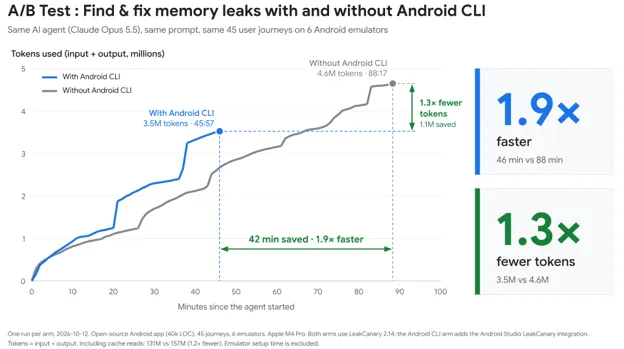 Google says integrating LeakCanary into the Android CLI reduces both runtime and token usage for AI agents. | Image: Google
Other command-line tools let agents capture system traces via the Android Performance Analyzer, pull crash reports from Firebase Crashlytics, or check code optimization through the R8 compiler. Language models often lack training on the newest APIs, so Google now provides over 30 Android Skills. These feed documentation to agents for tasks like checking Google Play policies before app submission, handling permission security issues, or adapting layouts for foldables and laptops branded as Googlebooks.
Gemini Nano 4 and MCP turn Android apps into interactive agent tools
Beyond developer tools, Google is shipping new APIs to build agent features into apps or connect apps to system agents. For local on-device processing, Google is adding an alpha Agentic API powered by Gemini Nano 4 to its ML Kit. This interface automatically executes functions, saves chat history, manages the orchestration loop, and provides safety filters.
Google is using the Model Context Protocol (MCP) and launching the AppFunctions API in beta as a unified tool-calling layer so apps can share functions with local or system-wide agents. The new alpha Agent-to-UI (A2UI) interface for Jetpack Compose builds on this. Instead of replying with plain text blocks, agents can display interactive user interfaces built from the specific app's components.
To bring these app services into Google Search and the Gemini app, the company is launching a preview of the Connected Apps Platform. Developers can link their apps via Android MCP or cloud-hosted MCP servers and manage them through a single console. Google says over 50 partner integrations from companies like Adobe, Peloton, and Experian are already live in the Gemini app, and they will roll out to web search in the coming weeks.
XREAL AURA smart glasses bring Android XR and Gemini into the real world
Google also announced updates for several hardware form factors. Updates to Jetpack Compose 1.13 and the AppState model make it easier to adapt apps for large screens, and the Extended Reality (XR) development environment is leaving the testing phase. The Jetpack XR SDK, the XR emulators in Android Studio, and the Engine Hub for Unity, Godot, and Unreal are now available as stable releases.
 The XREAL AURA projects up to five virtual windows into the user's field of view and connects to a laptop via cable. | Image: Google
Alongside the software updates, Google partnered with hardware maker XREAL to unveil the XREAL AURA. XR chief Shahram Izadi says they are the first wired smart glasses running Android XR. The glasses weigh under 95 grams and feature transparent, dimmable lenses with a 70-degree field of view. The computing unit and battery sit in an external puck that doubles as a trackpad and runs on Qualcomm's new Snapdragon Reality Elite chip.
Users can place up to five Android apps in their field of view at once or plug in a USB-C cable to mirror their laptop screen. Gemini is built in here too. The AI can see both the real-world environment through the glasses and the virtual screens, allowing it to organize windows, offer video game tips, or visually highlight physical objects in the room. The XREAL AURA is available to order now in the US, Canada, and South Korea for $1,099, with shipping set to begin in mid-November.