The Decoder · 10/13/2026, 02:48:29
Meta Launches Muse Wonder Frontier Model: Intelligence Index Jumps to 56 with Major Agentic Gains
Meta has released its new frontier model Muse Wonder and the enhanced Muse Wonder Full, scoring 52 and 56 respectively on the Artificial Analysis Intelligence Index, marking a significant leap into the top tier. The models demonstrate substantial improvements in agentic capabilities, with Terminal-Bench scores rising from 33% to 57%, while introducing an 'Active Memory' feature and reducing output token usage by approximately 10%.
SOURCE COVERAGEFull Original Report
Contents2 sections
Meta released its frontier model Muse Wonder in two variants, and both land among the best AI models available.
Muse Wonder Full scores 56 points on the Artificial Analysis Intelligence Index v4.3, while Muse Wonder hits 52. Its predecessor, Muse Spark 1.3, sat at 48 points, which makes this a significant jump from what was a mid-tier model.
The biggest gains show up in agentic evaluations, tests that measure how well an AI model can handle complex tasks on its own. On Terminal-Bench 4.0, performance jumped from 33 to 57 percent. Muse Wonder Full places in the top three on six out of ten benchmarks overall, a strong result for Meta, which seems to have recovered after a weaker stretch with its open Llama models.
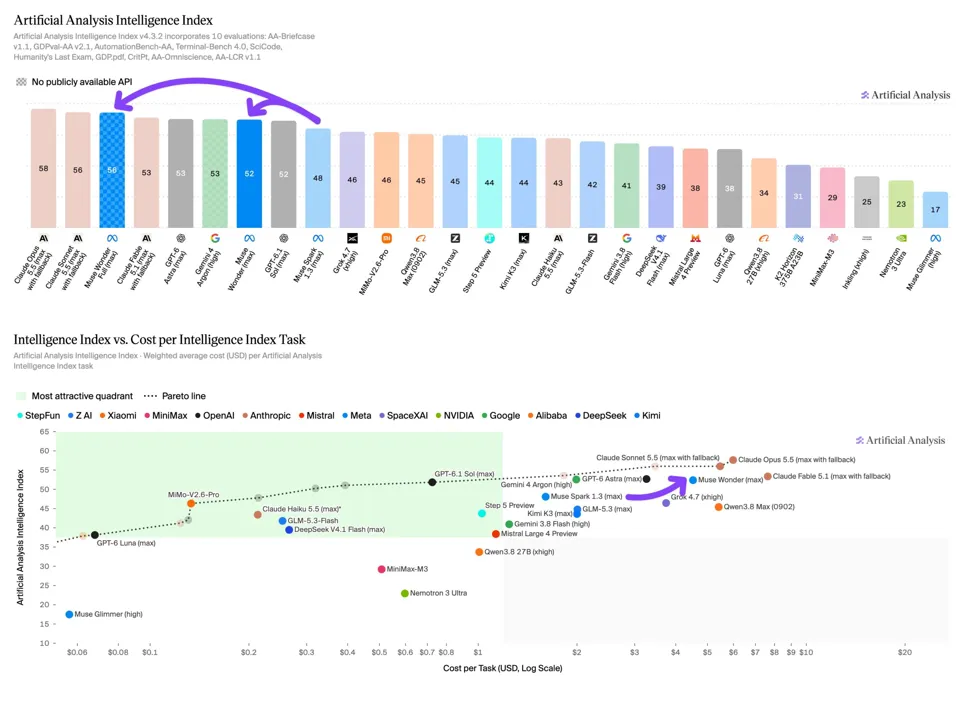
Muse Wonder Full scores 56 on the Artificial Analysis Intelligence Index, placing it among the top frontier models. | Image: Artificial Analysis
Meta highlights two new features. "Active Memory" lets the model remember key information across conversations and recall it when needed. "Active Focus" is the model's ability to stick with difficult tasks, try alternative approaches, and ask follow-up questions when something isn't clear. Both are central to Meta's pitch for a personal AI agent that can access calendars, messages, and documents.
Both models support a one-million-token context window and accept text, images, video, and audio as input. Muse Wonder is available through Meta's API and Muse Code, while Muse Wonder Full is currently limited to Muse Code users. Muse Wonder will soon power the Muse app as well, starting with paying subscribers. Over time, Meta plans to build specialized models from it for all users.
Coding jumps sharply, but factual knowledge lags behind
Both models show big improvements in coding. Muse Wonder Full hits 68 points on the Coding Agents Index, tying Claude Code with Sonnet 5.5. Muse Wonder scores 63, up from 54 for its predecessor.
Factual knowledge remains a weak spot. On the AA-Omniscience knowledge test, Muse Wonder Full manages only 30 points, and Muse Wonder gets 25. That's well behind Claude Opus 5.5 (46), GPT-6 Astra (43), and Gemini 4 Argon (42), which suggests the Wonder series is built on a smaller base model than its competitors. Low hallucination rates help offset this gap. Muse Wonder Full cuts its hallucination rate from 33 to 23 percent compared to its predecessor, the second-lowest among all models scoring at least 45 index points. Only Gemini 4 Argon (15 percent) hallucinates less often.
Meta addresses a common criticism in its blog post, that Muse models are tuned for benchmarks but fall short in real-world use. The company says Muse Wonder Full does better than expected on unfamiliar tasks that weren't part of training optimization, and credits this to a stronger base model.
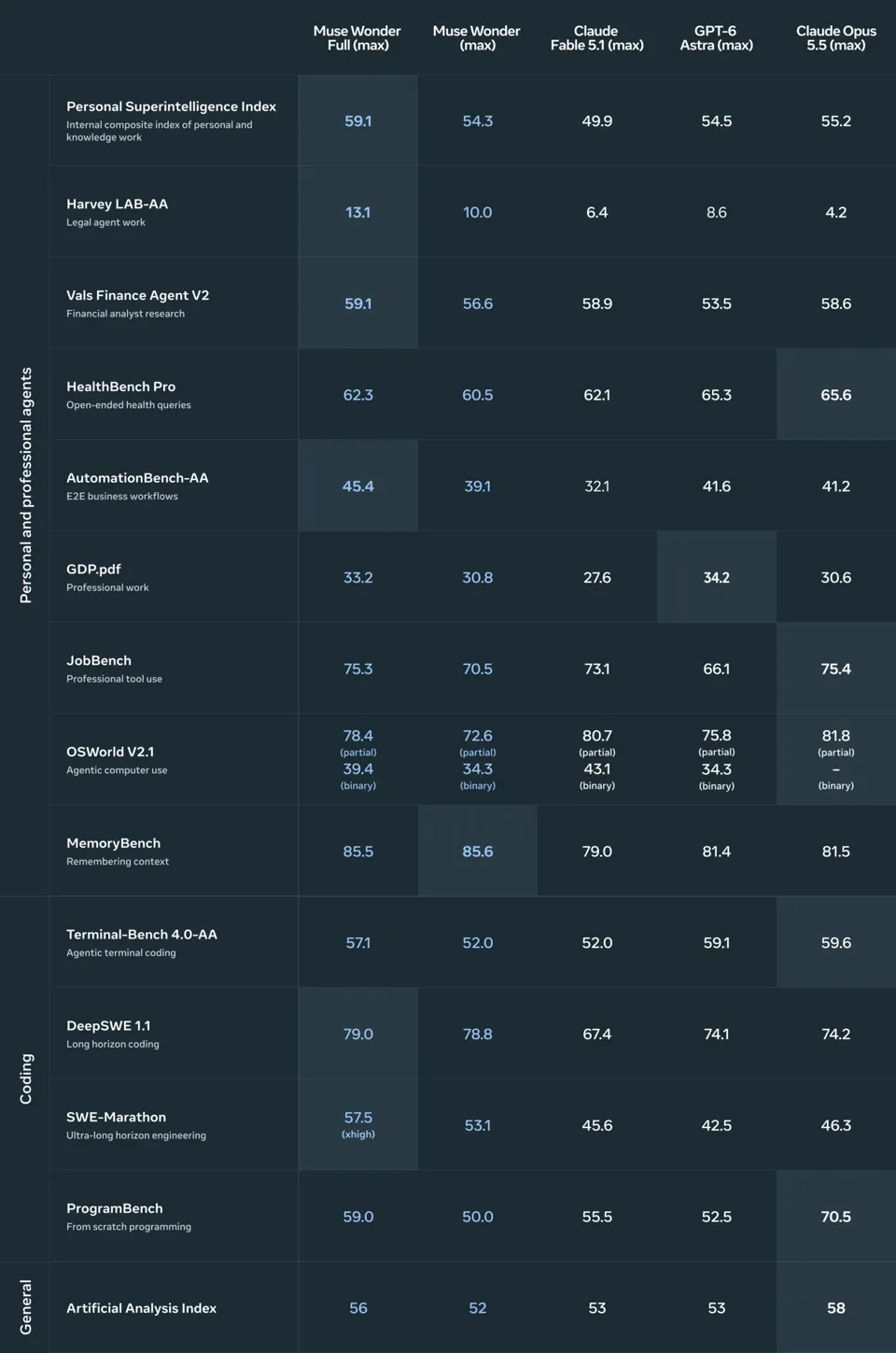
Meta's official benchmark results show the online advertising company has caught up to the leading frontier models. | Image: Meta
On the Vals AI Index, Muse Wonder Full (Max) debuts at fifth place and beats all OpenAI models, according to Vals AI. Only current Anthropic models score higher. Muse Wonder lands at tenth.
The biggest improvements come from coding and math. On ProofBench, a private benchmark for mathematical proofs, Muse Wonder Full solves 94 out of 100 problems, up from 58 for its predecessor. That puts it just five to six points behind the top models (99 to 100). On Terminal-Bench 4, Muse Wonder Full doubled its score while using 30 percent fewer output tokens. Performance on finance and legal tasks stayed at predecessor levels, dropping up to two points.
Better performance comes at a steep price
According to Artificial Analysis, Muse Wonder runs 1.60). Token pricing has climbed too, with 20 for output, up from 4.25 for the predecessor. Muse Wonder also uses 28 percent more input tokens per task, and those account for 76 percent of total costs.
That puts Muse Wonder below Claude Fable 5.1 (5.98) in pricing, but above GPT-6 Astra (1.99), and GPT-6.1 Sol ($0.72). No token pricing is available yet for Muse Wonder Full. Both models do use about 10 percent fewer output tokens than their predecessor.
Meta says it trained the models at its in-house Prometheus data center at gigawatt scale. More details are in the model card.