MiniMax Launches M3.1 Flash, Tops Domestic Agent Benchmarks
MiniMax officially released M3.1 Flash, the revealed identity of the anonymous 'Space Bunny' model. It scored 29.6% on Agents’ Last Exam (ALE), ranking first among domestic models, and entered the global top tier in coding, security, and Computer Use tasks. With output speeds exceeding 200 TPS and API pricing at just 30% of its predecessor, it offers significant cost-performance advantages.
Full Report
Contents2 sections
Under the Rabbit Skin, It's Actually MiniMax!
Jay from Ao Fei Si QbitAI | Official Account: QbitAI
During the National Day holiday, a mysterious model named Space Bunny (Jade Rabbit) emerged on OpenRouter and anonymously topped the leaderboards. Its true identity has finally been revealed.
Underneath the bunny disguise was none other than MiniMax!

The official codename for this release is M3.1 Flash.
And the performance of this official version is even stronger than Space Bunny’s, particularly in the Agent capability dimension—
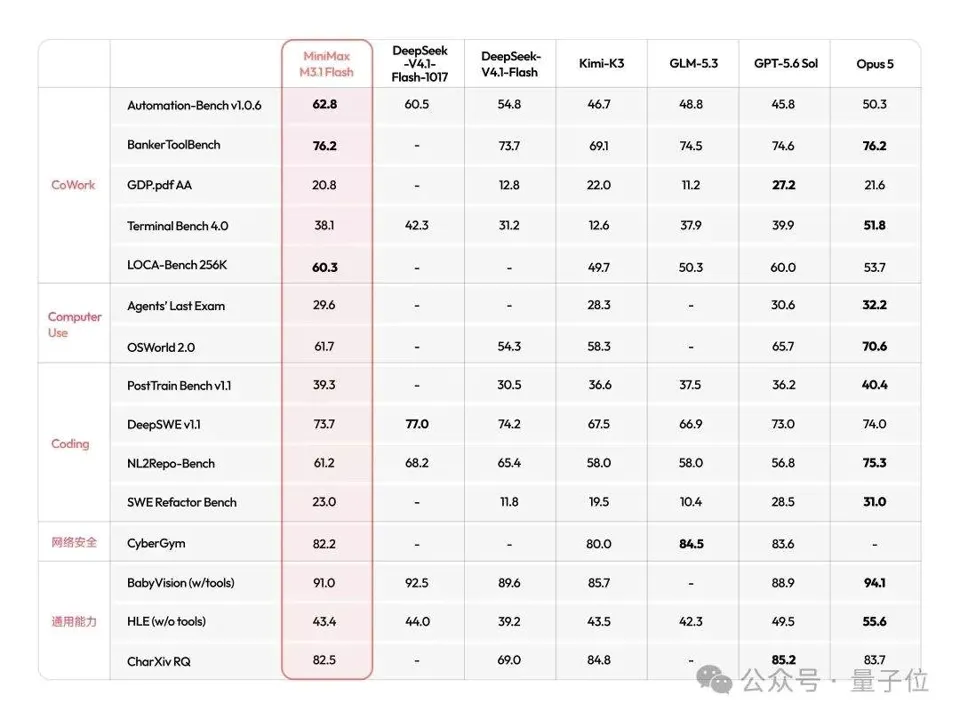
It scored 29.6% on Agents’ Last Exam (ALE), securing the top spot among Chinese models.

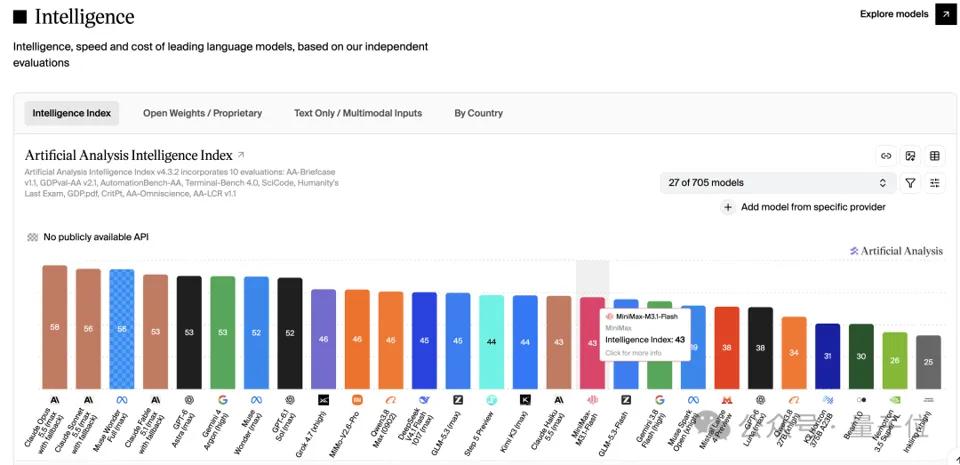
On the AA leaderboard, it also achieved a score of 43, which is quite impressive for a "Flash" model.
In short, its practical working capabilities have finally leveled up, earning it the title of a "senior workhorse" (doge).
Beyond that, it has also surged into the global first tier across Coding, Cybersecurity, Computer Use, and more.
Building on this foundation, the speed maintained during the "Jade Rabbit" era remains intact, with output speeds reaching over 200 TPS.
Then comes the most important part—
True to its "Flash" name, the price is incredibly low!!
Input costs 1 RMB per million tokens, output costs 4 RMB, and cache reads are just 0.1 RMB.
The total cost has been compressed to 30% of the previous generation M3.
What? You still don't have an intuitive sense of this pricing??
Let me put it this way—
It's comparable to DeepSeek V4.1 Flash.
That's remarkably generous. I hereby declare: use Liang Wen Gu when idle, Yan Jun Feng when busy! (Just kidding.)

△ Image source: @BigCompanyMicroscope
However, Silicon Valley's closed-source camp may be in trouble again.
Following DeepSeek, a new cost-performance kill line has been drawn under the large-parameter flagship models of Silicon Valley by domestic "Flash" models o(╥﹏╥)o.
A Comeback Victory for Text Models
To be honest, I had my doubts about MiniMax before.
Their multimodal and video generation capabilities were indeed top-tier, but their pure text LLMs seemed to have gone quiet at some point...
The debut of M3.1 Flash can certainly be seen as a comeback victory.
Let's look at the track record one by one:
Code Engineering and Real-World Bug Fixing
In the DeepSWE v1.1 evaluation, M3.1 Flash achieved 73.7%.
This is truly a reversal of expectations.
GPT-6.1 Sol, Claude Opus 5, Claude Fable 5... were all outperformed in benchmarks by a "Flash" model.
Only DeepSeek V4.1 Flash 1017, with a score of 77, ranked ahead of it.
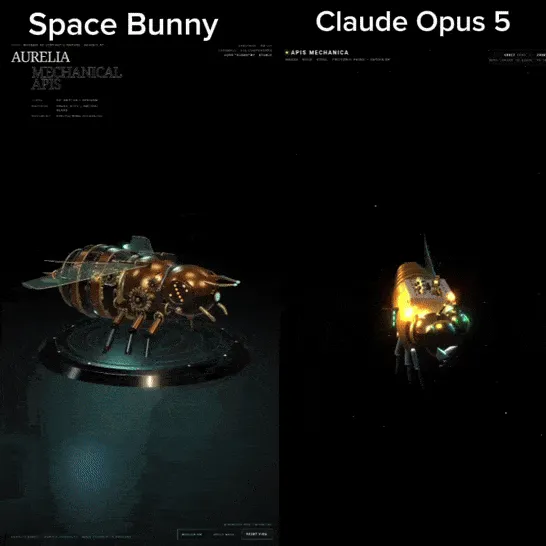
This confirms community feedback during the anonymous testing phase of Jade Rabbit: when handling 3D rendering tasks like Three.js and complex frontend work, its attention to detail is exceptionally rigorous.
Cybersecurity in Practice
In the CyberGym benchmark led by UC Berkeley, M3.1 Flash scored 82.2, firmly sitting alongside GLM-5.3 (84.5) and GPT-5.6 Sol (83.6) in the global first tier.
Complex Agents and Enterprise-Level Cross-SaaS Workflows
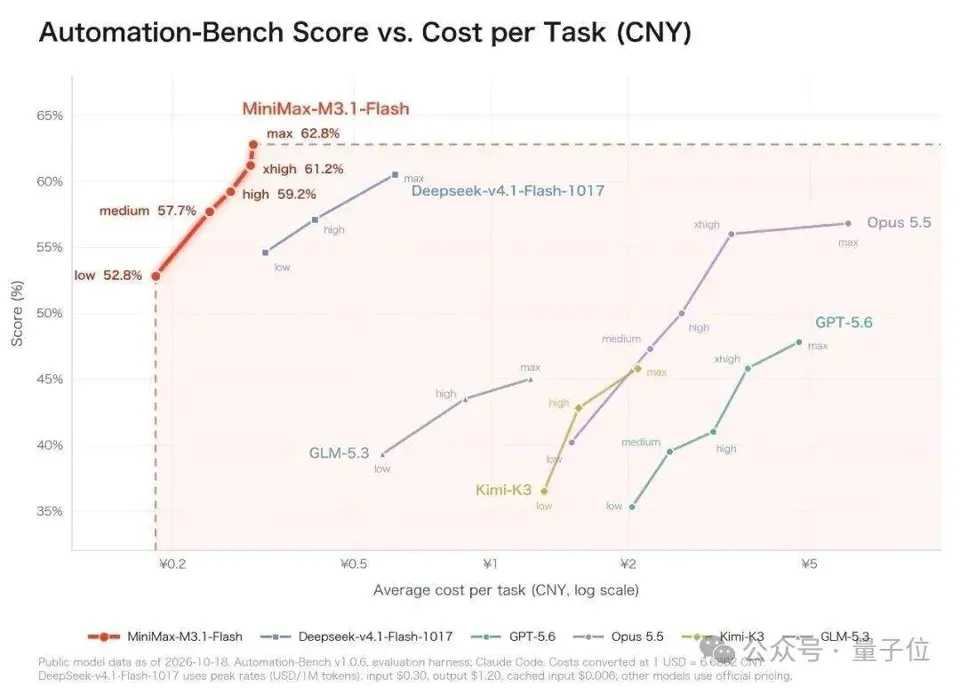
In AutomationBench-AA, an open-source evaluation by automation giant Zapier, M3.1 Flash ranked near the top.
With a single-task cost of less than $0.05, it can autonomously orchestrate complex workflows spanning sales, marketing, customer service, finance, and HR.
On BankerToolBench, a financial-specific benchmark with extremely low tolerance for error, M3.1 Flash soared to 76.2 points, tying with the acknowledged ceiling, Claude Opus 5, for the global number one spot.
Computer Use: Real Desktop Operations
It scored 61.7 on OSWorld V2, which simulates real computer operations;
On ALE, which measures scenarios with real economic value, M3.1 Flash achieved top-model-level performance at extremely low task costs.
Both metrics rank first among Chinese models, once again demonstrating the power of unbeatable cost-performance ratios.
Honestly, I expected MiniMax's text models to eventually return to the table.
But who would have guessed it would be a small model with a "Flash" suffix...
Extreme Speed and Low Price Are King
Looking only at benchmark scores, you might think this is just another day of giants fighting.
What truly excites people is the dimensional strike this model delivers on real-world deployment scenarios.
When building multi-agent collaborations or long-chain workflows, what do we fear most?
Two things: endless loading spinners and heart-stopping API bills at month-end.
A true enterprise-grade agent often needs to call tools dozens of times in the background and pass messages back and forth between multiple sub-agents.
If the model generates text slowly, users see the spinner and close the webpage immediately; if the unit price per call is high, finance sees the bill and shuts down the project on the spot.
This is where M3.1 Flash shines.
At its core, it employs a highly aggressive sparse attention architecture.
Online inference speed has increased nearly threefold, with output speeds reaching over 200 TPS, while the median (P50) remains steadily above 170 TPS.
What does 170 TPS mean?
When you dispatch a refactoring task in MiniMax Code desktop, Claude Code, or various local coding tools, the code on screen cascades instantly, filling the view in a flash.
Previously, chaining four sub-agents felt like waiting at a red light; now, it achieves nearly seamless refreshes.
While speed has skyrocketed, prices have been slashed to rock bottom: Input price: Just ¥1 per million tokens Output price: Just ¥4 per million tokens Cache read price: Just ¥0.1 per million tokens Input and output prices have been halved, while cache read costs have dropped by 75%. The result? Overall usage costs are down 70% compared to the previous generation M3.
What more is there to say? Stand up and sprint, everyone!!
Domestic Duo Strikes Back
In the past, there was a common consensus: Flash models were merely cheap, stripped-down versions of flagship large models. You chose Flash because you were on a budget or the task was trivial; when it came to critical, complex, hardcore scenarios, you still had to pay extra for high-parameter flagship Pro models. But now? DeepSeek V4.1 Flash (1017) just set the benchmark for cost-performance, and MiniMax M3.1 Flash immediately followed suit, cutting prices one after another. Small-size models are no longer toys; they can go head-to-head with flagship models that have several times the parameters and ten times the price. Haters, speak up!! Even more interestingly, these two domestic Flash models have taken highly complementary paths: DeepSeek takes the lead in extreme cost-performance for pure coding tasks; MiniMax M3.1 Flash strengthens its capabilities in cross-SaaS enterprise workflows, financial toolchain invocations, and other comprehensive Agent dimensions. One focuses relentlessly on code engineering, while the other delves deep into complex business flows. And folks, I scrolled through the internet and discovered a genius idea! Big Fish (a colloquial term for major providers like Anthropic/OpenAI) has peak and off-peak pricing, but previously, lacking equally cost-effective models, we gritted our teeth and paid the peak rates anyway. But now that M3.1 is out, it perfectly fills the gap. I simply use routing: MiniMax during busy hours, Big Fish during idle hours, thoroughly maximizing the token dividend. I'm moved to tears—this is our exciting domestic Flash combo move (not really).
With this approach, I believe APIs are actually becoming a viable option for ordinary users. After all, large models iterate so rapidly that even monthly subscriptions feel risky. For instance, when Opus 5.5 launched, Astra's subscription users from the previous wave basically hit a wall. Buying Pro 10X felt like a waste; my wallet hurts. Moreover, C-end users are truly suffering right now o(╥﹏╥)o. There are 5-hour limits, midnight resets that feel like betrayals, and constant worries about backend "dumbing down" attacks... Buying API credits, topping up with just tens of dollars, and switching away whenever a model underperforms is incredibly comfortable.
Moved to tears, everyone. I don't know if you share this feeling, but honestly, I've felt somewhat stifled over the past month. A Corp, OpenAI, and Google have been aggressively releasing flagship models, while the domestic camp has remained silent. Many industry leaders have claimed that the LLM battle is essentially over, with Silicon Valley winning everything through Scaling. But now, an inflection point seems to be emerging. In just two days, two domestic Flash models have arrived consecutively. Flagship-level capabilities are being democratized at Flash speeds and prices. Indeed, the fight for SOTA (State-of-the-Art) is not easy. But once the prerequisite of "cost-performance" is met, another more important battle— Large model industrial implementation—may have only just begun. And this is something Chinese companies have always excelled at. — End — QbitAI · Signed Headline Account Follow us to stay updated on cutting-edge tech trends