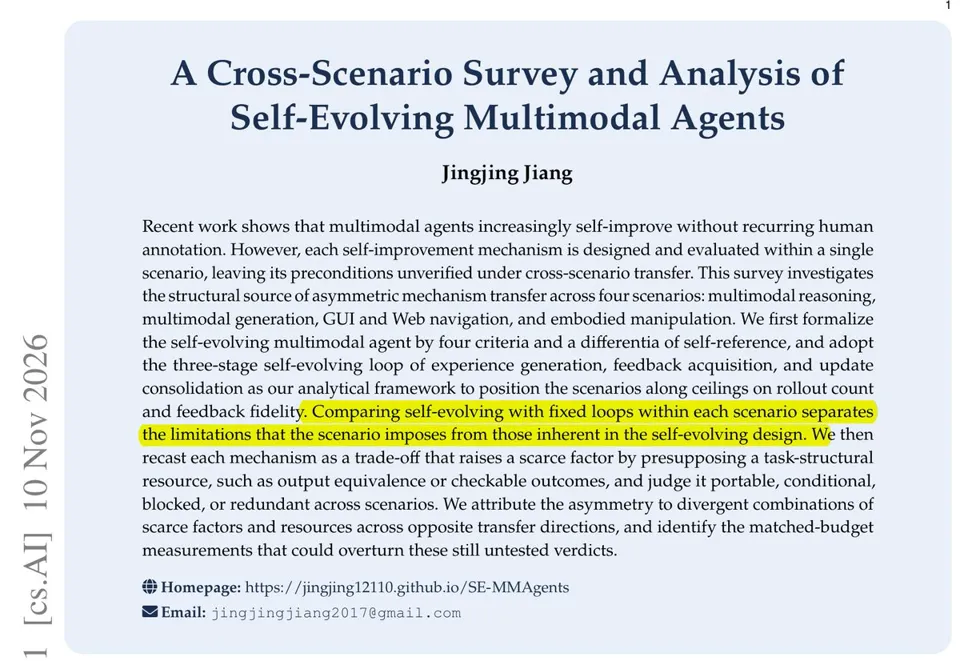
Survey Finds Self-Improvement Tricks for Multimodal Agents Fail to Transfer
A survey systematically reviews self-improvement methods for agents across visual reasoning, image generation, app and web navigation, and robotics, arguing that each trick depends on a checkable signal the task provides, such as votable answers or program-verifiable results, so most methods are validated in only one setting. A cited audit of 500 questions found 24% of retained majority-vote labels were wrong versus 5.6% for program-computed answers. The author stresses these transfer verdicts are predictions, not experimental results.
Full Report
Rohan Paul (@rohanpaul_ai) · 2026-11-16 22
This survey argues that self-improvement tricks for multimodal agents only carry over to tasks that have what the trick relies on, like checkable answers.
AI agent learn from its own attempts in 1 area, like questions about images, can fail in another, like robotics, where there is nothing to check.
Self-improving agents now span visual reasoning, image generation, app and web navigation, and robotics, but each method is tested in only 1 setting. Majority voting, for example, scores short visual answers but finds nothing to compare in robot action trajectories.
The author reviewed methods in the 4 settings and listed each trick's needs, like answers a vote can compare or results a program can check. Each trick then gets a verdict per setting: portable, conditional, blocked, or redundant.
In 1 cited audit of 500 questions, 24% of kept majority-vote labels were wrong, against 5.6% for program-computed answers. These verdicts are predictions, not results from transfer experiments.
Before moving a self-improvement trick to a new task, confirm that task offers the check the trick relies on, then test against a same-budget baseline.