综述指出多模态智能体自我改进方法难以跨任务迁移
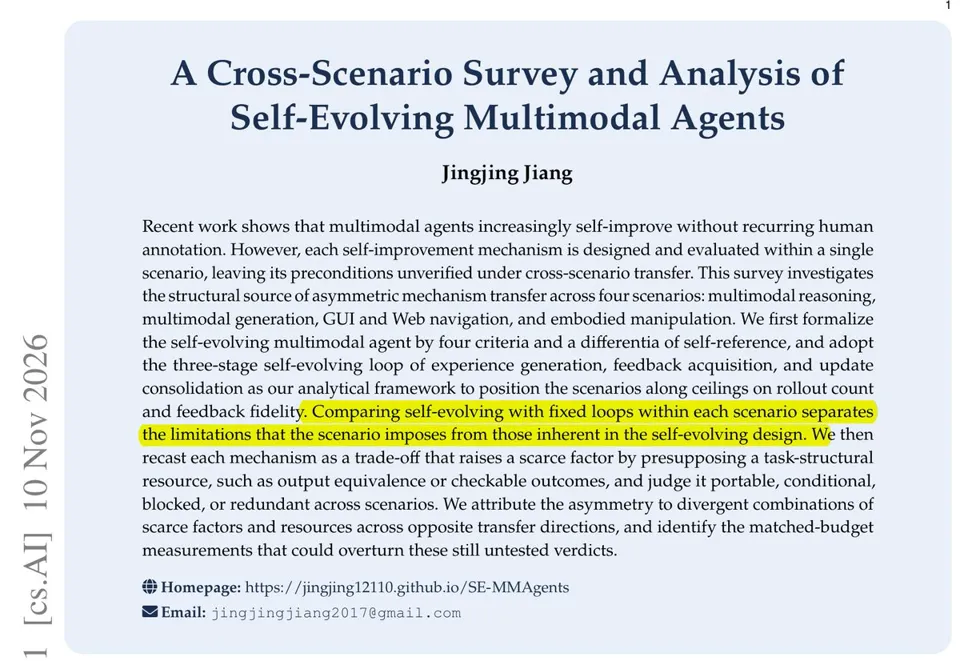
一篇综述系统梳理了视觉推理、图像生成、应用与网页导航、机器人四类场景中的智能体自我改进方法,指出每种技巧都依赖特定任务提供的可校验信号(如可投票比对的答案、可由程序验证的结果),因此多数方法只在单一场景中被验证,跨场景迁移需谨慎。文中引用的一项对 500 道题的审计显示,多数投票保留的标签错误率达 24%,而程序计算答案的错误率仅 5.6%。作者强调这些迁移判断目前只是预测,尚未经过迁移实验验证。
报道正文
Rohan Paul (@rohanpaul_ai) · 2026-11-16 22
This survey argues that self-improvement tricks for multimodal agents only carry over to tasks that have what the trick relies on, like checkable answers.
AI agent learn from its own attempts in 1 area, like questions about images, can fail in another, like robotics, where there is nothing to check.
Self-improving agents now span visual reasoning, image generation, app and web navigation, and robotics, but each method is tested in only 1 setting. Majority voting, for example, scores short visual answers but finds nothing to compare in robot action trajectories.
The author reviewed methods in the 4 settings and listed each trick's needs, like answers a vote can compare or results a program can check. Each trick then gets a verdict per setting: portable, conditional, blocked, or redundant.
In 1 cited audit of 500 questions, 24% of kept majority-vote labels were wrong, against 5.6% for program-computed answers. These verdicts are predictions, not results from transfer experiments.
Before moving a self-improvement trick to a new task, confirm that task offers the check the trick relies on, then test against a same-budget baseline.