Google Plans Low-Carbon Compute from Retired Phones
Google Research proposes building a distributed computing cluster using retired smartphones to provide low-carbon compute at minimal cost. Scheduled for full launch in Fall 2026, the project serves as a testbed for large-scale mobile computing, focusing on validating consumer-grade hardware reliability under sustained workloads.
Related Entities
Full Report
Contents11 sections
Explore our many areas of focus
Applied AI & sciences
 Earth AI
 Health AI
 Science AI
 Sustainability & crisis resilience
Foundational ML & algorithms
 Algorithms & theory
 Information retrieval
 Machine intelligence
 Machine perception
 Natural language processing
People, systems & quantum AI
 Human-computer interaction and visualization
 Networking
 Quantum AI
 Responsible AI
 Anti abuse
 Software engineering
 Software systems
Learn More
 Publications
 Projects
Building a collaborative ecosystem
 Datasets Access high-quality datasets to accelerate your research.
 Tools & services Explore our latest AI models and products.
Open source Discover open-source code and collaborate with the community.
Shaping the future together
 Faculty programs Participating in the academic research community through meaningful engagement with university faculty.
 Student programs Supporting the next generation of researchers through a wide range of programming.
 R&D programs Collaborating with industry and academic experts to support foundational science and innovation.
 Locations Find your place in our global offices and research labs.
Translating discovery into real-world impact
 Teams Collaborative groups tackling the world's most challenging AI problems.
Research
Explore our many areas of focus
Applied AI & sciences
Earth AI Health AI Science AI Sustainability & crisis resilience
Foundational ML & algorithms
Algorithms & theory Information retrieval Machine intelligence Machine perception Natural language processing
People, systems & quantum AI
Human-computer interaction and visualization Networking Quantum AI Responsible AI Anti abuse Software engineering Software systems
Learn More
Resources
Building a collaborative ecosystem
Datasets Access high-quality datasets to accelerate your research. Tools & services Explore our latest AI models and products. Open source Discover open-source code and collaborate with the community.
Careers
Shaping the future together
Faculty programs Participating in the academic research community through meaningful engagement with university faculty. Student programs Supporting the next generation of researchers through a wide range of programming. R&D programs Collaborating with industry and academic experts to support foundational science and innovation. Locations Find your place in our global offices and research labs.
About
Translating discovery into real-world impact
People Our researchers drive advancements in computer science through both fundamental and applied research. Teams Collaborative groups tackling the world's most challenging AI problems.
Google AI Learn about all our AIGoogle DeepMind Explore the frontier of AIGoogle Labs Try our AI experiments
Research
Resources
Careers
About
Search

A low-carbon computing platform from your retired phones
June 12, 2026
Jennifer Switzer, Visiting Postdoctoral Researcher, and David Patterson, Fellow, Google
With support from Google, Researchers at the University of California San Diego are building a useful second-life for consumer smartphones.
The carbon footprint of computing is a key sustainability challenge. It is driven by two major sources: operational carbon reflects emissions from energy consumed during use, and embodied carbon encompasses emissions associated with hardware manufacturing. While operational carbon is often addressed with efforts such as improved energy efficiency and using clean energy, the manufacturing footprint represents a more complex hurdle.
To address this, researchers at the University of California San Diego are building a pathway for the second life of phones through the exploration of “phone cluster computing.” This is a process whereby the motherboards of retired smartphones are extracted, collected into clusters, and redeployed as a general-purpose computing platform. With Google’s support, the university plans to deploy a datacenter built from 2,000 Pixel smartphones that will provide hundreds of researchers and students with low-cost, low-carbon cloud computing, reducing the need for newly-manufactured hardware and their associated emissions.
Smartphones: A significant contributor
On average, people replace their phone every four years. This is generally driven by people’s desire for a new device, including for the functionalities provided by new models. Many replaced phones, however, have their core compute functionalities intact and are still relatively powerful computers with integrated processors, accelerators, memory, and storage. While an old phone might no longer be of interest to its first purchaser, putting it back in service can directly reduce the environmental footprint of computing by avoiding the need for further raw material extraction.
This blog discusses a novel strategy: re-deploying unwanted smartphones for cloud computing applications.
The single-threaded performance of modern smartphones’ performance processor cores is on-par with or better than those of modern multicore servers (see figure below). The most significant difference between a smartphone and a server is their size: servers contain dozens of powerful multithreaded processor cores and a huge memory capacity, while a smartphone has a handful of heterogeneous processor cores and 8-12GB of memory. One of the key challenges, then, is to target applications that fit into, or can be made to fit into, the capacity of a smartphone.
From consumer devices to datacenter hardware

Single-threaded performance of a modern smartphone (2023 Pixel Fold) compared to a server (ASUS RS720A-E11) using theSPEC benchmarking suite. The blue bars represent the per-core performance of the Pixel Fold’s performance cores. On most benchmarks they beat the per-core performance of the baseline data center server.
play silent looping video pause silent looping video
unmute video mute video
Animation of the construction of a server using smartphones.
Redeploying unmodified consumer smartphones in a datacenter environment would be hazardous and inefficient. Smartphones’ compute elements are wrapped in components that aren’t needed in the server context — display, battery, chassis, and peripheral hardware like cameras. In addition to taking up valuable space, some components, such as batteries, contain materials not rated for a datacenter environment.
Prior to deployment, smartphones must be processed to remove all but the motherboard, which contains the core compute functionality. Note that the motherboard is responsible for the largest fraction of embodied carbon (approximately 50% based on internal carbon footprinting assessments), so this effort targets the most impactful components.
The Android operating system (OS) is already based on Linux, but the mobile-oriented Android userspace must be replaced with a general-purpose Linux distro. Updating the OS doesn't just get programmability; it also switches off many of the protections that are important for consumer devices, but unnecessary for cloud computing. For example, phones have a “low memory killer” daemon, which throttles memory-hungry applications.
The challenge of orchestrating jobs across the large number of devices that are needed to meet the performance of a traditional server — SPEC benchmarking results indicate that 25-50 phones equate to a modern server — is addressed by the use of containerized applications managed by Kubernetes. The phones are organized into self-managing clusters of 25-50 devices.
Building a low-carbon cloud computing platform
At many universities, an abundance of EdTech, grading, and research applications are already being run on the cloud. These applications range from tiny machines for hosting Jupyter notebooks to expensive GPU-based servers for parallel computing classes. The vast majority of these applications are within the capabilities of a single smartphone to host, with the standard grading backend running on small cloud instances such as AWS’ t3.micro (2 vCPU, 1 GB memory).
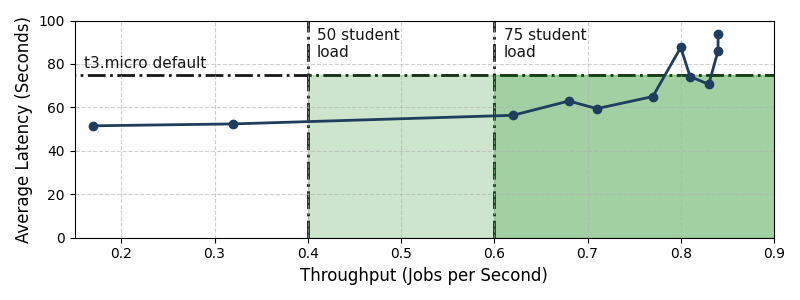
Cluster latency and throughput for a 20 phone cluster running a parallel computing grading task. The horizontal “t3.micro” line represents the latency of a single job running on an AWS t3.micro instance; at least 50 such instances are required to support the load plotted here. Green represents operating points at which the cluster meets or exceeds typical throughput and latency requirements. The matrix multiply-based assignment is CPU intensive and runs for approximately 50 seconds on a single device. Latency numbers include cluster orchestration.
Researchers at the University of California San Diego are planning a 2,000-phone computing cluster to support computer science classes such as Parallel Computation and Systems Programming. Early experiments show that even a moderately-sized cluster of 20 phones is capable of supporting peak submission rates for a 75+ student class, with grading latencies below the default AWS backend. A 2,000 phone deployment will be capable of supporting a hundred such classes at once.
In addition to the direct benefit of providing 50 server-equivalents worth of compute at a fraction of the usual cost, the deployment will also act as a testbed for smartphone-based computing at scale. In particular, the project will investigate the reliability of consumer-grade hardware under sustained use. The full system is expected to launch in Fall 2026.