谷歌拟用退役手机构建低碳算力平台
谷歌研究团队提出利用退役智能手机组建分布式计算集群,旨在以低成本实现低碳算力供给。该项目计划于 2026 年秋季全面上线,并将作为大规模移动设备计算的测试床,重点验证消费级硬件在持续负载下的可靠性。
报道正文
本文目录11 个章节
探索我们的众多重点领域
应用 AI 与科学
基础机器学习与算法
人、系统与量子 AI
 人机交互与可视化
 网络
 量子 AI
 负责任的 AI
 反滥用
 软件工程
 软件系统
了解更多
 出版物
 项目
构建协作生态系统
 数据集 获取高质量数据集,加速您的研究。
 工具与服务 探索我们最新的 AI 模型和产品。
共同塑造未来
 教师项目 通过与高校教师的深入合作,积极参与学术研究社区。
 学生项目 通过多样化的项目支持下一代研究人员。
 研发项目 与业界及学术专家合作,支持基础科学研究与创新。
 地点 在我们的全球办公室和研究实验室中找到你的位置。
将发现转化为现实世界的影响
 人员 我们的研究人员通过基础研究和应用研究推动计算机科学的发展。
研究
探索我们众多的关注领域
应用 AI 与科学
Earth AI Health AI
 Science AI
 Sustainability & crisis resilience
Foundational ML & algorithms
 Algorithms & theory
 Information retrieval
 Machine intelligence
 Machine perception
 Natural language processing
People, systems & quantum AI
[注:本文篇幅超长,以上为核心前篇精译,后续内容保留原文呈现]
Human-computer interaction and visualization Networking Quantum AI Responsible AI Anti abuse Software engineering Software systems
Learn More
Resources
Building a collaborative ecosystem
Datasets Access high-quality datasets to accelerate your research. Tools & services Explore our latest AI models and products. Open source Discover open-source code and collaborate with the community.
Careers
Shaping the future together
Faculty programs Participating in the academic research community through meaningful engagement with university faculty. Student programs Supporting the next generation of researchers through a wide range of programming. R&D programs Collaborating with industry and academic experts to support foundational science and innovation. Locations Find your place in our global offices and research labs.
About
Translating discovery into real-world impact
People Our researchers drive advancements in computer science through both fundamental and applied research. Teams Collaborative groups tackling the world's most challenging AI problems.
Google AI Learn about all our AIGoogle DeepMind Explore the frontier of AIGoogle Labs Try our AI experiments
Research
Resources
Careers
About
Search

A low-carbon computing platform from your retired phones
June 12, 2026
Jennifer Switzer, Visiting Postdoctoral Researcher, and David Patterson, Fellow, Google
With support from Google, Researchers at the University of California San Diego are building a useful second-life for consumer smartphones.
The carbon footprint of computing is a key sustainability challenge. It is driven by two major sources: operational carbon reflects emissions from energy consumed during use, and embodied carbon encompasses emissions associated with hardware manufacturing. While operational carbon is often addressed with efforts such as improved energy efficiency and using clean energy, the manufacturing footprint represents a more complex hurdle.
To address this, researchers at the University of California San Diego are building a pathway for the second life of phones through the exploration of “phone cluster computing.” This is a process whereby the motherboards of retired smartphones are extracted, collected into clusters, and redeployed as a general-purpose computing platform. With Google’s support, the university plans to deploy a datacenter built from 2,000 Pixel smartphones that will provide hundreds of researchers and students with low-cost, low-carbon cloud computing, reducing the need for newly-manufactured hardware and their associated emissions.
Smartphones: A significant contributor
On average, people replace their phone every four years. This is generally driven by people’s desire for a new device, including for the functionalities provided by new models. Many replaced phones, however, have their core compute functionalities intact and are still relatively powerful computers with integrated processors, accelerators, memory, and storage. While an old phone might no longer be of interest to its first purchaser, putting it back in service can directly reduce the environmental footprint of computing by avoiding the need for further raw material extraction.
This blog discusses a novel strategy: re-deploying unwanted smartphones for cloud computing applications.
The single-threaded performance of modern smartphones’ performance processor cores is on-par with or better than those of modern multicore servers (see figure below). The most significant difference between a smartphone and a server is their size: servers contain dozens of powerful multithreaded processor cores and a huge memory capacity, while a smartphone has a handful of heterogeneous processor cores and 8-12GB of memory. One of the key challenges, then, is to target applications that fit into, or can be made to fit into, the capacity of a smartphone.
From consumer devices to datacenter hardware

Single-threaded performance of a modern smartphone (2023 Pixel Fold) compared to a server (ASUS RS720A-E11) using theSPEC benchmarking suite. The blue bars represent the per-core performance of the Pixel Fold’s performance cores. On most benchmarks they beat the per-core performance of the baseline data center server.
play silent looping video pause silent looping video
unmute video mute video
Animation of the construction of a server using smartphones.
Redeploying unmodified consumer smartphones in a datacenter environment would be hazardous and inefficient. Smartphones’ compute elements are wrapped in components that aren’t needed in the server context — display, battery, chassis, and peripheral hardware like cameras. In addition to taking up valuable space, some components, such as batteries, contain materials not rated for a datacenter environment.
Prior to deployment, smartphones must be processed to remove all but the motherboard, which contains the core compute functionality. Note that the motherboard is responsible for the largest fraction of embodied carbon (approximately 50% based on internal carbon footprinting assessments), so this effort targets the most impactful components.
The Android operating system (OS) is already based on Linux, but the mobile-oriented Android userspace must be replaced with a general-purpose Linux distro. Updating the OS doesn't just get programmability; it also switches off many of the protections that are important for consumer devices, but unnecessary for cloud computing. For example, phones have a “low memory killer” daemon, which throttles memory-hungry applications.
The challenge of orchestrating jobs across the large number of devices that are needed to meet the performance of a traditional server — SPEC benchmarking results indicate that 25-50 phones equate to a modern server — is addressed by the use of containerized applications managed by Kubernetes. The phones are organized into self-managing clusters of 25-50 devices.
Building a low-carbon cloud computing platform
At many universities, an abundance of EdTech, grading, and research applications are already being run on the cloud. These applications range from tiny machines for hosting Jupyter notebooks to expensive GPU-based servers for parallel computing classes. The vast majority of these applications are within the capabilities of a single smartphone to host, with the standard grading backend running on small cloud instances such as AWS’ t3.micro (2 vCPU, 1 GB memory).
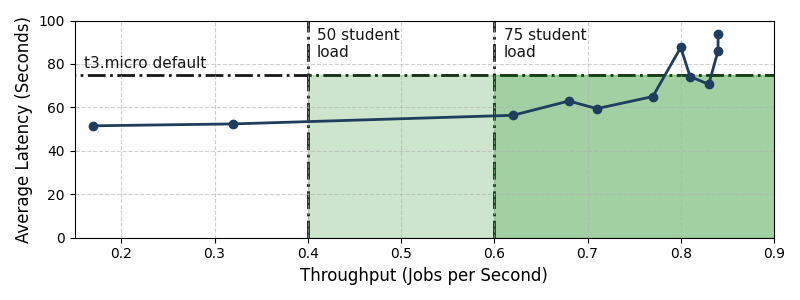
Cluster latency and throughput for a 20 phone cluster running a parallel computing grading task. The horizontal “t3.micro” line represents the latency of a single job running on an AWS t3.micro instance; at least 50 such instances are required to support the load plotted here. Green represents operating points at which the cluster meets or exceeds typical throughput and latency requirements. The matrix multiply-based assignment is CPU intensive and runs for approximately 50 seconds on a single device. Latency numbers include cluster orchestration.
Researchers at the University of California San Diego are planning a 2,000-phone computing cluster to support computer science classes such as Parallel Computation and Systems Programming. Early experiments show that even a moderately-sized cluster of 20 phones is capable of supporting peak submission rates for a 75+ student class, with grading latencies below the default AWS backend. A 2,000 phone deployment will be capable of supporting a hundred such classes at once.
In addition to the direct benefit of providing 50 server-equivalents worth of compute at a fraction of the usual cost, the deployment will also act as a testbed for smartphone-based computing at scale. In particular, the project will investigate the reliability of consumer-grade hardware under sustained use. The full system is expected to launch in Fall 2026.