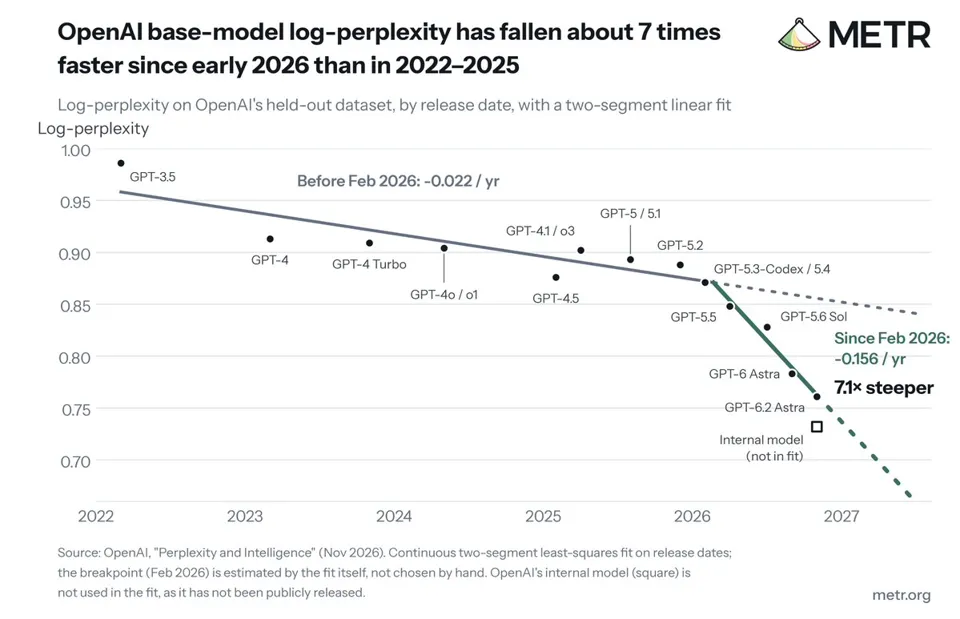
METR Finds OpenAI Base Models Cutting Prediction Error 7x Faster
METR, analyzing OpenAI's published pretraining loss for 13 frontier models since GPT-3.5, finds log-perplexity has fallen roughly 7x faster since early 2026 than over 2022-2025. At that pace, the three-year GPT-3.5-to-GPT-4.1 gain would repeat in about 6.5 months, implying 8-10x faster effective compute growth. OpenAI credits long-term research and compute, while acknowledging AI made meaningful design contributions; METR separately estimates about 80% of Anthropic's October 2026 R&D acceleration came from AI.
Related Entities
Full Report
Rohan Paul (@rohanpaul_ai) · 2026-11-25 01
New METR finds OpenAI's base models have been cutting prediction error about 7 times faster since early 2026 than during 2022-2025.
At that rate, the 3-year gain from GPT-3.5 to GPT-4.1 would repeat in about 6.5 months, and under a simple single-scaling-law assumption, effective compute is growing 8 to 10 times faster than before.
The figures cover 13 models since GPT-3.5, measured by log-perplexity on a fixed held-out corpus from the company's own codebase.
OpenAI attributes most of the acceleration to long-term research and compute but says AI made meaningful design contributions to its newest models, while METR separately estimated that about 80% of Anthropic's October 2026 R&D acceleration comes from AI.
↳ 引用 @METR_Evals (METR): OpenAI published the pretraining loss of all of its frontier models since GPT-3.5. They show log-perplexity falling ~7 times faster since early 2026 than over 2022-2025.
We think sharing pretraining loss is very valuable for improving public understanding of AI R&D acceleration.