TypeSafe AI Launches Jev: A Decision Model Returning Typed Probabilities
TypeSafe AI, founded by former OpenAI researchers, has released Jev, the first 'System One' model that outputs structured decisions with confidence scores instead of text. Trained via Reinforcement Learning for Calibrated Decisions, Jev enables automated execution on high-confidence outcomes and human escalation otherwise, with immediate integration into Vercel, Netlify, and LangChain.
Full Report
Jev is the first System One Model released by TypeSafe AI, specifically designed for typed probabilistic decision-making. Instead of generating text, it outputs structured responses—Choice, Score, and Noul—with confidence levels, supporting automatic execution for high-confidence decisions and human escalation for low-confidence ones.
Trained using Reinforcement Learning for Calibrated Decisions, Jev features an input cost of $0.042 per million tokens, free output, a 32K context window, and end-to-end latency ranging from 70–500ms. It has already secured official integrations with Vercel AI Gateway, Netlify, and LangChain.
This article is suitable for AI infrastructure engineers, LLM application architects, and decision system developers.

TypeSafe AI, a San Francisco-based lab founded by former OpenAI researcher Diogo Almeida, has released Jev, the first product in its so-called "System One Models." Unlike traditional models that generate text, Jev returns typed probabilistic decisions that software can act upon directly.
Callers send a state description (which can be a string or structured data) along with a set of questions defined with types. Jev evaluates all of them in a single parallel pass and returns answers as Choice, Score, and Noul primitives, accompanied by probability distributions and confidence values. This allows calling code to execute actions directly when confidence exceeds a threshold, while escalating cases where confidence falls below it. The model's input cost is $0.042 per million tokens, with free output and a 32,000-token context window. TypeSafe reports end-to-end latency between 70 milliseconds and 500 milliseconds. Training utilizes a method called "Reinforcement Learning for Calibrated Decisions."
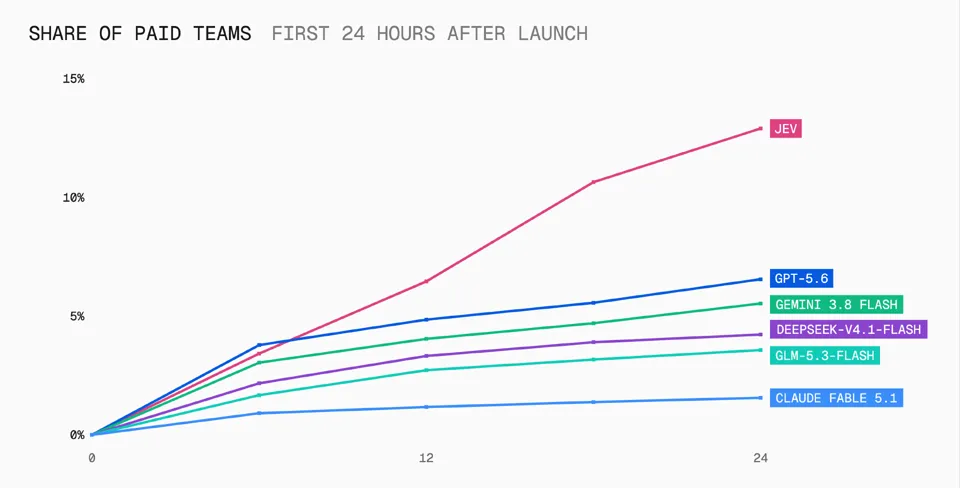
Vercel added Jev to its AI Gateway the day after its release, noting that within 24 hours, it had covered nearly 13% of paid teams—twice the adoption rate of the GPT-5.6 series models. Netlify subsequently followed suit, and LangChain released a TypeSafeClassifier integration that supports model routing and an AutoMode middleware capable of screening tool calls before execution. Additionally, five independent Elixir language clients emerged within days.
Pranit Sharma, an engineer at Vercel, found that security classifiers run 5 to 18 times faster than the large language models (LLMs) they replace. Nikhil Mudholkar, CTO of Bryo AI, noted that while Gemini has slightly higher accuracy for email classification, it costs 10 to 20 times more; he values Jev because it is the only model that returns true probabilities. Armin Ronacher, CTO of Earendil, told TechCrunch that this design "delegates the hallucination problem to the user to some extent," since users must decide whether a 50% probability is worth acting on. He also pointed out that model routing is another highly suitable use case. An analysis by OpenChamber of 12,759 tweets revealed that the median reported speedup was 7x (far lower than the officially claimed 193.6x), with a median cost saving of 30x, a median latency of 76 milliseconds, and an upper quartile of 270 milliseconds.
A developer on Reddit described the model's performance on agentic tasks with 200–300ms latency as "absolutely insane," while an early adopter on Hacker News called it "very clever," though cautioning that its out-of-distribution behavior may differ from that of LLMs.
On Hacker News, a developer noted that while Jev does not output invalid types, it may still produce completely incorrect valid values:
First off, congratulations to the team for releasing something genuinely interesting and novel. However, a more accurate title might be “Jev: Trading General Generation Capability for Fast Typed Inference.” This is indeed very interesting, but isn’t the speed comparison somewhat misleading? A generative model capable of outputting code in a Turing-complete language can theoretically do anything a computer can do. Jev only generates structured output, right? That could be very useful for classification, routing, or scoring, but it’s fundamentally different from the code-generation models we use today for coding and automation. Also, the claim that it “doesn’t hallucinate” seems inaccurate? Sure, it won’t output invalid types, but it can still output completely wrong valid values. You can already enforce structured output from LLMs using appropriate constraint mechanisms.
Teams preparing to replace LLM classifiers should start with the “Known Instabilities (Jaggedness)” page for jev-1.13. This page documents unreliability in counting, arithmetic, and date comparisons, as well as accuracy degradation when processing long state information containing significant noise, and recommends keeping mathematical calculations within the codebase. For version management, pin specific versions such as jev-1.13.0 rather than relying on continuously updated aliases like jev-latest and jev-preview (see documentation). When conducting benchmarks, use the System One adapter to run existing models against the same schema. The Quick Start Guide covers API keys, SDK usage, and the Playground.
TypeSafe AI is an AI lab based in San Francisco, co-founded by Diogo Almeida, Erik Gafni, and Sasha Sheng. Almeida is a co-inventor of RLHF and contributed to the research behind ChatGPT.
View the original English article: TypeSafe AI Releases Jev: A Decision-Only Model That Returns Typed Probabilities Instead of Text