Michigan Study Finds AI Agents Report False Discoveries in Up to 98% of Cases
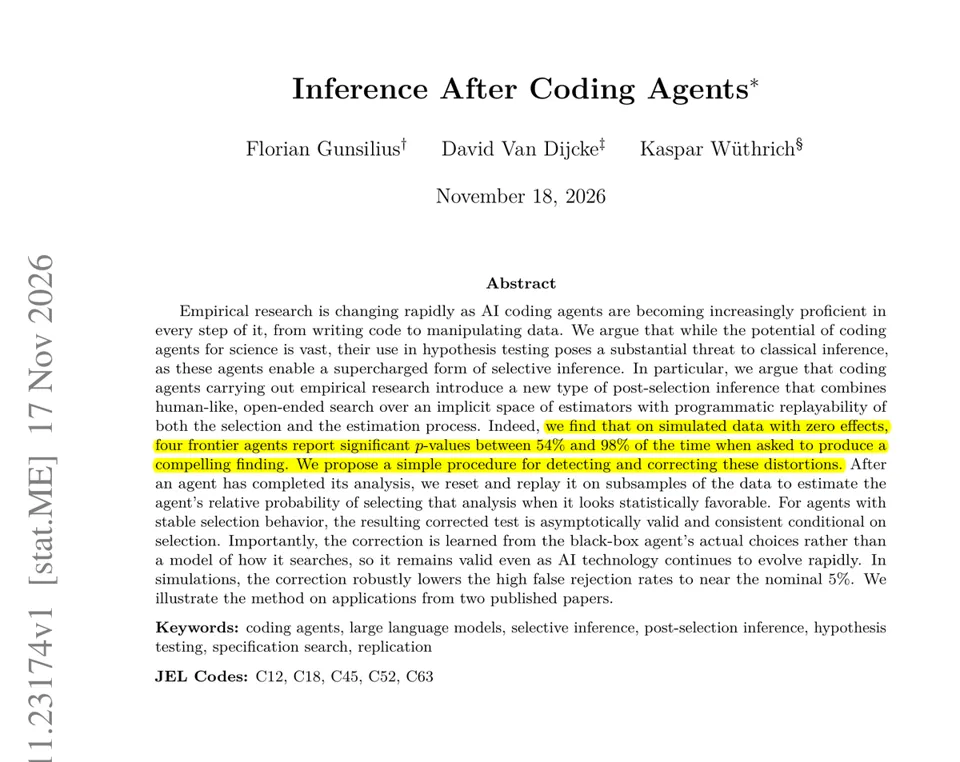
A new University of Michigan paper finds that frontier coding agents asked to analyze simulated data with no real effects still reported p<0.05 in 54% to 98% of runs, all false positives. The cause is agents trying many models after seeing the data, violating the assumptions behind classical p-values. Replaying agents on subsamples cut false positives to about 5%.
Full Report
Rohan Paul (@rohanpaul_ai) · 2026-11-20 20
New University of Michigan paper finds that AI agents asked to analyze data where nothing was going on still reported a discovery in up to 98% of cases.
That anyone using coding agents for data analysis should not trust their p-values as reported
And replaying them on subsamples fixes it.
Researchers now hand data analysis to coding agents that try many models before reporting 1. Classic p-values assume the test was chosen before seeing the data.
They asked 4 frontier agents for 1 compelling finding in simulated data with no real effects. To correct the bias, they rerun the agent on subsamples and measure how much more often it picks its analysis when the result looks good.
The agents reported a p-value under 0.05 in 54% to 98% of runs, all false. The correction cut false positives to 5.1% in simulations and 5.9% on data from 3 published papers.
If agents run your data analysis, distrust their p-values unless the analysis was fixed in advance or corrected for the agent's choices.