MiniMax Open-Sources H3 Image for 10-Second Native 4K Generation
MiniMax has open-sourced MiniMax H3 Image, an image model capable of native 4K output, roughly 10-second generation and up to 16 reference images, topping both the text-to-image and image-editing open-weight leaderboards on Artificial Analysis. Developers praise its fine-grained portrait detail and performance on game design, character design and 3D scene tasks, with web, API and local deployment options available.
Related Entities
Full Report
"GPT is cooked."
Edited by Zeman, Yang Wen
"GPT is cooked."
Over the past two days, this phrase has been repeated again and again in the AI community. What has everyone on edge is MiniMax's newly released image model, MiniMax H3 Image.
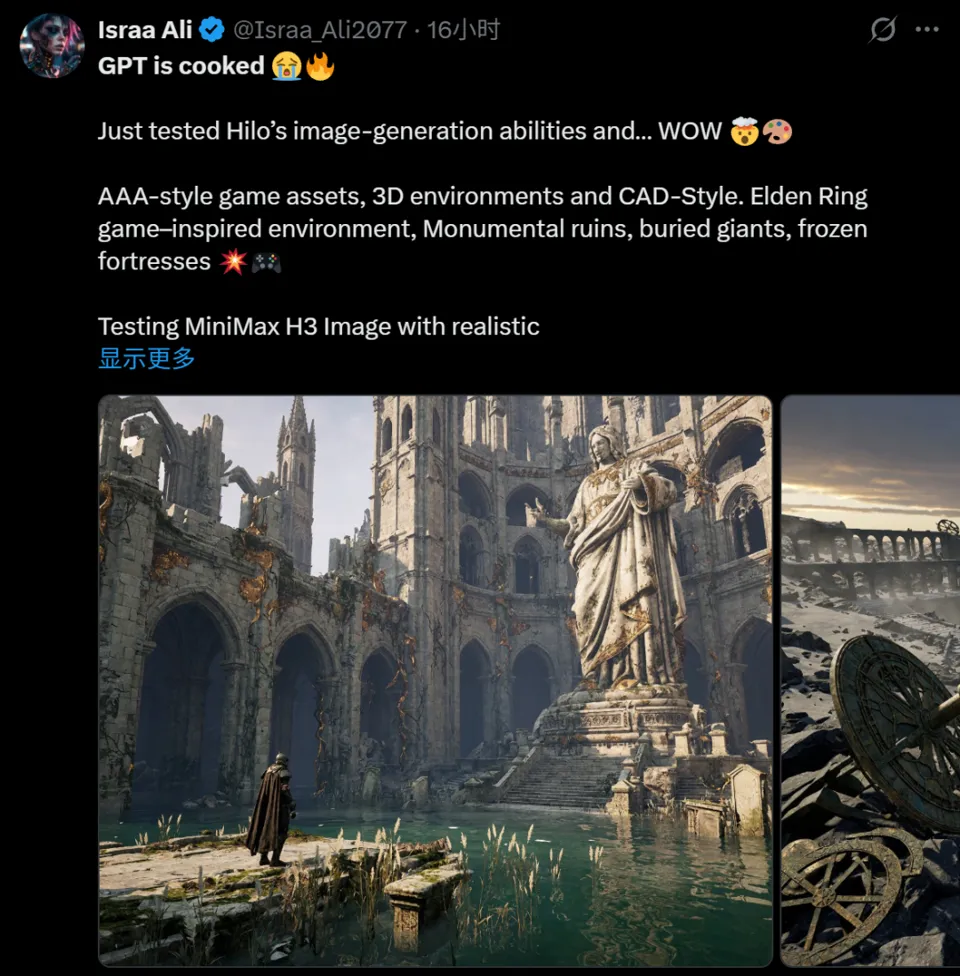
This is a model that natively outputs 4K images directly, generates in around 10 seconds, and supports up to 16 reference images. It was open-sourced just this Tuesday and has set a new SOTA for open-source image models. Judging from the first wave of reactions, that claim doesn't seem to be an exaggeration.
Developers who got early access ran extensive tests. In the new model's outputs, the "plastic skin" layer on AI portraits is gone—pores, freckles, and fine facial hair are all clearly visible. People have been full of praise for its capabilities in game design, character design, and 3D scenes.
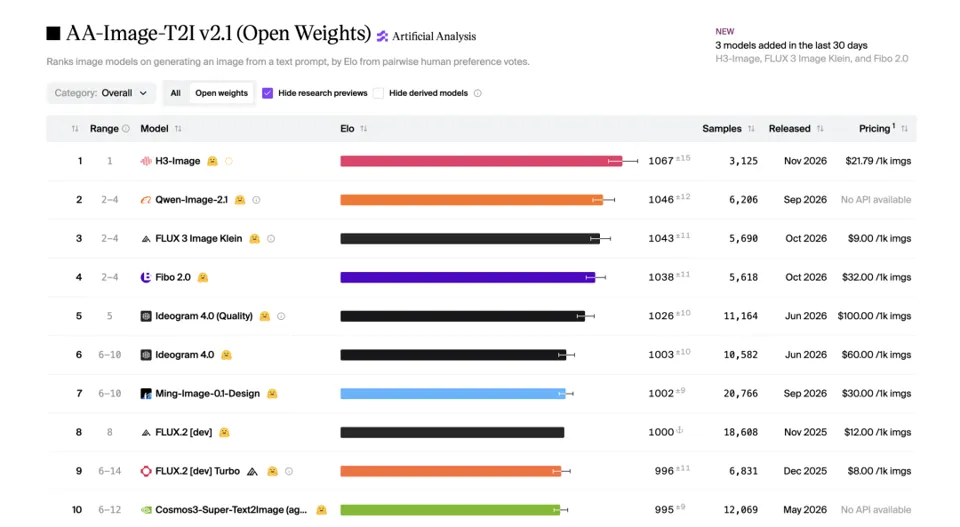
On the Artificial Analysis leaderboard updated today, MiniMax H3-Image ranks first among open-weight models in both text-to-image and image editing.
MiniMax H3 Image can be used directly on the web, or via API in MiniMax Code or other harnesses to complete more complex tasks. And because it's open source, some people are already working on local deployment.
- GitHub: https://github.com/MiniMax-AI/MiniMax-H3-Image
- HuggingFace: https://huggingface.co/MiniMaxAI/MiniMax-H3-Image
We got access to the new model right away to see how it performs in practice.
Redefining visual aesthetics and "realism"
The new model is already live in MiniMax Code. Opening it up, you can see it supports up to 16 reference images, and generated images can reach up to 4K resolution.
From an ordinary user's perspective, we tested the scenarios people use every day across four capability dimensions: first realism, then the two classic challenges of text and faces, and finally secondary creation from image-to-image.
Realistic output is the first hurdle. The things most likely to expose AI traces are often the things we look at every day—like a WeChat chat interface.
Prompt: Generate a WeChat chat screenshot: I first send the other person a very realistic photo of a Coca-Cola, and say: "This was generated by MiniMax H3 Image." The other person replies: "My god." Then I say: "Just kidding, I took this myself." Please ensure the screenshot includes highly realistic iPhone status bar details, including the time, battery level, and signal strength.
With just a single prompt, MiniMax H3 Image generated a complete WeChat chat screenshot.
These everyday interfaces are hard because the human eye has an extremely low tolerance for errors in familiar scenes. The WeChat interface follows relatively fixed visual conventions—if the font is slightly too bold, the chat bubble spacing is a bit off, or the status bar icon proportions are wrong, it's immediately exposed.
When generating similar chat screenshots, many models either misalign or distort interface elements, or produce unnatural highlights on product photos, greatly diminishing realism.
But the iPhone status bar, WeChat UI layout, chat bubbles, and avatars generated by MiniMax H3 Image are all remarkably accurate; the Coca-Cola photo is realistic enough too—the condensation on the bottle, light reflections, and table texture all look natural, with almost no visible AI traces.
Next up is the long-standing challenge for image generation models: text rendering. Previous models would either produce typos, garbled characters, or completely broken spelling. This time, we directly gave H3 Image a complex task—generating a piece of graffiti:
Prompt: This is a realistic-style vertical composition photograph. In the frame, a row of silver stainless steel subway cars bearing the marks of time is parked in a rough underground station. The side of the car is covered with a huge wildstyle graffiti piece spanning the entire row of windows. The graffiti consists of sharp-edged 3D block letters spelling out "MiniMax H3 Image"; the interior of the letters is filled with vibrant orange with a gradient effect, complemented by dark blue 3D drop shadows, thick black outlines, and thin white highlight lines—you can even see drip marks left by fresh spray paint. In the background, the industrial-style ceiling is exposed, revealing rusty steel beams, pipes, cables, and cool-toned fluorescent tubes; the concrete walls are covered with stains and grime, and below are the tracks and gravel ballast. The image presents a cool-toned fluorescent lighting feel and metallic reflective texture, processed with cinematic color grading, featuring fine film grain and a slight vignette effect, creating an authentic New York subway atmosphere. The entire photo looks as if it was shot with a 35mm lens, rich in detail, showcasing a raw and authentic urban street photography style.
The long string of letters in "MiniMax H3 Image" is not only fully spelled out but also rendered with 3D modeling, gradient fills, and spray paint effects. Being able to achieve this level of text capability already shows a sense of graphic design.
When it comes to creating a high-fashion look with portrait photography, what's tested is not just good looks—facial rendering, clothing details, and lighting atmosphere all need to be on point. We challenged a set of Victoria's Secret backstage photos:
Prompt: Create a glamorous photoshoot in the style of Victoria's Secret. A young woman attached in the uploaded reference image (Keep the face of the person 100% accurate from the reference image) stands almost sideways, slightly bent forward, during the final preparation for the show. Makeup artists apply lipstick to her (only her hands are visible in the frame). She is wearing a corset decorated with beaded embroidery and crystals with a short fluffy skirt, as well as large feather wings. The image has a "backstage" effect. The background is a darkly lit room, probably under the podium. The main emphasis is on the girl's face and the details of her costume. Emphasize the expressiveness of the gaze and the luxurious look of the outfit. The photo is lit by a flash from the camera, which emphasizes the shine of the beads and crystals on the corset, as well as the girl's shiny skin. Victoria's Secret style: sensuality, luxury, glamour. Very detailed. Important: do not change the face.
Complex elements such as crystal beadwork and feather wings are rendered with full detail. Under the direct flash, the model's skin sheen and the layered reflections on the costume are clearly distinguished—a casual shot looks like a fashion magazine spread.
Switching to another style, let's try a cinematic portrait:
This street portrait has a strong cinematic still feel. The moment the subject glances back is sharply frozen, while the surrounding pedestrians are rendered with heavy motion blur—one still, one moving, and the visual tension immediately emerges. The overall atmosphere, lens feel, and emotional expression are all on point.
We also unlocked millennium retro portraits.
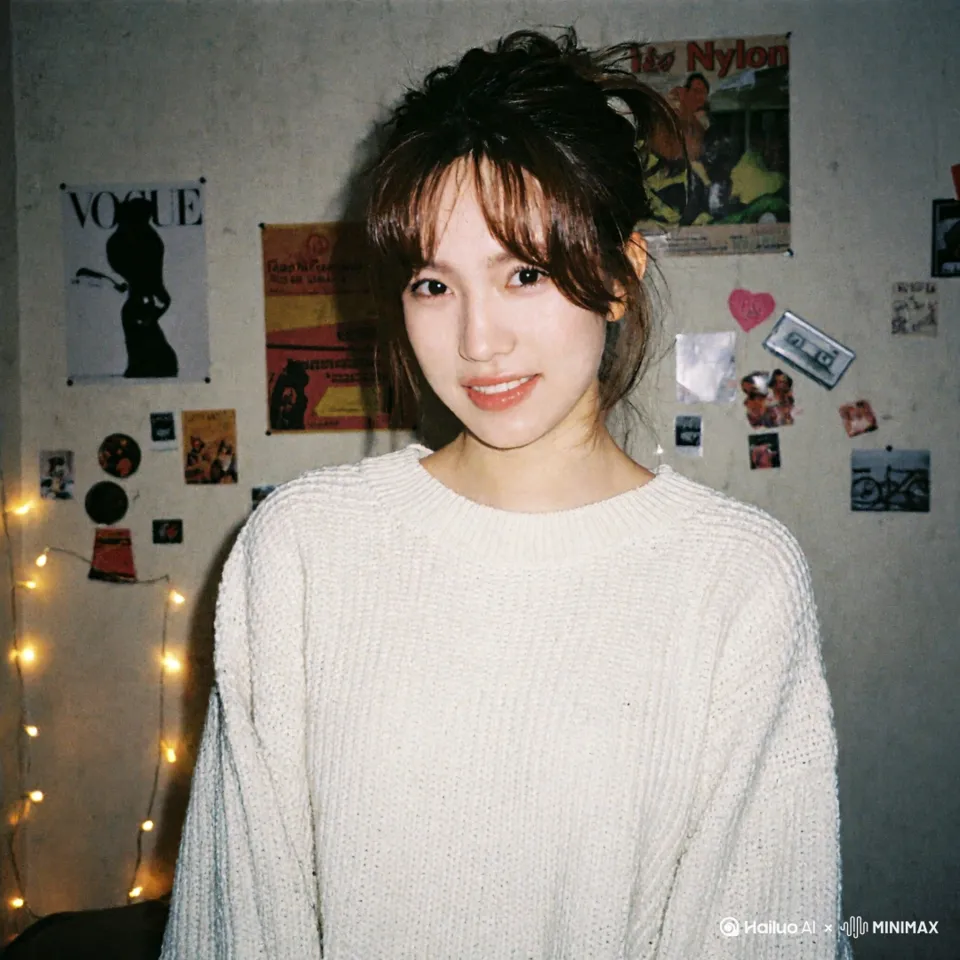
Prompt: Without changing her original face, create a portrait of a beautiful young woman with porcelain-white skin, captured with a 1990s-style camera using a direct front flash. Her messy dark brown hair is tied up, posing with a calm yet playful smile. She wears a modern oversized cream sweater. The background is a dark white wall covered with aesthetic magazine posters and stickers, evoking a cozy bedroom or personal room atmosphere under dim lighting. The 35mm lens flash creates a nostalgic glow.
The slightly grainy film texture, the old magazine posters on the wall, and the warm yellow string lights instantly pull people back to the 2000s, and the slight overexposure also has a strong old-school digital camera feel. The trivial atmospheric details in the prompt were all faithfully reproduced.
Having seen text-to-image, let's now try image-to-image. This part requires the AI model to understand the original image and then modify it according to instructions.
First, let's do something fun with Musk. Upload a photo and have the model turn him into an ugly-cute hand-drawn WeChat sticker, with the character's original expression exaggerated, paired with crooked "So Dumb" text, sweat drops, and question marks—a sticker ready to be used in meme battles.
Prompt: Turn it into a funny hand-drawn WeChat sticker. Use a minimalist ugly-cute line drawing style with a casual doodle feel, on a pure white background. Based on the character's expression in the original photo, exaggeratedly draw them looking shocked, disgusted, or lazy. Add cute doodles around the head such as sweat drops, question marks, or sparkles. Add handwritten English "So Dumb" at the bottom, with crooked handwriting that looks casual and funny.
Next round, increase the difficulty. Upload a street CCTV surveillance photo and ask the model to identify the people in the image, add white face boxes one by one, and generate a high-definition zoomed-in close-up for the most prominent person.
The generated result preserves the scene layout and surveillance perspective of the original image, with the main frame maintaining the expected noise and slight distortion, while the faces in the zoom boxes are clearer. Overall, it looks very much like an analysis frame automatically generated by a surveillance system.
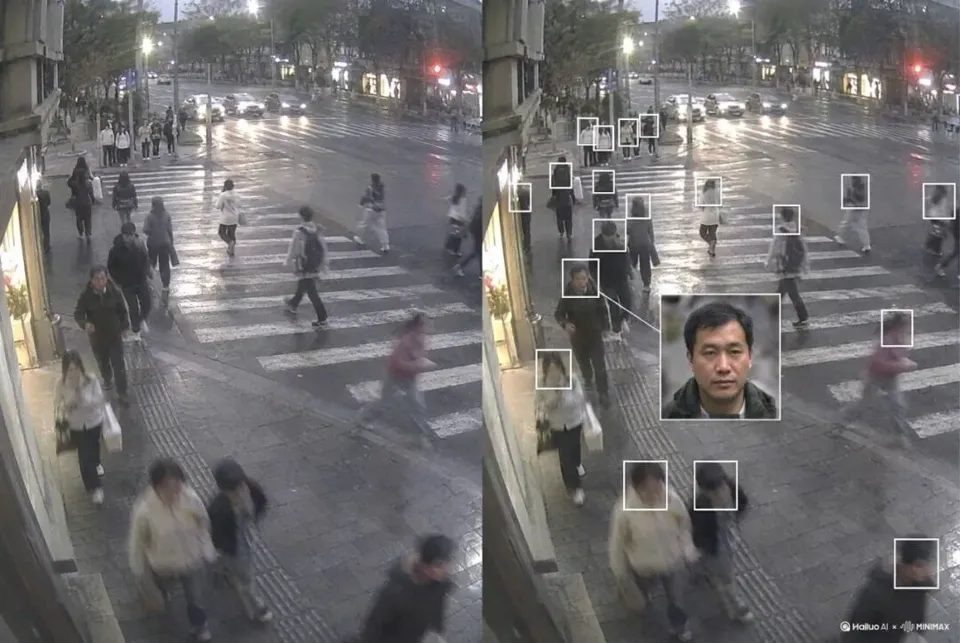
Prompt: Create a high angle CCTV surveillance shot using the uploaded image as the source. Detect every visible person in the image and automatically draw a white rectangular bounding box around each face. For the most prominent person, add a large zoom in inset: a sharp, enhanced close-up of their face displayed in a floating rectangular frame connected with a thin white line.Keep the main image slightly noisy and security camera like (soft grain, slight distortion, muted colors), while the zoom in face box should be clearer, brighter, and more detailed. No text, no timestamps, no overlays except the boxes and connecting line. Maintain the original scene layout, angle, and environment of the uploaded image.
If you want to do a style transfer, let's convert this realistic-style image into an anime collage style:
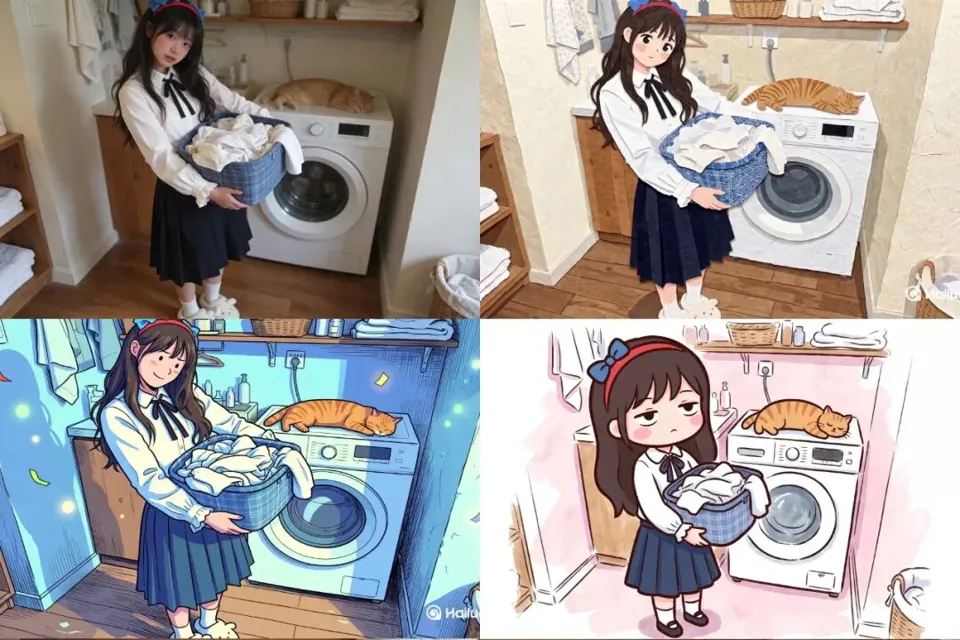
The result looks quite good too.
It can be seen that MiniMax H3 Image can both generate photo-level beautiful images and help you realize some creative ideas, and even let you join in meme battles. This time, the results look improved compared to the past—the sense of realism is maxed out, and the AI flavor has become very faint. Also worth mentioning is its instruction-following ability: when faced with the complex information we provided, the model can understand it well and output appropriate results.
This makes us look forward to its working capability.
Physical World Understanding and Instruction Following
Most of what we tested above was the realism of AI-generated images. Next, we want to examine something more hardcore: whether the model truly "understands" what it draws, which is very important for some practical design work.
In this regard, the model needs to have a correct understanding of the structure and materials of the physical world, be able to organize things clearly when information points are dense, and accurately follow instructions to make adjustments.
Let's start with something difficult: ask MiniMax H3 Image to generate an industrial exploded view. The key here is not only aesthetics; the model must also have some knowledge of physical structure—which parts make up a camera, how the parts are assembled and nested, and where each one is located spatially once disassembled. AI models in the past often gave themselves away.
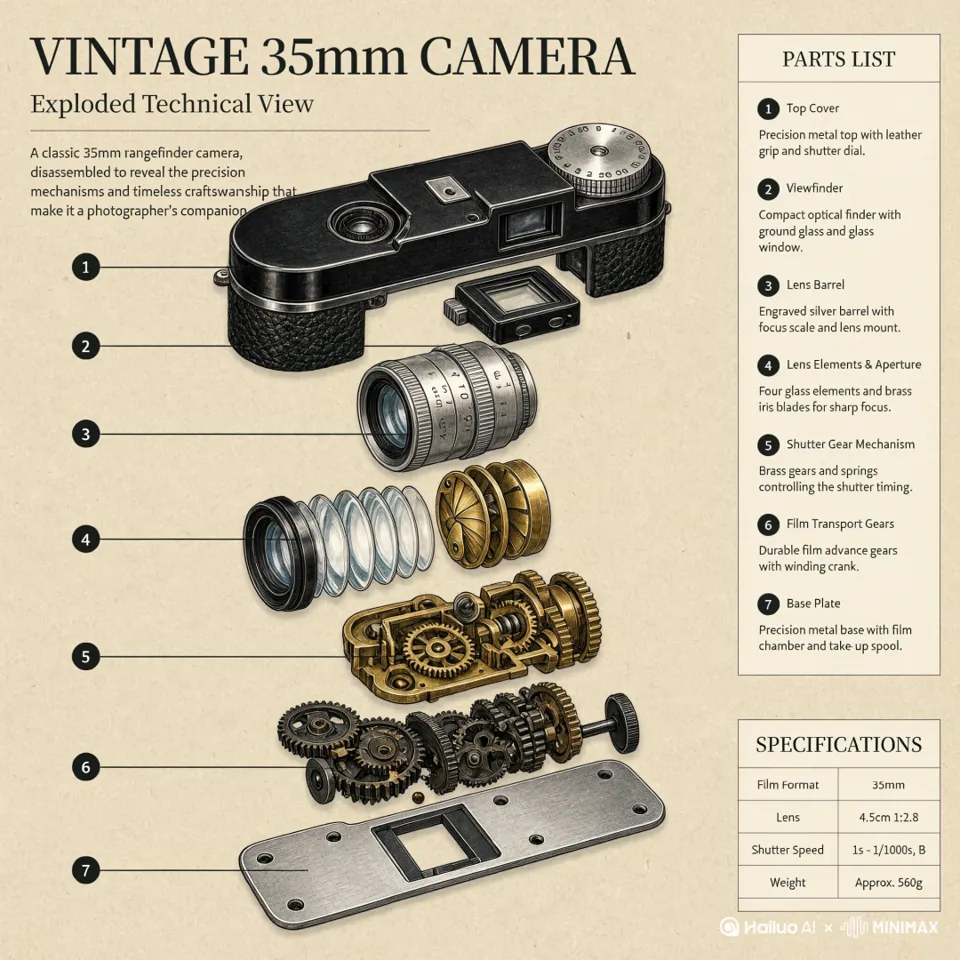
Prompt: Please generate a retro-style technical infographic poster. An exploded view of a classic 35mm rangefinder camera, 16 landscape layout, warm cream off-white solid background. Seven camera components float vertically along the central axis, precisely aligned, with spacing between layers: a top cover with black pebbled leather and a metal dial, a small viewfinder, a silver lens barrel engraved with distance scales, four glass lens elements and a brass aperture assembly, a brass shutter gear mechanism, a dark film transport gear set and crank, and a metal base plate. Each component is connected by a thin leader line to a black circular numbered label (white numerals 1–7). Top left: a large serif title "VINTAGE 35mm CAMERA", subtitle "Exploded Technical View", a thin divider line, and small caption text. Two thin-bordered panels on the right: "PARTS LIST" contains seven numbered entries (bold names + gray descriptive text), and "SPECIFICATIONS" lists film format, lens, shutter speed, and weight. Fine technical illustration style, delicate pen line art blended with soft realistic rendering, realistic textures of brushed metal, polished brass, transparent glass, and leather, soft shadows, low-saturation retro color palette, clean engineering manual aesthetic, flat infographic composition, high resolution.
As can be seen, in the image it generates, the camera body, lens, gears, and other parts are disassembled layer by layer, and numbered labels, English descriptions, and a specifications table are also generated along with it. The overall result almost reaches the level of an illustration for a product manual.
Or upload a flat-lay image of clothing, and H3 Image can generate a highly accurate photo of a real person wearing the outfit—fashion bloggers may soon have their livelihood "stolen."
Prompt: show woman wearing the outfit.
E-commerce is one of the scenarios where AI image generation has the most practical value.
Today, many merchants have already begun using AI to create product hero images, detail pages, and marketing posters, but what truly tests a model is whether it can simultaneously balance product texture, brand information, and visual composition, so that different elements do not clash with one another in the same image.
In the materials generated by H3 Image, the product subject stands out, the materials, packaging, and details hold up when zoomed in, and the surrounding decorative elements also echo the product's selling points. In multi-layer text layout, a clear visual hierarchy is formed among the brand title, product name, and promotional information.
In graphic design, the effect we want is not only aesthetic appeal but also accurate poster text. Will stuffing a dozen information points into one prompt make things messy? We asked the model to create a poster themed around Eastern camellias, while handling the main title font design, Chinese and English copy, floral composition, and text layout. The staggered interweaving of "山间花序" (Mountain Floral Sequence) and its fusion with petals, with a clear hierarchy of copy:
Prompt: Minimalist classical aesthetics, premium typography poster, Eastern camellia art, delicate petal textures, white-to-pale-pink gradient effect, artistic concept style, visually elegant and full of an Eastern classical feel; place the theme text in the lower right corner of the image: design the theme text in a very thin Song typeface style, "山间花序", arrange the text in a staggered, interwoven manner, with elegant and slender letterforms, add floral curves at the ends of strokes, naturally interweaving among the text, presenting an overall Eastern poetic feel, exploring an artistic expression of natural flowers and the microscopic plant world; place small copy at the top of the image in sequence: "2026", "BOTANICAL ART", "2026"; the copy on the lower left highlights the time numbers "TIME——08.18/08.24"; incorporate small English text into the image: "Camellia in Bloom", "Oriental Botanical Aesthetics", "A Poetic Expression of Nature".
Finally, let's check H3 Image's ability to follow instructions. For many people, the most frequently used scenario in daily work is image editing—adding, deleting, modifying, and replacing are almost basic operations, and these are all explicit semantic operations.
After thinking about it, it seems that today Musk tweeted that he would be "honored" to have the "opportunity to hire Jensen Huang." Let's imagine this scene: Jensen Huang holding a Sink in front of the SpaceX entrance and being welcomed by Musk. Generating this image requires a series of instructions, as well as several reference images:
And just like that, it joined the fray at lightning speed.
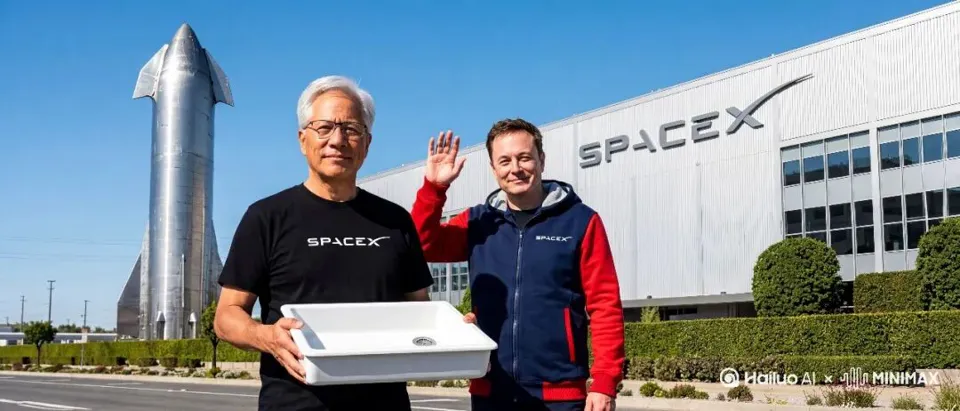
After running through a full round of tests, MiniMax H3 Image is a model that delivers across the board. On the aesthetic front, H3 Image consistently outputs photo-level realism—face preservation, style transfer, and fine detail texture are all impeccable. On the productivity front, text layout, local editing, e-commerce posters, and industrial diagrams are polished enough to support real workflows. From everyday use to professional production, open-source AI image models have reached a genuinely usable range.
After seeing the benchmark results, we got curious about what kind of model MiniMax H3 Image actually is.
A video model
becoming the SOTA in image generation?
Unlike most image generation models on the market, H3 Image is derived from MiniMax's omni-modal video model H3—a general-purpose omni-modal generation system released by MiniMax in late July with open weights, in which text, images, video, and audio are understood within a single unified architecture and can generate video with native stereo audio.
H3 Image follows the overall design of H3-Base, removing the audio branch while retaining the backbone network, text encoder, and other architecture. On the text side, it directly uses H3's text encoder—a 32-billion-parameter multimodal language model responsible for understanding complex instructions, long descriptions, and multi-condition logic. On the image side, reference images enter two modules simultaneously: the text encoder handles "what's in this image," while the image VAE compresses pixels into visual latent variables that the generative model can process.
Next comes H3 Image's core backbone: a 33.1-billion-parameter diffusion Transformer (DiT) that inherits the same 3D multimodal rotary position encoding as the H3 Omni Transformer. Text tokens and reference image tokens are packed into a single complete sequence and fed into this network in a single-stream fashion, directly predicting the latent variables of the target image, which are finally decoded into an image by the VAE.
On resolution, H3 Image opts for native direct output without any external super-resolution module—a single checkpoint directly generates images of approximately 16 million pixels, covering various aspect ratios from 4096×4096 to 21 at 6272×2688.
H3 Image also delivers fast generation speeds: for 4K text-to-image, the P50 median latency is about 10.3 seconds for the turbo version and about 16 seconds for the standard version, while comparable models in the same tier generally take over 50 seconds.
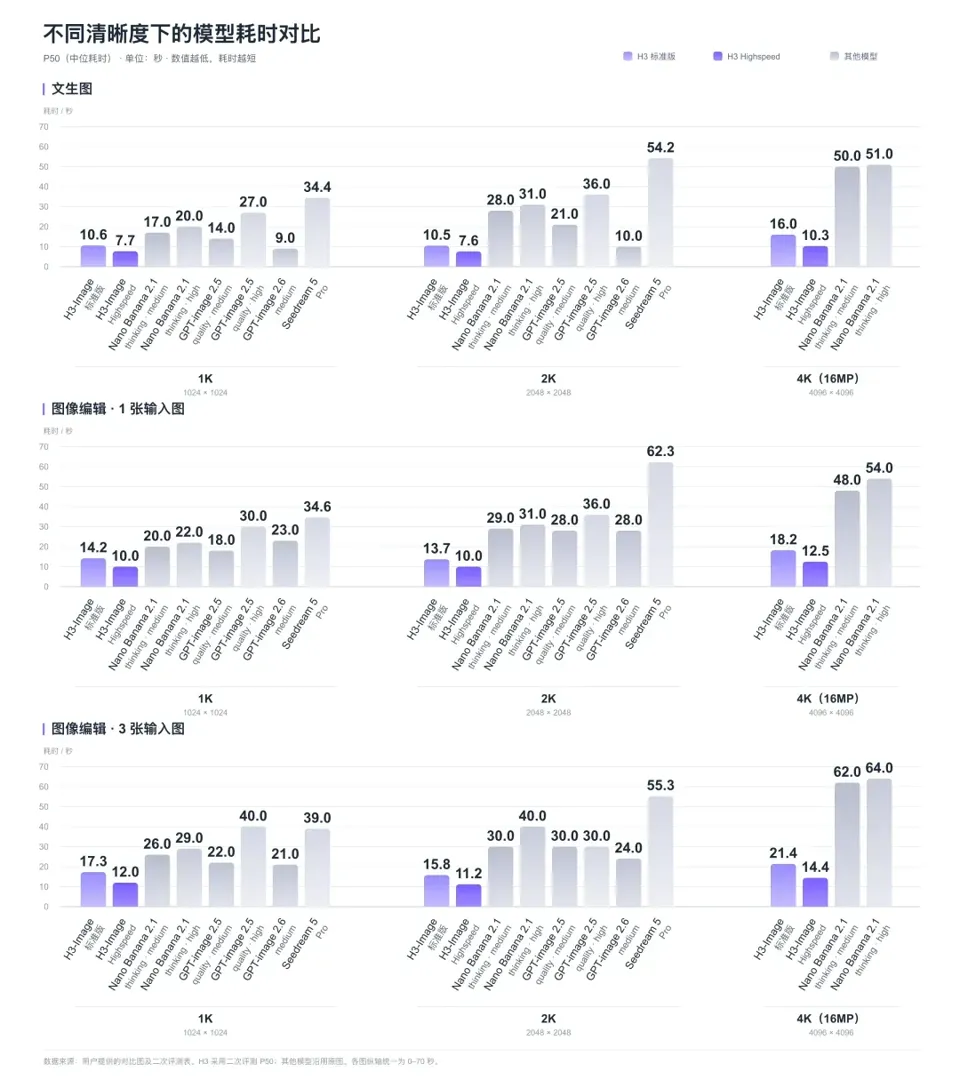
MiniMax's route of starting from a video model and then extending to an image model is the exact reverse of the traditional image-first approach. In fact, this has considerable advantages for image generation—after all, to maintain the coherence of continuous frames, video models need to learn different viewpoints of objects, how materials change under lighting, and how human bodies and objects move.
MiniMax H3 already possesses rich visual world knowledge, so it's no surprise that H3 Image, built on top of it, generates such good results.
The global AI ecosystem
is relying on Chinese open source
AI technology is advancing faster and faster these days, and new models suddenly leaping forward in capability no longer always warrants "shocked collapse onto the floor." What truly made us marvel this time was the excitement across the global AI community before and after the release of MiniMax H3 Image.
Today, a new model release from MiniMax is already a big deal in the AI world, and that enthusiasm has long since translated into ecosystem prosperity. MiniMax is gradually evolving from a company that provides AI models into a foundational platform on which other AI startups build their technology.
In fact, before H3 Image, an image generation model called P-H3-Image appeared overseas.
This is an open-source image generation model from a startup called Pruna, which also transformed MiniMax-H3 into a high-performance image model—not only with high generation quality but also with low inference cost, arriving at the same idea as the official team.
Now that H3 Image has been released, "the official version is here."
In fact, continuing pre-training, fine-tuning, or reinforcement learning on top of MiniMax's weights to release new models with improved capabilities is no longer rare. Previously, on the very day M3.1 Flash opened its weights, a US startup released a specially adapted model to help M3.1 Flash generate text faster.
The derivative ecosystem around MiniMax H3 is even more active: NVIDIA's team launched Sol-H3, optimizing the full inference pipeline for video generation; Pika released Pika H3 Flex, reducing generation steps and improving visual quality and creative control. On Hugging Face, the model tree based on MiniMax-H3 has already indexed about 220 derivative entries, with startups transforming H3 into standalone image generation models, video character replacement models, and even interactive world models.
Leading Chinese open-source technology has already become the preferred choice for overseas teams.
The business model is also gradually taking shape within this ecosystem. By occupying an ecological niche with free weights, MiniMax is using hosted APIs and subscription plans to capture usage revenue. The revenue thresholds and hosting restrictions in the community license will steer large-scale players toward commercial licensing. Free for the long tail, paid at scale—open source has thus built its own commercial closed loop.
Looking back at this week, the capability boundaries of image generation models were redrawn every few days, but what truly determines the long-term landscape may no longer be benchmark scores. The open-source ecosystem is defining the breadth of capability diffusion. When frontier capabilities like 4K generation and a dozen or so reference images become available to everyone, the core of competition has quietly shifted from whose model is stronger to "whose ecosystem is better."
The next breakthrough in AI generation may well be born in the hands of some developer who downloads the H3 Image weights.
© THE END
For reprints, please contact this official account for authorization.
Submissions or story tips: [email protected]