PSI Launches AI System Solving Five Open Quantum Information Problems
Startup Physical Superintelligence (PSI) announced that its proprietary AI research system has made breakthroughs on five long-standing open problems in quantum information theory, covering core areas such as entanglement distillation and quantum channel capacity. The associated papers, Lean formal proofs, and verification code have been published on GitHub for community review, marking a new phase in the application of AI to fundamental physical science research.
Related Entities
Full Report
Contents5 sections
The last MIT triple-major genius has made his move.
By Cheng Qian, reporting from Aofeisi
QbitAI | Official Account: QbitAI
It’s terrifying—how long has it been?
Just as AI was shaking up mathematics, it has now turned its attention to physics...
Moments ago, five open problems in quantum information were announced as solved with AI assistance.
The company behind this breakthrough is a mysterious entity named Physical Superintelligence (PSI).
They claim that using their proprietary AI research system, they have achieved results on five open problems in quantum information theory. The papers, Lean formalized proofs, and verification code are all available on GitHub for peer review.

Who exactly is PSI, a company established less than two months ago?
What Did PSI Solve?
PSI’s current focus is quantum information science, which primarily studies how to leverage the unique laws of quantum mechanics to store, process, and transmit information. This aims to break through the computational limits of traditional computers and explore more secure communication methods.
The five challenges tackled by AI come from the Open Quantum Problems (OQP) catalog, which has a 27-year history.
This catalog was established in 1999 by German physicist Reinhard Werner specifically to collect significant research questions that have stumped the quantum information community for decades.
These five problems span five core directions: entanglement distillation, quantum field theory, high-dimensional quantum communication, quantum channel capacity, and quantum causality. They include:
- OQP 2: Non-distillability of NPT states
- OQP 12: Vacuum entanglement and Bell inequalities
- OQP 27: Optimal measurements for CGLMP Bell inequalities
- OQP 38: PPT-squared conjecture and entanglement breaking
- OQP 43: Purifiability of quantum causal processes
We won’t delve into the specific proof processes here. It suffices to note that three of the five problems where PSI made progress (OQP 2, OQP 12, and OQP 27) were included in the catalog at the beginning of this century. This speaks volumes about the difficulty of these tasks.
“The World’s Most Advanced Physics Research Lab”
Visiting PSI’s website reveals something almost empty; tackling these quantum information problems marks their first major achievement.
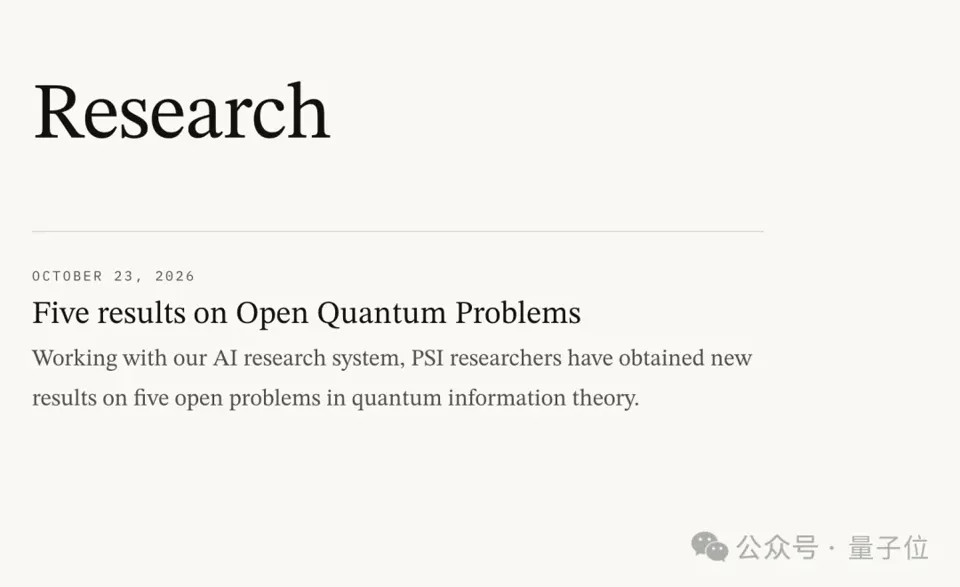
After all, the company only officially launched on September 1st of this year.
But when they do speak, they make waves. Upon their debut, they boldly declared their intention to build “the world’s most advanced physics research laboratory.”
PSI’s founding team is intriguing, but co-founder and Chief Scientist Alex Wissner-Gross is particularly interesting.
Wissner-Gross completed undergraduate degrees in Physics, Electrical Engineering, and Mathematics simultaneously at MIT, graduating as the top student in his engineering class...
What does completing these three majors concurrently actually mean? To put it in perspective, MIT discontinued the option of pursuing three simultaneous majors after him, citing that “too few people could manage it, making the option impractical.”
Consequently, Wissner-Gross can legitimately claim the title of “MIT’s last undergraduate to graduate with a triple major.”

Perhaps after testing the waters, he realized his true passion lay in physics. In 2007, he earned his PhD in Physics from Harvard.
It must be said that his understanding of “AI + Physics” was far ahead of its time.
As early as 2013, when deep learning was still in its infancy, he took the TEDx stage to explain intelligent behavior using the concept of “causal entropic forces” from physics.
He proposed a bold idea:
Intelligence can be understood as a tendency to maximize future freedom of action.
This might be hard to grasp, so let me give an example.
When you’re riding a crowded subway, why do you try so hard to maintain your balance and avoid falling?
According to his theory, it’s because if you fall, your range of possible actions shrinks. Staying upright means you retain the ability to move forward, backward, left, or right in the future.
Thus, any system following the rule of “maximizing future possibilities” may spontaneously exhibit behaviors resembling tool use, cooperation, and other forms of intelligence.
While this sounds plausible, the hypothesis remains unproven.
Despite being such a genius, Wissner-Gross reached a tipping point this year, proposing the goal to “Solve Everything.”
In two articles published earlier this February, he outlined the vision for what is now PSI.
Some insights resonate strongly with the present moment: “The Singularity needs a Department of Physics.”
“The era of proof has arrived.”
Beyond Wissner-Gross, PSI’s co-founder and President, Alex Klokus, is also noteworthy. He is the founder of Futurism, a prominent US tech media outlet.

Their funding background offers a glimpse into their strength. Upon their September launch, PSI announced a completed $58 million seed round.
The lead investor was Breakthrough Energy Ventures, founded by Bill Gates.
This fund is backed by tech and business titans including Amazon founder Jeff Bezos, Alibaba founder Jack Ma, and Virgin Group founder Richard Branson. It specializes in investing in frontier technologies with the potential to drive energy transition.
The follow-on investors included SV Angel, a veteran Silicon Valley venture capital firm. Its founder, Ron Conway, is a renowned angel investor who famously backed companies like Google, PayPal, and Twitter in their early days.
Furthermore, Balaji Srinivasan, former partner at a16z, participated in the investment. The round also attracted individual investors from tech giants such as OpenAI, NVIDIA, Hugging Face, and Oracle.
Scaling Scientific Discovery
Having covered so much ground, PSI’s vision can be summarized in one phrase: moving scientific discovery “from genius to scale.”
For centuries, leaps in fundamental human science have relied almost entirely on the flashes of insight from individual geniuses like Newton and Einstein.
However, PSI believes that this purely artisanal approach to research has hit a ceiling. Otherwise, why are we in the 21st century still building upon the foundations of 20th-century physics?
Scientific discovery should no longer be constrained by human time.
PSI calls its fundamental research unit the Autonomous Campaign, aiming to keep research continuously running from problem definition and hypothesis generation through validation, experimentation, and engineering deployment.
PSI also believes that in the AI era of scientific research, while ideas are no longer scarce, truth remains rare.
Large models can rapidly generate hundreds of conjectures, but these are far from becoming established truths.
To address this challenge, PSI launched its proprietary AI research system, Emmy (named in tribute to Emmy Noether, the great 20th-century mathematician and foundational figure in theoretical physics), which separates the steps of "generation" and "verification."
Its workflow is roughly as follows:
First, when faced with a grand open problem in physics, Emmy invokes state-of-the-art large models to decompose it into countless tiny, verifiable mathematical sub-hypotheses.
Second, these hypotheses are fed directly into the Lean formal proof assistant, symbolic computation engines, and high-precision verification code for rigorous screening. Hypotheses that trigger errors are eliminated on the spot, while paths that pass local verification are retained and continue to evolve.
As long as the final Lean code compiles successfully, it means the physical theorem is 100% logically impeccable.
The verification results generated during the process can also serve as reward signals for training the next generation of AI physicists, driving continuous system improvement and enabling the scaling of scientific discovery.
One More Thing
This sounds promising, but here’s the question: How does a company researching physical theories make money?
I looked into their current projects, and they remain quite pragmatic.
They plan to start earning revenue by tackling the most realistic problems first.
Which ones? AI data centers.
Modern supercomputing clusters are essentially extremely complex macroscopic physical systems, where power supply, cooling, networking, and compute resources involve highly coupled engineering optimization challenges.
This aligns perfectly with their expertise. The Emmy system can start from fundamental physical laws, treating power delivery, heat dissipation, communication, and computing capacity as a single holistic equation to solve, thereby finding higher energy efficiency ratios based on physical limits.
Even more interestingly, beyond commercial applications, PSI has taken on a side project for a private investor (who might be a sci-fi enthusiast).
The Fermi Explorer Interstellar Mission.
PSI announced: We are starting to build spacecraft now!
According to the official announcement, they plan to launch the deep-space interstellar probe "Fermi Explorer" before 2029.
Using the optimal lightweight engineering solutions optimized by the Emmy system within existing physical limits, this spacecraft will leave the Solar System, taking 80,000 years to reach Alpha Centauri—home to the Trisolarans from The Three-Body Problem and the Na'vi from Avatar, located 4.2 light-years away.

Although perhaps no human being will live to see that day, we wish them success.
References: [1] https://psi.inc/ [2] https://github.com/physical-superintelligence/oqp-batch-2026