360 and Peking University Unveil TriPlay-RL Tri-Role Safety Training Loop
A joint team from 360 AI Brain and Peking University's Peking University–360 LLM Lab proposes TriPlay-RL, which places attacker, defender and evaluator as three separate model instances in one GRPO-based reinforcement learning loop updated in sequence, addressing inflated attack success rates that mask template repetition (diversity score just 0.004). A 14B defender's JailBreakBench attack success rate drops from 25.6% to 4.6%; the paper is accepted to ACL 2026 with code released.
Related Entities
Full Report
Contents20 sections
Contributed by the TriPlay-RL team | QbitAI public account
Does a 98.2% attack success rate prove that a red-team model is strong enough?
In one set of ablation experiments, against Nemotron-Nano-8B, a red-team model reached an attack success rate of 98.2%, succeeding almost every time; but when the target was switched to Llama-3.1-8B-Instruct, that number dropped to just 0.2%.
At the same time, its output diversity score was only 0.004, repeatedly generating fixed attack templates.
This contrast shows that focusing only on the attack success rate against a single target can easily mistake repetitive routines for genuine capability progress.
In real-world scenarios, the red team needs to continuously discover new defensive weak points, while the blue team must keep up with increasingly complex challenges and provide helpful answers under safe conditions.
So who is to judge the difference between dangerous outputs, mechanical refusals, and safe guidance?
Around these questions, the 360 Zhinao Sun Lin team and the Peking University Yang Tong team, relying on the PKU–360 Large Model Joint Laboratory, proposed TriPlay-RL, which brings the attacker, defender, and evaluator into a single reinforcement learning loop.
In experiments, the proportion of successful attacks on the 14B defense model on JailBreakBench dropped from 25.6% to 4.6%.
The paper has been published in the ACL2026 Long Papers.
Beyond the red team and blue team, why train the evaluator as well?
Suppose a risky request is packaged as a historical research question and then sent to the defense model. The blue team must identify the risk, refuse dangerous details, and at the same time provide an explanation of the risk or a safe alternative direction.
If the evaluator only judges "safe" or "unsafe," simple refusals and constructive guidance may receive the same evaluation; the red team may also repeatedly try around a few high-scoring expressions.
TriPlay-RL puts all three roles into an iterative process:
- The red team continuously explores: discovering new defensive weak points and maintaining the diversity of attack samples.
- The blue team learns to respond: refusing dangerous content and, where appropriate, providing safe and helpful information.
- The evaluator updates its judgment: distinguishing risky answers, simple refusals, and safe guidance, providing feedback for the next round of training.
The evaluator is trained alongside new attack and defense samples, and its evaluation capability is updated in sync.
Following one round of training to see how the three roles drive each other
The attacker MRed, defender MBlue, and evaluator MEval in the framework are three independent model instances. They are updated alternately in the order "red team → blue team → evaluator," with only one role trained at each stage, all using GRPO-based reinforcement learning objectives.
Training starts from 1800 seed prompts formed by 200 base attack prompts and 9 packaging methods. The red team preserves the original attack intent to generate adversarial prompts, and the blue team then learns to respond using the latest prompts.
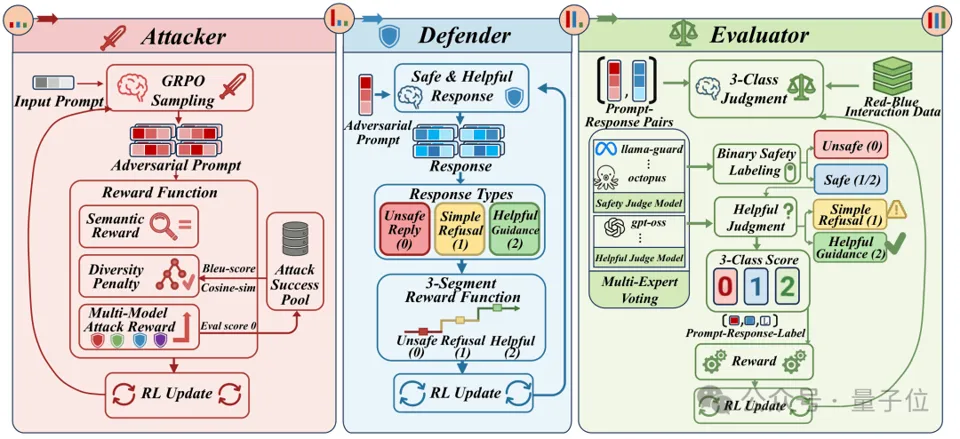
△ The red team generates challenges, the blue team learns to respond, and the interaction data enters evaluator training.
The prompts and answers produced by attack and defense are retained: safety experts first judge the risk, then utility experts distinguish simple refusals from helpful guidance, and a three-class label is formed through multi-expert voting for the evaluator to learn from.
Challenges generate data, data improves judgment, and judgment guides the next round of attack and defense. The three roles thus form a continuously updated training loop.
Key design: discover vulnerabilities while avoiding "score gaming"
Red team: effective attacks, unchanged intent, diverse expressions
The red team's training signal consists of three parts:
Final reward = multi-model attack reward + semantic reward − diversity penalty.
Multi-model feedback makes the red team face different defense models simultaneously. The semantic reward checks whether the prompt is still testing the original question, awarding +3 points for preserving the attack intent and −2 otherwise; the diversity penalty combines Self-BLEU and sentence-embedding cosine similarity to check textual and semantic repetition. Whether the attack succeeds, whether the intent is preserved, and whether the expression is novel jointly determine the training direction.
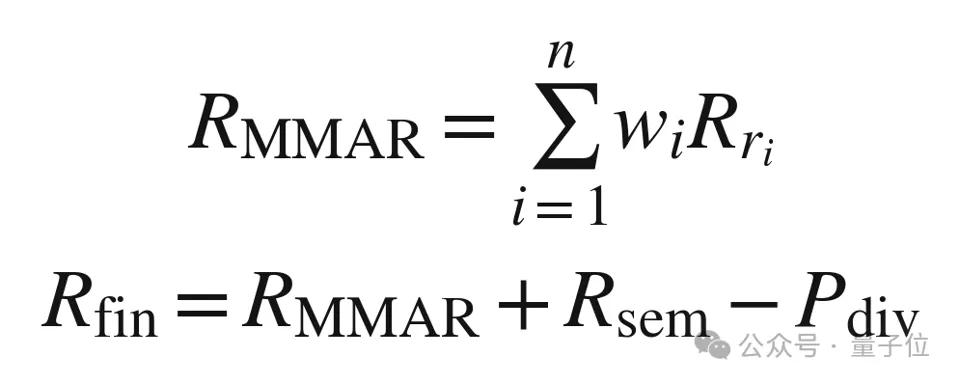
Here, n is the number of defense models participating in the feedback, and w is the corresponding weight.
Blue team: moving from "refusing to answer" toward "safe help"
The evaluator classifies answers into three categories: dangerous outputs, simple refusals, and safe and helpful guidance. The same classification result means different rewards for the red and blue sides:
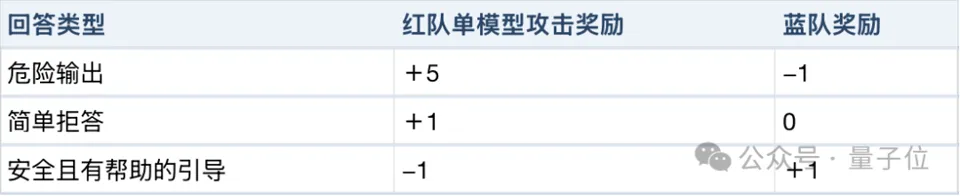
△ Red-team attack rewards and blue-team rewards corresponding to different answer types.
Simple refusals score 0, while safe guidance receives a positive reward. After refusing dangerous details, the blue team still has an incentive to explain the risk, provide background knowledge, and offer alternative directions. Because the training prompts come from the latest round of the red team, the challenges the blue team faces are also updated as the red team's capability changes.
Evaluator: using interaction data to learn more nuanced judgments
The evaluator's training labels come from attack-defense interactions and multi-expert voting. The paper additionally constructs 3000 three-class evaluation samples, which are filtered and expert-verified, to test the ability to judge the three types of answers.
After training, what changes occurred in attack, defense, and evaluation?
The experiments use Qwen3-4B, 8B, and 14B as initial models, examining the three roles and analyzing key components.
Red team: discovering more vulnerabilities in three target models
On a fixed set of 1125 base test prompts, after 16 rounds and 3200 steps of training, MRed-14B's attack success rate increased against all three target models: from 21.84% to 67.75% against Qwen3-8B, and from 13.0% to 32.0% against DeepSeek-R1-0528-Qwen3-8B.
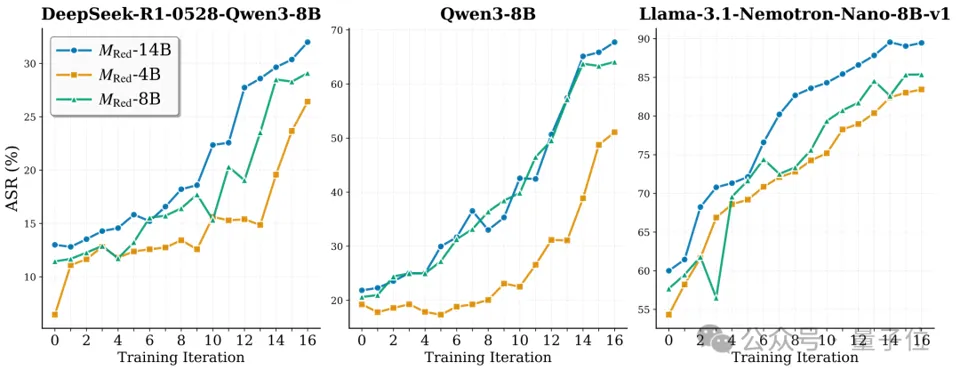
△ Changes in attack success rates of red teams of different scales against three target models.
As the red team becomes more challenging, the blue team's defense effectiveness is then tested using independent public safety benchmarks.
Blue team: harder to breach on public safety benchmarks
On four benchmarks—AIR-Bench2024, JailBreakBench, WildJailBreak, and S-Eval—the attack success rates of the three blue-team model scales generally decreased. After 10 rounds of training, MBlue-14B's AIR-Bench2024 rate dropped from 13.9% to 4.4%, and its JailBreakBench rate dropped from 25.6% to 4.6%.

△ The attack success rate of the blue team on four safety benchmarks decreases with training.
General Capabilities: Overall Close to the Base Model After Safety Training
The blue team model training did not incorporate reasoning or general task data. The research team used LiveCodeBench, GPQA, AIME2025, and IFEval to check code, knowledge, mathematical reasoning, and instruction following. Across the 12 comparisons of the three model sizes, performance was overall close to the base model.
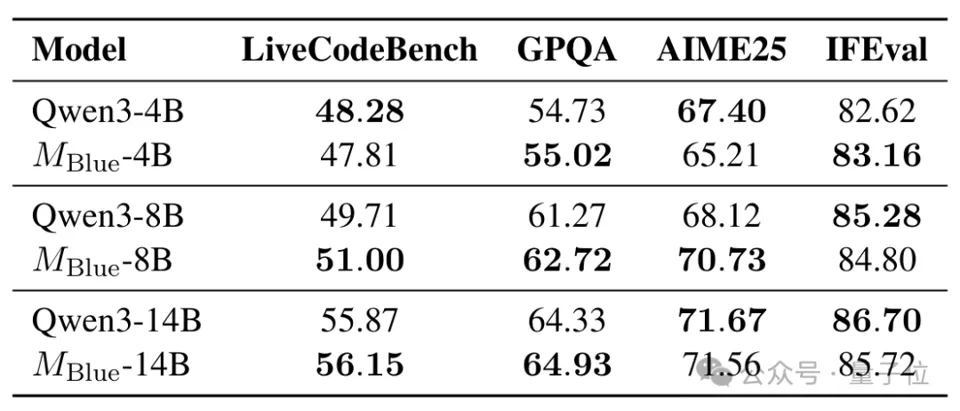
△ Each report uses avg@32; IFEval adopts prompt-level strict evaluation; Qwen3 is the base model, and MBlue is the defense model after training.
Evaluator: Judgment Accuracy Improves on Three Types of Responses
On 3,000 three-classification samples, MEval-4B rose from 48.2% to 56.2%, MEval-8B from 54.9% to 64.3%, and MEval-14B from 97.0% to 98.2%.
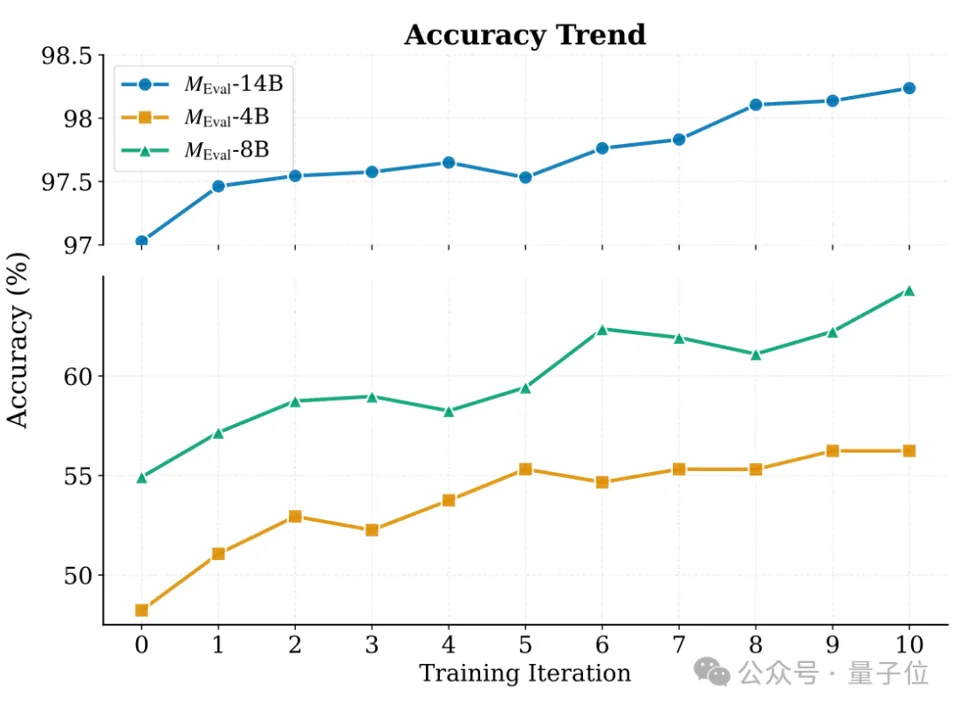
△ Accuracy changes of the three evaluators on 3,000 three-classification samples.
Back to the Beginning: Why Is a 98.2% Attack Success Rate Still Not Enough?
After removing closed-loop training and the diversity penalty, the red team's attack success rate against Nano-8B reached 98.2%, but against Llama-8B it was only 0.2%, and the output diversity score dropped to 0.004. The full configuration achieved a diversity score of 0.588, with attack success rates of 85.4% and 6.6% against the two targets, respectively.
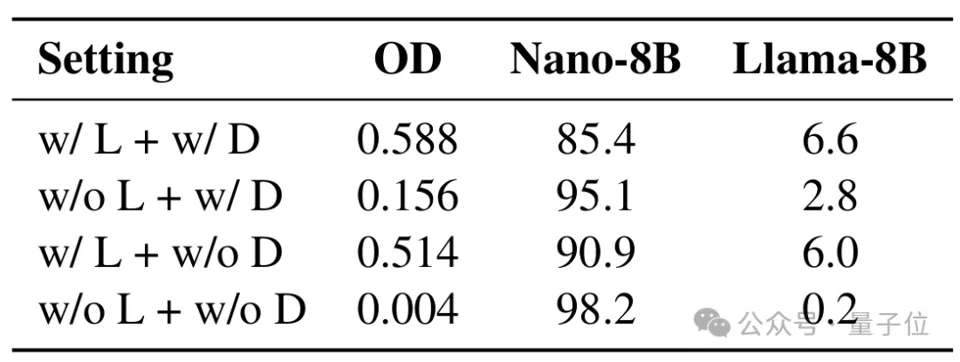
△ L is training closed loop, D is diversity penalty, OD is output diversity, and the last two columns are attack success rates (%). Nano-8B and Llama-8B correspond to Llama-3.1-Nemotron-Nano-8B and Meta-Llama-3.1-8B-Instruct, respectively.
When both designs are removed, high-scoring and highly repetitive attack templates appear at the same time, and they almost fail when switched to another target; the full configuration retains more diverse outputs and improves performance on the other target. What red team training needs to optimize is not only how many times it breaks through, but also how many ways it uses, and whether it remains effective after switching to another target.
Enabling Safety Training to Continuously Obtain New Challenges and Feedback
TriPlay-RL connects three interrelated problems: how the red team maintains exploration, how the blue team balances safety and helpfulness, and how the evaluator keeps up with changes in attack and defense.
The red team provides new challenges, the blue team learns to respond, the evaluator provides judgments, and the interaction data then enters the next round of training. This provides a path for continuously updating safety capabilities, from generating training data through model interaction to driving capability improvement.
Paper authors: Zhewen Tan, Wenhan Yu, Jianfeng Si, Tongxin Liu, Kaiqi Guan, Huiyan Jin, Jiawen Tao, Xiaokun Yuan, Xiangzheng Zhang, Duohe Ma, Tong Yang*, Lin Sun*.* This research was completed by the PKU–360 Large Model Joint Laboratory. The laboratory relies on the industry-academia-research collaboration between the 360 Zhinao team and Peking University, and conducts research on large model post-training, safety alignment, and agents. Paper link: https://aclanthology.org/2026.acl-long.1216/ Code: github.com/Qihoo360/TriPlay-RL