Thinking Machines Lab Open-Sources 26B Looped Transformer That Runs on Laptops
Thinking Machines Lab has open-sourced Inkling 2 Mini under Apache 2.0, a 26B-parameter multimodal looped transformer supporting text and image inputs with a 1M-token context window, plus inference and fine-tuning via Tinker. In an offline demo on a 48GB M5 Pro MacBook Pro, it generated a playable flight simulator in minutes, scoring 20.1 on the AA Index and targeting agentic workloads on personal hardware.
Full Report

Inkling 2 Mini is a looped Transformer with only 26B parameters—small enough to run on your laptop, yet powerful enough for agentic tasks, scoring 20.1 on the AA Index.

Editor|Panda
Last night, an AI proof claim for the Riemann Hypothesis once again pushed the reasoning capabilities of large models into the spotlight. Anthropic mathematician Levent Alpöge claimed that he and Claude had collaborated to find a proof and published formalized materials. Although the claim still awaits independent verification, it has already prompted people to ask again: just how complex a task can AI accomplish?
And just now, Thinking Machines Lab (TML) released and open-sourced the weights of Inkling 2 Mini.
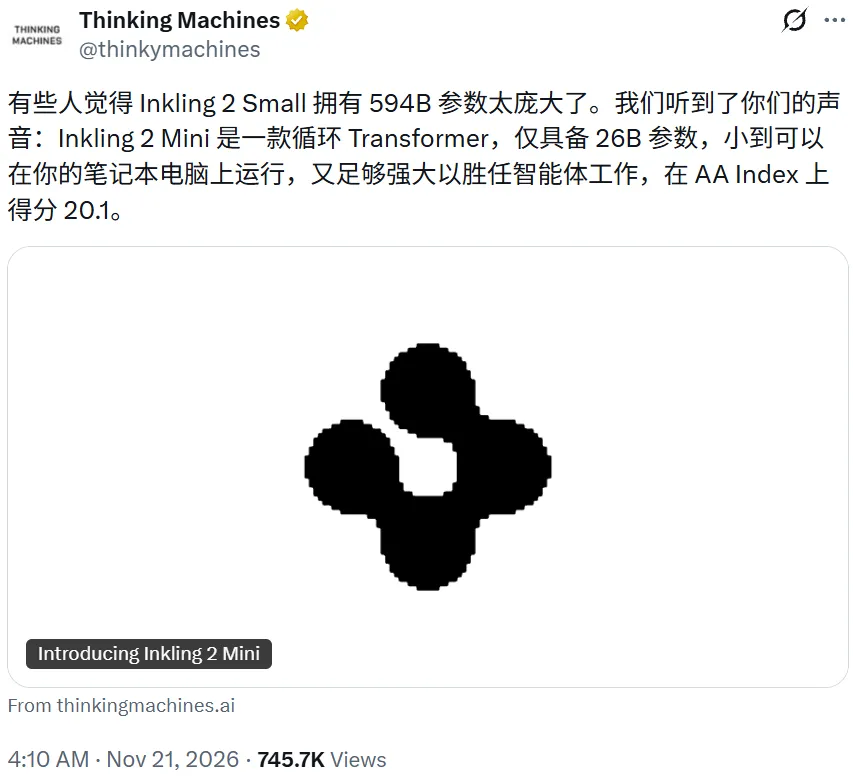
This is a multimodal model with 26B total parameters, built on a looped Transformer architecture. It supports text and image inputs and has a maximum context window of 1 million tokens. The weights have been released under the Apache 2.0 license, so developers can download and deploy them, and can also run inference and fine-tuning through Tinker.
- Model card and weights: https://huggingface.co/thinkingmachines/Inkling-2-Mini
- Official blog: https://thinkingmachines.ai/news/inkling-2-mini/
The official claim is that it can run on a laptop and is up to the job of agentic work. It seems the point they want to make is how far a model on a personal computer can go.
In a demo released by TML, researchers boarded a plane with a MacBook Pro, disconnected from the network, and had Inkling 2 Mini write a playable flight simulator in a matter of minutes. The demo used an M5 Pro model with 48GB of memory, with inference performed locally.
They also built Thinkyville, a tiny pixel town powered by Inkling 2 Mini. In it, the same model drives all 20 villagers on an offline MacBook. They plan their days, gossip, hold baking competitions, and even reply to notes you leave on their doors.
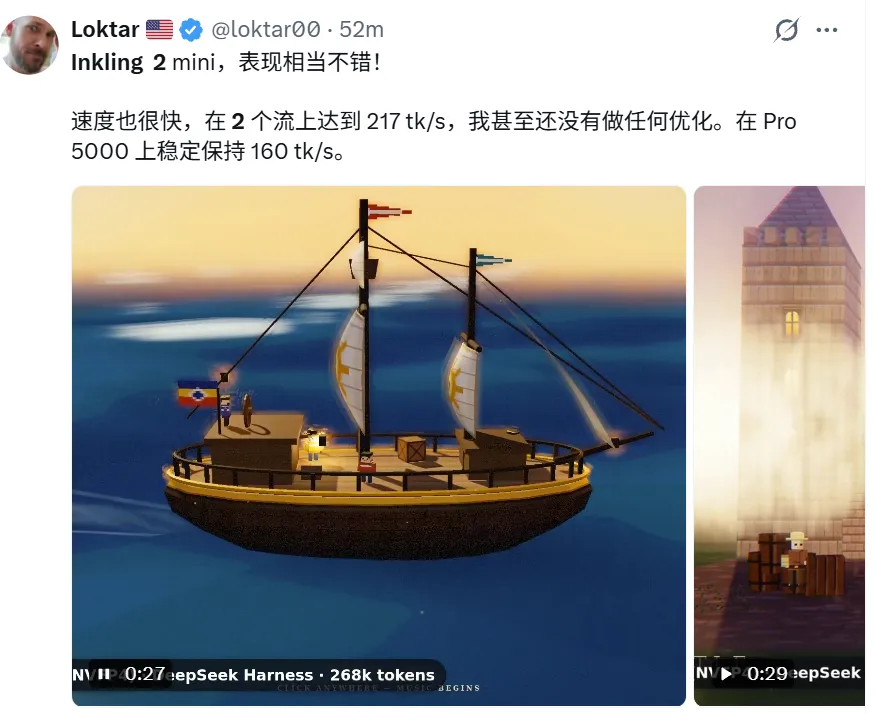
After the model's release, the community response was enthusiastic. Some hooked it up to DeepSeek Harness and got blazing-fast speeds.
Others had it play through a video game and found that it could replay the game, optimize its strategy, and learn to speedrun it.
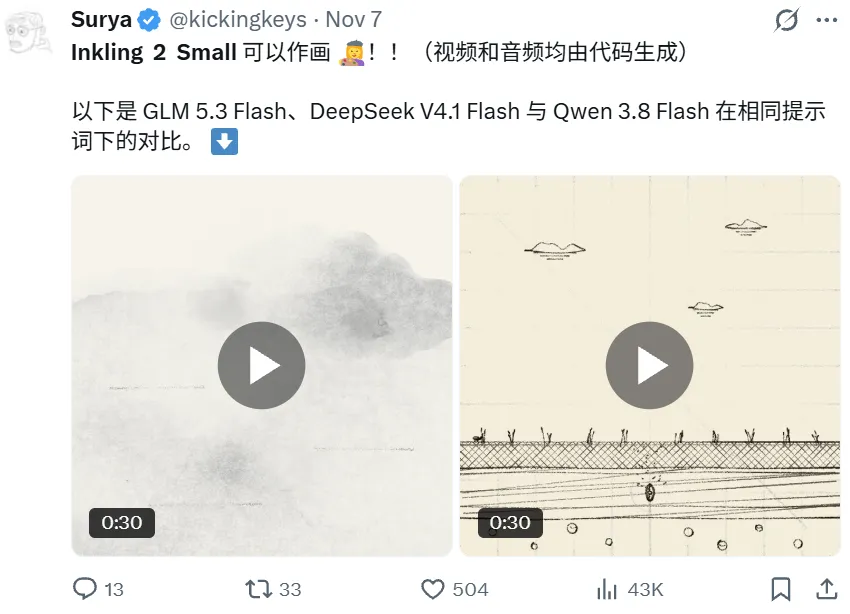
Generating animated music videos is no problem either:
Same set of weights, more rounds of compute
The technical highlight of Inkling 2 Mini is its use of a looped Transformer architecture.
A standard Transformer, when generating each token, passes information sequentially through a fixed set of network layers. Inkling 2 Mini instead reuses a middle segment of the network: the full model has 24 layers in total, with the first and last 6 layers each run once and the middle 12 layers run three times. Subsequent rounds also read information passed from the previous round.
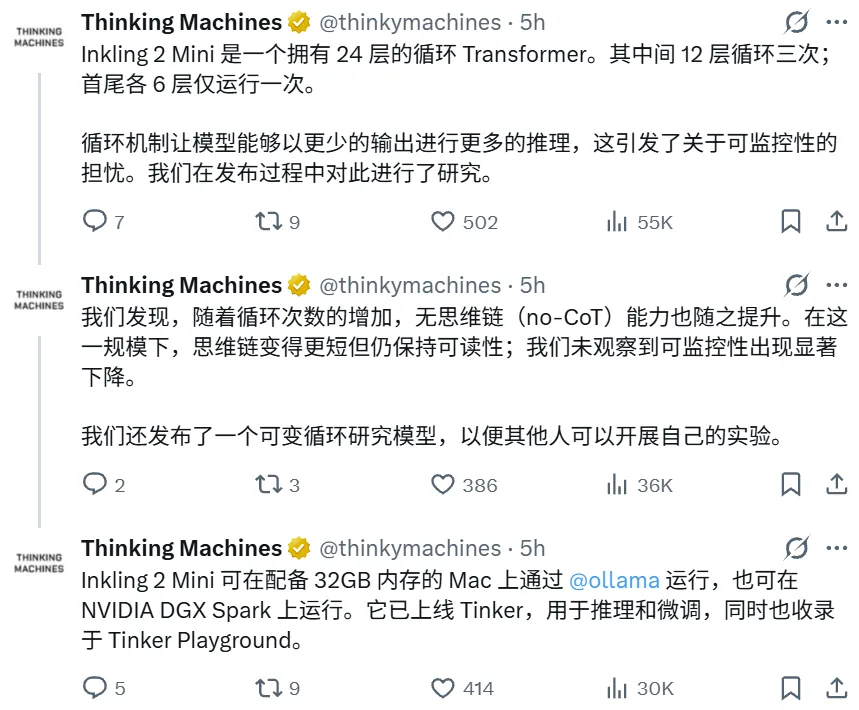
As a result, the model only needs to store 24 layers of weights while performing 48 layer computations per token. The added internal computation provides more processing room for tasks requiring continuous reasoning, while keeping the weight size in check.
It also uses a Mixture-of-Experts (MoE) architecture, where each token only invokes a subset of experts for computation. The model has about 3.4B activated parameters; counting the repeated computation in the loop, the effective activated parameter count is about 5.4B.
https://vllm-project.github.io/2026/11/20/inkling2-mini.html
Coding Performance
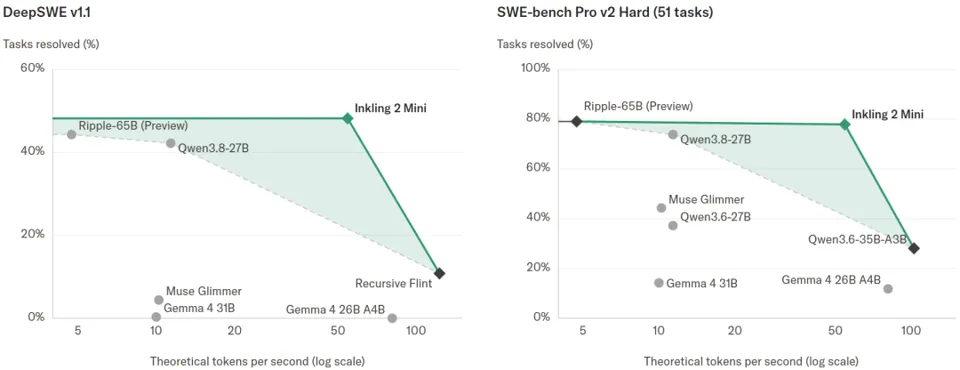
Based on the evaluations published by TML, Inkling 2 Mini's strengths are concentrated in agentic coding, search, and tool use.
On DeepSWE v1.1, its task resolution rate is 48.2%, compared with 42.2% for Qwen3.8-27B; on SWE-bench Verified, the two are 79.2% and 77.8%, respectively.
To fit such a model into a laptop, the way weights are stored is also critical. Inkling 2 Mini's expert layers mainly use the NVFP4 low-precision format, with the last 4 layers using MXFP8. It used the corresponding precision during training and is deployed at the same precision, reducing the step of converting precision again at delivery time.
The released checkpoint is approximately 20GB. It is officially supported to run on Apple silicon devices with at least 32GB of memory; other GPU platforms are recommended to provide at least 32GB of VRAM; local inference is already supported by tools such as Ollama, vLLM, and SGLang.
Shorter Chain of Thought
Recurrent computation has another implication worth noting: the model can complete more internal processing before outputting text. As a result, researchers need to further examine how much the written chain of thought helps people understand and supervise the model.
To this end, TML has also released TML-d24-varloop-research. Unlike Inkling 2 Mini, which loops a fixed three times, this research version allows the number of loops to be adjusted at inference time, making it convenient for researchers to compare the impact of increased computation on the same set of weights. It is explicitly positioned as a research model, and Inkling 2 Mini is still recommended for actual product applications.
Link: https://thinkingmachines.ai/model-card/tml-d24-varloop-research/
Inkling 2 Mini also has clear capability boundaries. According to TML's description, it still has shortcomings in multi-turn dialogue and multi-constraint instructions, and its complex reasoning performance lags behind larger models; increasing the number of loops will not directly expand the factual knowledge stored in the weights.
What is noteworthy about this release is that it increases inference computation within a limited weight size and hands the model to developers to run on their own devices. For those who want to build a local coding assistant or run agents over the long term, Inkling 2 Mini is a new option worth trying.
For more details, please visit the official blog and repository.

© THE END
For reprinting, please contact this official account for authorization.
Submissions or report requests: [email protected]