Runway Open-Sources 27B Robotics Model Praxis-1
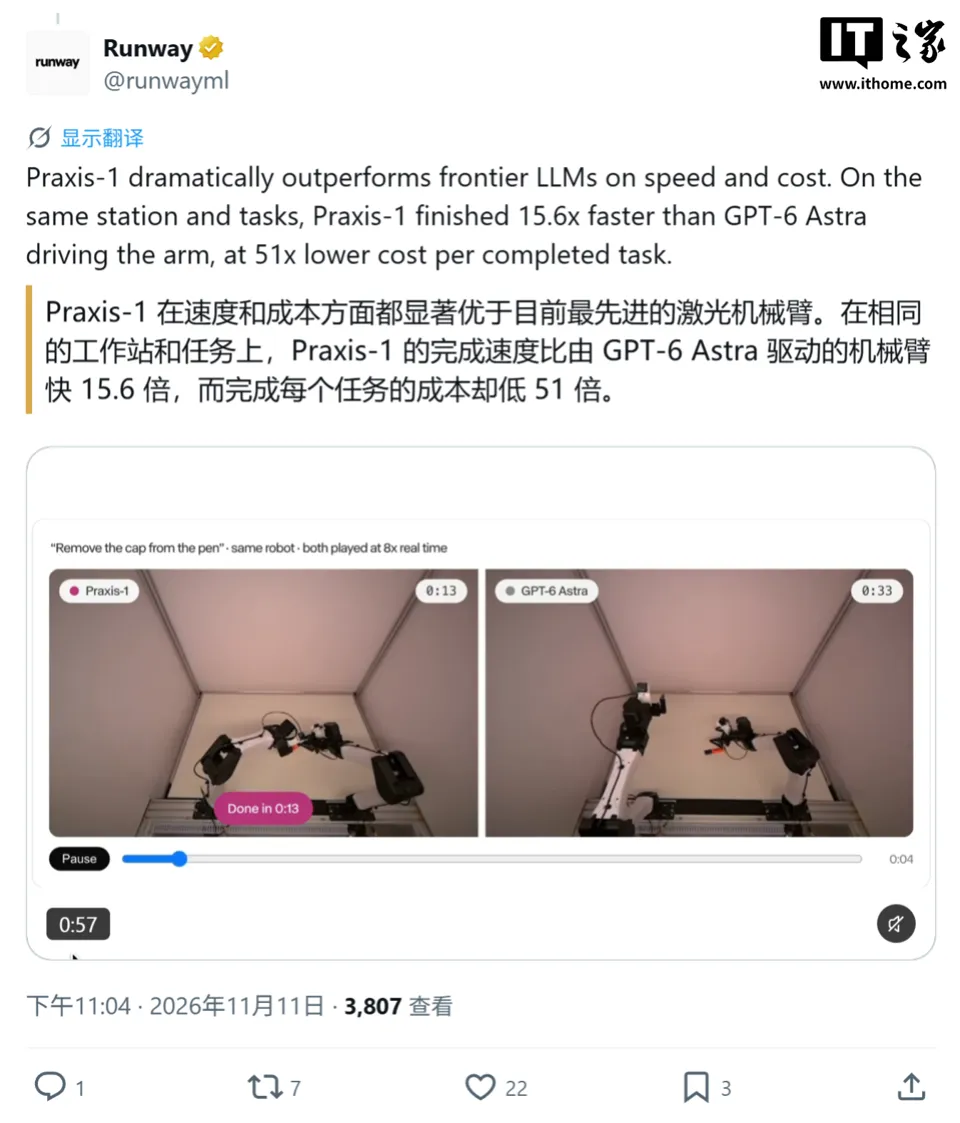
Runway released Praxis-1, an open-weight robotics control model built on a 27B-parameter video foundation model under Apache 2.0, runnable and fine-tunable on local hardware. Runway claims it completes robotic arm tasks 15.6x faster than a GPT-6 Astra-driven setup at 1/51 the per-task cost, leading the world-action-model category on the RoboLab-120 benchmark.
Related Entities
Full Report
IT之家 November 12 news: The US video AI company Runway announced yesterday (November 11) the launch of the robotics model Praxis-1, which applies knowledge learned from video pretraining to real robot control. The model has open weights and is released under the Apache 2.0 license, allowing developers to run and fine-tune it on their own hardware.

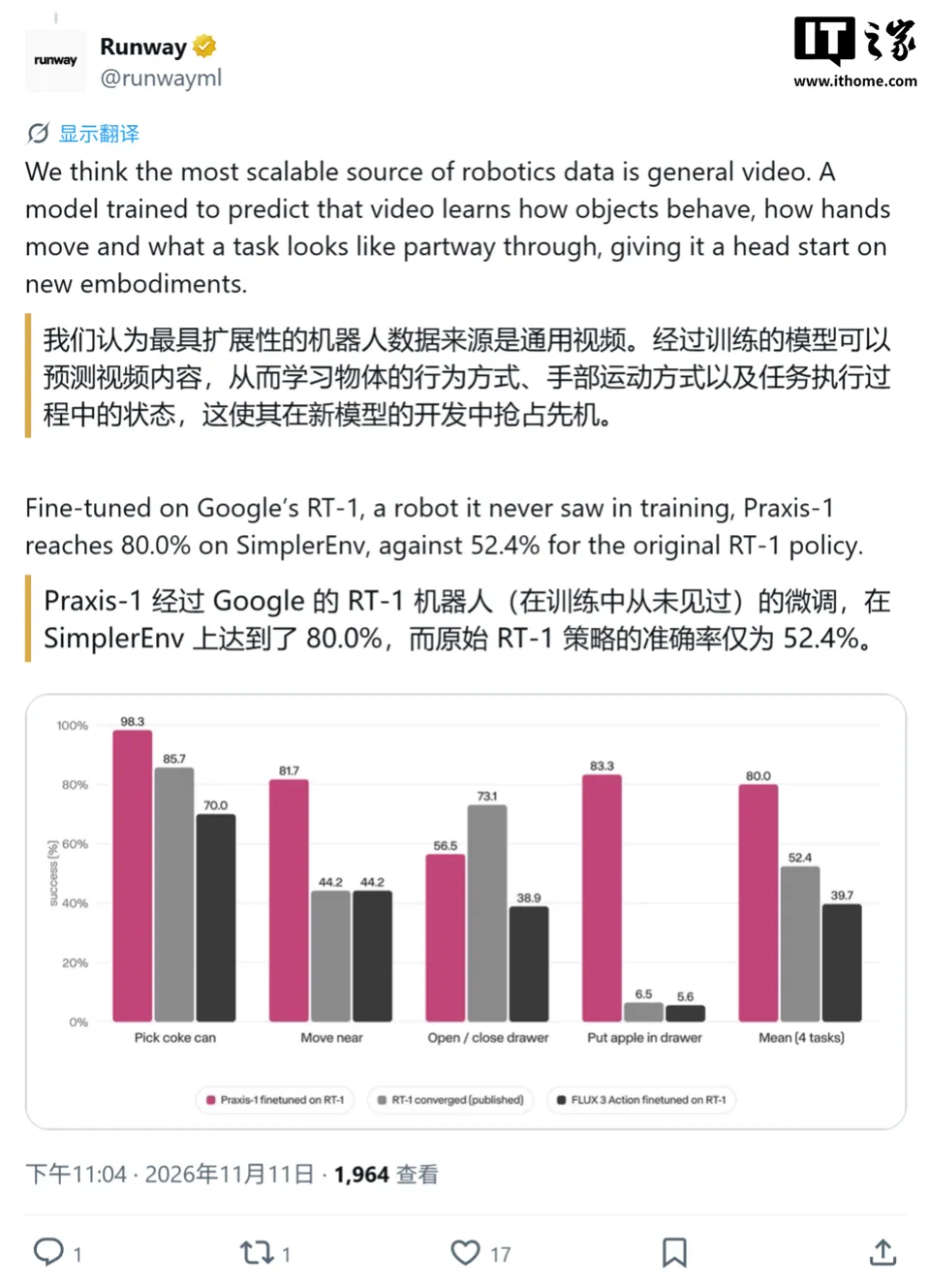
The design philosophy of the Praxis-1 model is to let AI first learn from ordinary videos how objects move and how human hands manipulate them, and then apply this knowledge to robot action learning, thereby addressing the high cost of collecting robot training data. When executing tasks, the model not only predicts what the scene will look like next, but also predicts what actions are required to achieve that result.
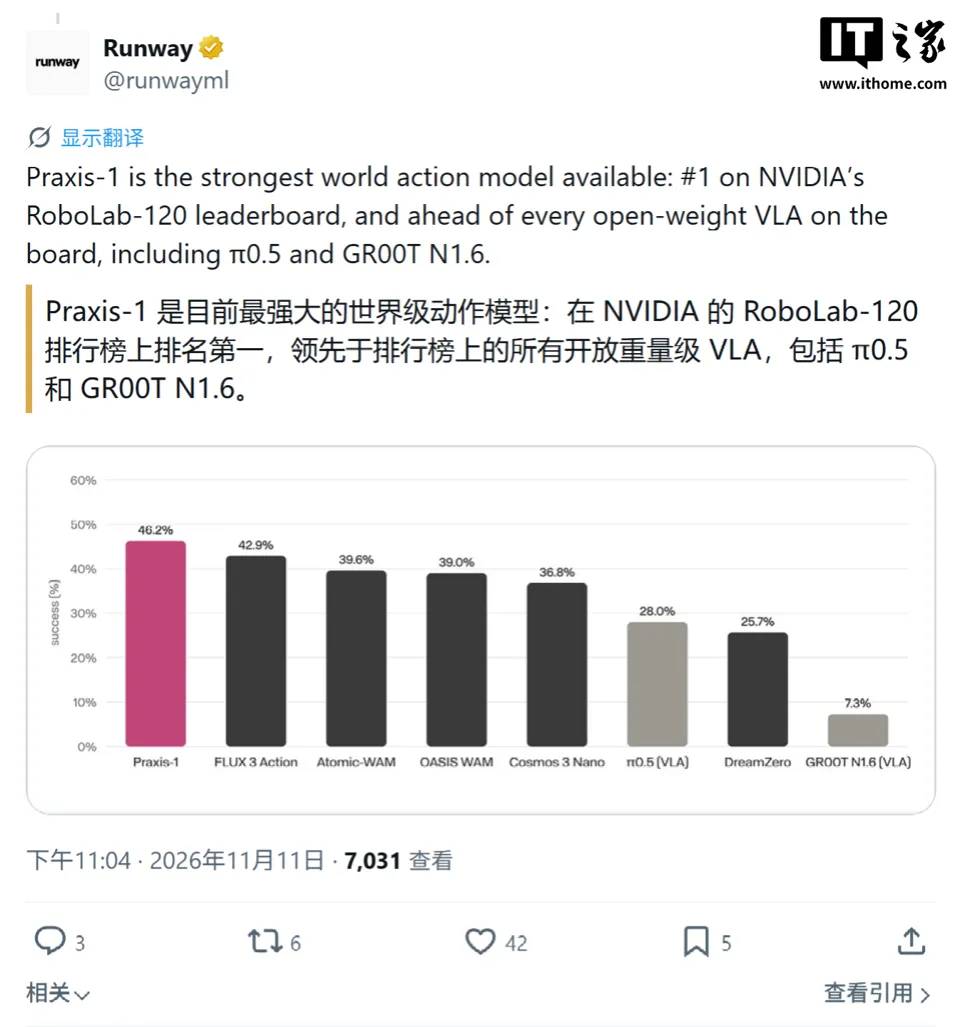
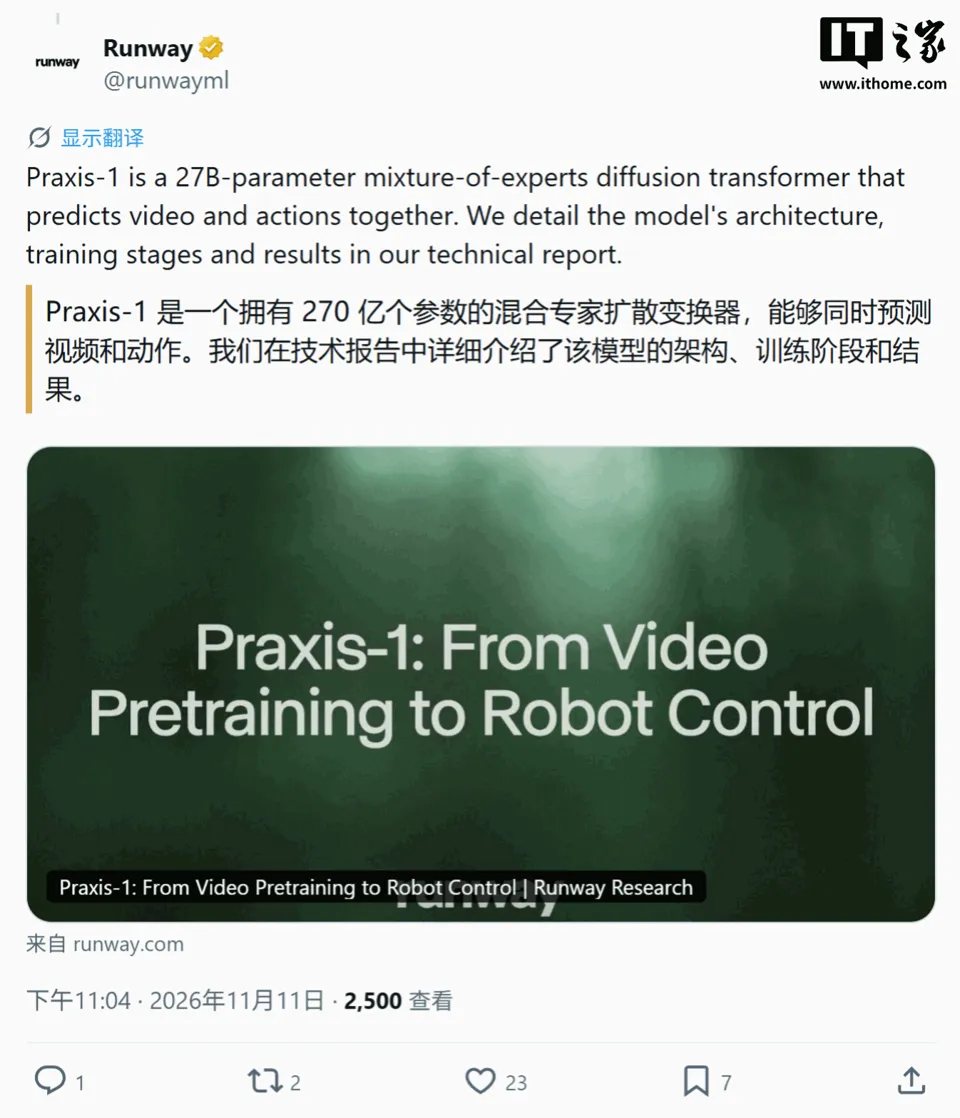
The model is built on Runway's 27-billion-parameter video foundation model, supports local operation, and offers an NVFP4 quantized version that can run on NVIDIA RTX 5090 GPUs. The model weights and related code are publicly available on Hugging Face and GitHub, respectively.
According to the test results disclosed in the report, Praxis-1 completed 555 of the 1,200 scenarios in the RoboLab-120 benchmark, with a success rate of about 46.2%, leading in the world action model and open robot foundation model categories. Runway stated that the related research is still in its early stages, and future work will focus on long-horizon planning and enabling the model to use its predictions to evaluate and improve its own actions.
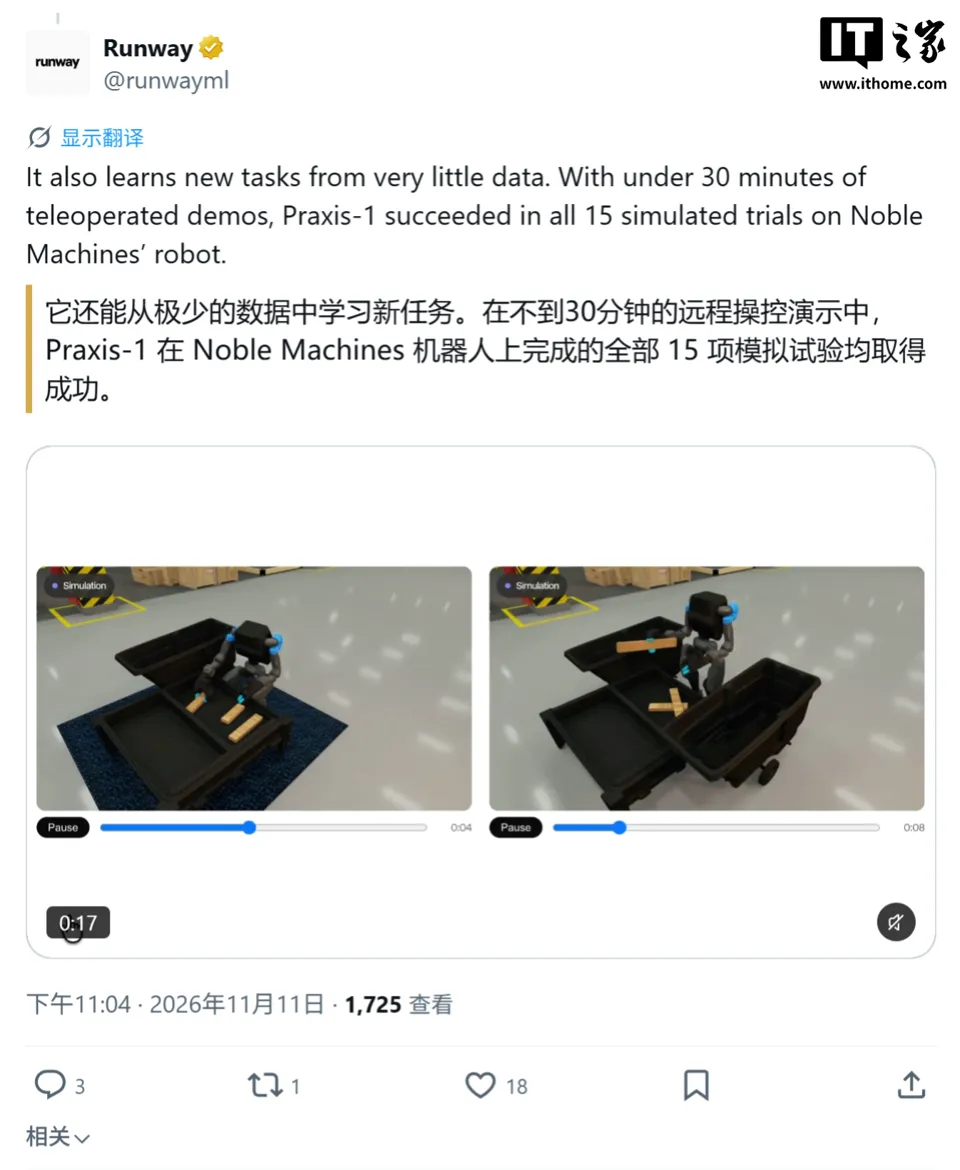
The company states that Praxis-1 is significantly superior to the current state-of-the-art laser robotic arm in both speed and cost. On the same workstation and tasks, Praxis-1 completes tasks 15.6 times faster than a robotic arm driven by GPT-6 Astra, at 1/51 the cost per task.
Advertising statement: External redirect links contained in this article (including but not limited to hyperlinks, QR codes, passcodes, etc.) are used to convey more information and save selection time. The results are for reference only. All articles on IT之家 that contain external links include this statement.