Alibaba Tencent Moonshot Tighten Cyberattack Capabilities in Flagship Models
Bloomberg reports that Alibaba's Qwen4-Max, Tencent's Hy4 and Moonshot's Kimi K3.1 Pro have systematically stripped cyberattack-related training data from their new flagship models while retaining defensive capabilities such as vulnerability detection, with Qwen4-Max withholding open weights. The move aligns with China's draft export-control rules targeting AI-driven malicious code generation, signaling a deliberate capability-safety tradeoff among leading vendors.
Full Report
IT之家 November 17 news, Bloomberg reported today that the latest generation models released by Alibaba, Tencent, and Moonshot AI generally restrict cyber offensive capabilities while strengthening vulnerability detection and defense functions.
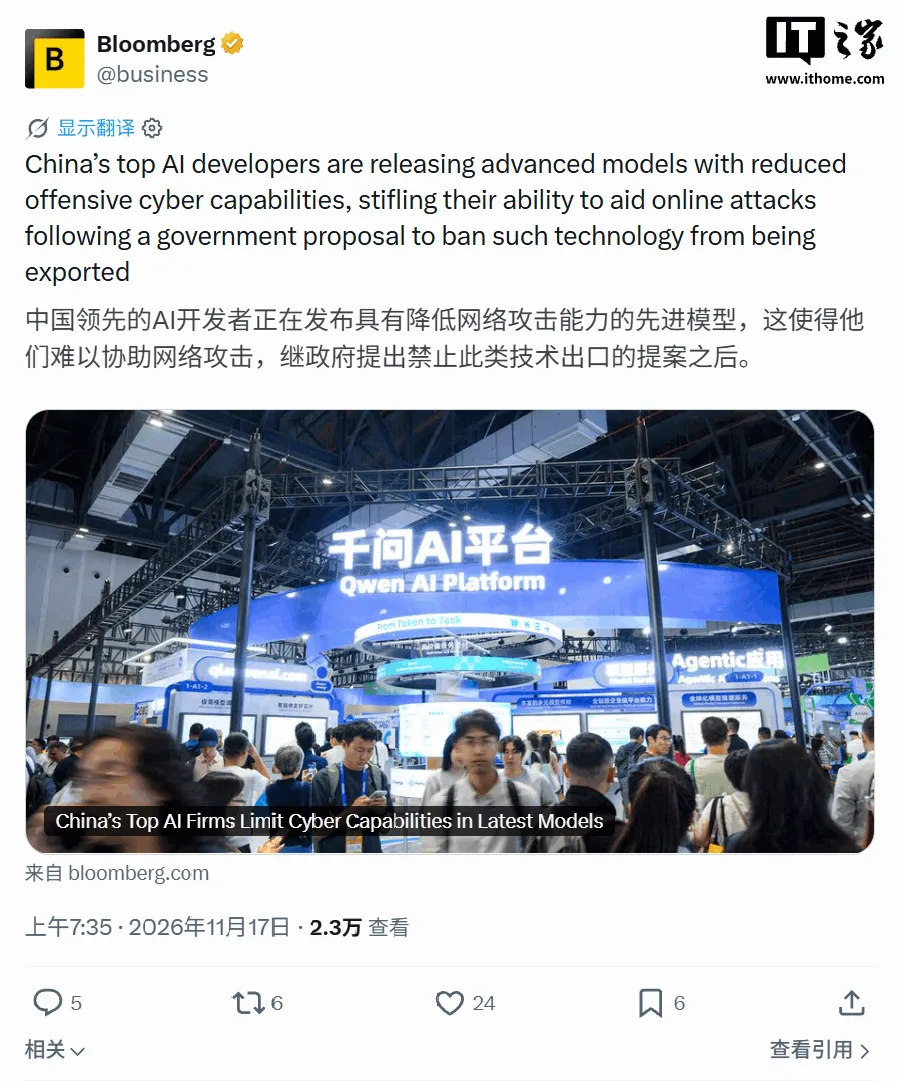
Bloomberg noted that Alibaba's latest flagship model Qwen4-Max deliberately filtered materials usable for cyberattacks from its training data, while retaining capabilities useful for defensive scenarios such as vulnerability detection. Moreover, this version has not publicly released model weights, so users cannot download and deploy an uncensored version themselves. IT之家 noted that this model series was previously highly favored by the open-source community, and the Alibaba Qwen series was once one of the most-downloaded open-weight model families globally.
In addition to Alibaba, Tencent explicitly restricted the model's cybersecurity functions before the official release of Hy4 and removed vulnerability exploit generation-related data from the training pipeline.
When Moonshot AI announced Kimi K3.1 Pro on October 23, it likewise removed cyberattack-related materials from two post-training stages. According to the company's disclosure, the filtered model scored 81.0% on an internal exploit benchmark, lower than the unfiltered version's 90.5%.
Zhipu conducted a security review before open-sourcing the GLM-5.3 weights in August and reported system vulnerabilities to relevant authorities.
As background, CrowdStrike disclosed in a report released at the end of October that a group named VAPOR PANDA used the DeepSeek model together with the ARTEX framework to launch intrusions against more than 200 organizations in at least 14 countries within an 11-day window.
Tencent Chief AI Scientist Yao Shunyu said on November 7 at a science conference in Hong Kong that models' cyber capabilities and "soon-to-arrive biological capabilities" will reach thresholds that could cause real harm.
Li Xiaojian, founder of AI security company Fangcun AI, told Bloomberg that removing offensive materials from training is a balance between cost and effectiveness, but "there is currently no method that can completely eliminate model risks."
On the policy front, on October 16 this year, the Ministry of Commerce, together with the Ministry of Science and Technology, issued a notice soliciting public comments on revising the Catalog of Technologies Prohibited or Restricted from Export in China, proposing to include AI-driven malicious code generation and mutation technologies in the scope of export control or restriction, involving a total of 23 technologies in the artificial intelligence field. In early November, an official from the National Development and Reform Commission said that security standards and ethical guidelines for AI developers are being rolled out at an accelerated pace, emphasizing the embedding of security measures during the development process.